




Malaysia's 'clash of civilisations' a phoney war
Shortly after the invasion of Iraq, I took part in a discussion about the so-called ‘clash of civilisations' between the neatly compartmentalised ‘West' and the ‘Islamic world'.
Shortly after the invasion of Iraq, I took part in a discussion about the so-called ‘clash of civilisations' between the neatly compartmentalised ‘West' and the ‘Islamic world'.
I suggested that the Judaeo-Christian Western tradition and Islamic civilisation share far more similarities with each other than differences.
"Yes," someone volunteered, "but the devil is in the details."
To this day, I disagree. Conflict arises, not so much from the details of any particular faith, as from our human and very fallible interpretations of religious texts.
Language and human communication can only transmit meaning imperfectly. Even if, as believers profess, divine revelation isunimpeachable and immutable, our flawed understanding of language can never allow this messageto be conveyed perfectly to human believers. Something is always lost in translation.
Clash of politicians
The devil lies, in the main, not in the detail of the faiths themselves. The devil usually lurks in ambitious, but unimaginative, political and clerical leaders. The demagogues exploit these to gain power. Malaysians see our fair share of polemics.
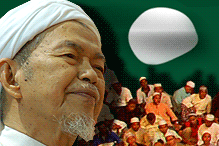 A minority of politicians and clerics, you might argue, like PAS spiritual leader Nik Aziz Nik Mat, may believe earnestly and wholeheartedly in their arguments.
We can live with this, because civil society, the ballot box, the information revolution and globalisation have all influenced PAS to a startling extent. Over the past decade, these currents have moved PAS closer to the centre, far more than PAS has drawn Malaysians, of all religious or ethnic backgrounds, to its traditional brand of theocracy.
Many of the pro-establishment politicians and preachers, on the other hand, have repeatedly demonstrated their deceit and hypocrisy in public. They leave us in little doubt that they stir up religious feeling simply to stay in power, to survive on corruption.
They care little for the sorrow that religious conflict might carve into our nation's history, and into the human race - as we have witnessed from Belfast to Beirut, Kigali to Sarajevo, and, closer to home, from Pattani to Ambon.
Their strategy derives from thespeculative idea of the ‘clash of civilisations', flogged by an American academic, Samuel Huntington. He divided the world into six or seven ‘major' civilisations and postulated conflicts arising from the cultural barriers between them, particularly between the ‘Western' and ‘Islamic' blocs.
Huntington's clunking hypothesis won him enough fans in the US State Department to make the ‘clash of civilisations' a self-fulfilling prophecy, though he claimed his intention was to forecast conflict, rather than to prescribe it. The US and its proxies waged a series of ‘either-you're-with-us-or-against-us' wars against several Muslim countries, including Afghanistan, Pakistan and Iraq.
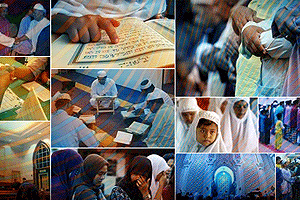 But Huntington's attempt to present ‘Western society' or ‘Islamic civilisation' as monolithic entities crumbles under scrutiny. He refused to consider the vast diversity of values and beliefs within the Western tradition, and within Muslim societies too. Huntington ignored, too, the intimate links between the US and client states like Saudi Arabia, Kuwait and Egypt.
Indeed, the Western enlightenment tradition owes a tremendous debt to Islamic scholars for having preserved the works of Aristotle, the father of science (translated into Arabic, of course), when all his books had been destroyed in Europe by the medieval church, for ‘heresy'.
Aristotle's seminal writing, translated back into the European languages, engendered the natural sciences, taxonomy and empiricism.
The cross-fertilisation between Christians and Muslims bore fruit, over the centuries, in advancements in philosophy, science, mathematics, geography, architecture and astronomy - in short, in most important spheres of life.
As the late post-colonial scholar Edward Said pointed out, Huntington's postulation "speaks to how much simpler it is to make bellicose statements for the purpose of mobilising collective passions than to reflect, examine, sort out what it is we are dealing with in reality, the interconnectedness of innumerable lives, ‘ours' as well as ‘theirs'."
Said's observation holds particularly true for the jumbled-up, inter-dependent ethnic and religious mix that is Malaysia. This includes the diversity of the eastern states of Sabah and Sarawak, where political Islam is as irrelevant to most local Muslims, as the fight against the Malayan Union, say, or Merdeka Day.
Malays unite - against corruption
Before his death in 1999, Dr Eqbal Ahmad, a prolific writer from the Indian subcontinent, contributed three essays to the Pakistani periodical Dawn , condemning "the mutilations of Islam by absolutists and fanatical tyrants". He argued that their "obsession with regulating personal behavior promotes an Islamic order reduced to a penal code, stripped of its humanism, aesthetics, intellectual quests, and spiritual devotion."
He went on to say this exaggerated and regimented publicpiety asserts only one aspect of religion, such as jihad or hudud , removing the context of Islamic history and tradition, and disregarding the rest of its teaching. This, he wrote, distorts religion, debases tradition, and twists the political process.
Eqbal Ahmad described the religious-political right wing as being "concerned with power, not with the soul; with the mobilisation of people for political purposes rather than with sharing and alleviating their sufferings and aspirations. Theirs is a very limited and time-bound political agenda."
Edward Said added that similar distortions and zealotry also abound in the ‘Jewish' and ‘Christian' universes, and these feed a downward spiral of mutual hatred and mistrust.
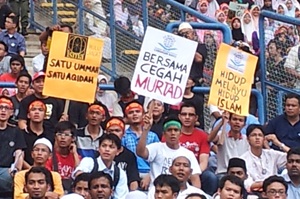 One recent local example of grotesque efforts to drive a wedge between Muslims and Christians was the ‘
Himpun Sejuta Umat'
rally on Oct 22, purporting to unify Malay Muslims against the imagined threat of Christians in Malaysia. The rally was
poorly attended
.
One recent local example of grotesque efforts to drive a wedge between Muslims and Christians was the ‘
Himpun Sejuta Umat'
rally on Oct 22, purporting to unify Malay Muslims against the imagined threat of Christians in Malaysia. The rally was
poorly attended
.
Even so, the call from the right wing in Malaysia's political hierarchy, mass media and religious orthodoxy, for Malay Muslims to unite, does have a nub of truth to it, but not in the sense of our bloated politicians' self-serving, hollow rhetoric.
All Malaysians, Malay Muslims as well as others from the ‘rainbow of faith' , must unite against the unholy corruption gnawing away at our politics, and our collective future.
All of us together must reject the demagogues trying to manufacture a ‘clash of civilisations' - a phoney war - designed to keep the corrupt in power.
KERUAH USIT is a human rights activist - ‘anak Sarawak, bangsa Malaysia' . This weekly column is an effort to provide a voice for marginalised Malaysians. Keruah Usit can be contacted at keruah_usit@yahoo.com


Are you sure you want to delete this comment?
This action cannot be undone.