




Ex-EC chief sees 'flickering lights' of electoral reform
After 26 years as an “election man”, former Election Commission (EC) chief Abdul Rashid Abdul Rahman is now testing the waters.
After 26 years as an “election man”, former Election Commission (EC) chief Abdul Rashid Abdul Rahman is now testing the waters.
Out of the public limelight since retiring in 2008, Abdul Rashid, who served as EC secretary for more than a decade, said he senses a change of climate in Malaysia, which is kinder to what he has to say.
According to the man who took over as EC chairperson in 2000, the national leaders, who were once quite conservative when it came to electoral reform, are now having “a big change of heart”.
 “There has been a big change of heart by our leaders on some issues concerning the conduct of democratic election in the country.
“Encouraging remarks by our leaders are recorded on matters of what I consider as the deepening process of democracy in Malaysia,” he said.
In an email interview with Malaysiakini , Abdul Rashid said that this signals a new era for the nation, which at 54 years, is doing well compared to developed nations who took “between 85 to 256 years” to build their democracy.
“We have gone past the formative period and are coming to the much-awaited transitional period in terms of democratic practices. We are not slow or late in that.
“Our ‘controlled’ democracy is barely 54 years old and we are already seeing some flickering lights at the end of the tunnel,” he said.
This is different to when he was the chief secretary, he said of the post he held for 17 years.
Malaysians pacified then
The man who bore the brunt of public outrage over the last-minute reversal on indelible ink in 2008 said that even in the 1980s, Malaysian were “very much pacified and accepted the electoral system as it was”.
He said even the legal fraternity was not too concerned over electoral laws, and most people were satisfied that they had “freedom not only to choose but also to organise”.
 “Malaysia was fortunate that right from the start after its independence political parties were allowed to grow and participate in all elections except for the banned Communist Party of Malaya,” he said.
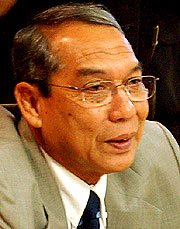
Seemingly supportive of the “agitations” in society pushing for electoral reform, Abdul Rashid ( left ) said that it is now high time for a review of electoral laws, particularly to appease concerns over the lack of a level playing field.
He said it no review is done, more people including the outside world will “cast doubts on the legitimacy of our elected government and the principle of free choice that is being practiced in the country”.
That is not to say that Abdul Rashid believes that elections in Malaysia are not free or fair.
EC ever ready to do more if law allows
“Except for some negligible hitches here and there all the 12 elections so far conducted conformed strictly to the laws that had been put in place. All elections were efficiently run and credible electoral standard had been achieved.
“Indeed the election management body had the organisational ability to overcome the weaknesses in the legal framework to continue to build the required tradition of independence and impartiality,” he said.
All the same, he said, the EC can only work within the ambit of the law which is “pushed down its throat” and it “does not require wake up calls” for the authorities to realise that we have an “ageing electoral system”.
 In fact, Abdul Rashid, who introduced transparent ballot boxes and allowed the presence of polling and counting agents, said the EC was “very much aware of the weaknesses in the electoral laws”.
“Studies were conducted from time to time and officials looked beyond our shores and took serious note of what could possibly be changed here when sanctioned to do so,” he said.
He added that this was also carried out by the EC when he became chairperson in 2000, with in-house committees studying weaknesses in the law with input from the Commonwealth secretariat, Australia, New Zealand, Britain, Germany and other developed nations.
“What the public should know and should be convinced is that the (EC) was and still is, I believe ever ready to do more if the country decided to expand the scope of the Malaysian democratic election to higher level in terms of the legal framework.
And then, with a hint of regret: “It was rather unfortunate that I would not be able to participate actively in the process of formulating and perhaps delivering the expected changes.”
Related stories


Are you sure you want to delete this comment?
This action cannot be undone.