




Electoral roll audit detects 8% invalid addresses
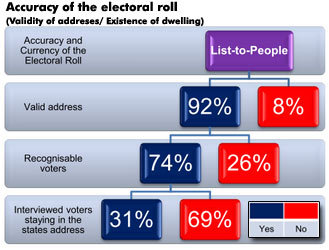
An independent audit by civil society on the much-disputed electoral roll found eight percent of the voters’ addresses to be invalid.
An independent audit by civil society on the much-disputed electoral roll found eight percent of the voters’ addresses to be invalid.
Among the 92 percent valid addresses, 74 percent of the voters can be recognised, but only 31 percent out of the recognisable voters resided at their listed addresses.
The unidentified addresses were largely concentrated in Kuala Lumpur, with the highest percentage of 27 percent, the audit report states.
The report was jointly prepared by election watchdog National Institute for Democracy and Electoral Integrity (NIEI), media rights group Centre for Independent Journalism (CIJ) and public survey organisation Merdeka Centre.
“The reason for the eight percent unidentified addresses submitted was largely attributed to the rapid development and re-development of the capital city and weak coordination between town and country planning units, and cross-department coordination and cooperation towards maintaining the changes in the locality in line with the changes in the electoral roll,” the report says.
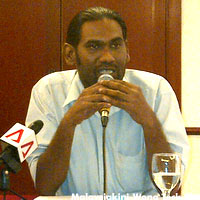 NIEI acting chairperson K Shan (
left
) said the passive “civil service attitude” of the Election Commission (EC) and its failure to catch up with the changes in the voting localities, as well as its lack of auditing and verification exercise, also contributed to the problem.
NIEI acting chairperson K Shan (
left
) said the passive “civil service attitude” of the Election Commission (EC) and its failure to catch up with the changes in the voting localities, as well as its lack of auditing and verification exercise, also contributed to the problem.
Merdeka Centre programme director Ibrahim Suffian added that the invalid addresses were not created deliberately or out of bad faith but was the result of urbanisation.
The high percentage (69 percent) of voters who did not reside at their registered voting addresses was a major concern and an unhealthy practice of democracy, said Shan.
Malaysia practises the electoral system of ‘first past the post’, which is specifically designed to provide for actual residents to elect their representatives in accordance with local needs, but the high number of non-resident voters gives rise to a detached and inadequately informed decision-making process, Shan explained.
First audit since first GE
The audit conducted from June 4 to July 6, 2011, sampled 2,400 voters randomly selected across 240 polling districts from 60 parliamentary constituencies nationwide, including Sabah and Sarawak, based on the electoral roll updated for the last quarter of 2010.
Enumerators were required to locate and verify the addresses and identities of the selected voters before interviewing them.
In the event the voters were not found at the address, the enumerators would verify their identities with their neighbours.
This is the first formal and independent audit of the electoral roll since the first general election in 1959.
 Other states with higher percentage of invalid addresses were Negri Sembilan (26 percent), Selangor (14 percent) and Malacca, Perak as well as Terengganu (all 10 percent).
Urban areas also recorded highest percentage of unidentifiable voters (those could not be located at the addresses and recognised by their neighbours ) such as Kuala Lumpur (70 percent), Selangor (45 percent) and Malacca (38 percent).
The audit showed that these voters were mostly youths and senior citizens.
The former cited lack of time to update information in their MyKad due to busy work schedule and lack of people-friendly processes, while the latter were unable to update their data owing to limited mobility and a lack of suitable services provided for them by the authorities, the report reveals.
Parties transfer voters to win
Besides mobility factors related to changes to employment, the report says the EC's decision to outsource the voter registration process has allowed political parties to cluster their supporters from other areas into the constituencies they contest, or to maintain the racial composition of the particular constituencies in their political interest.
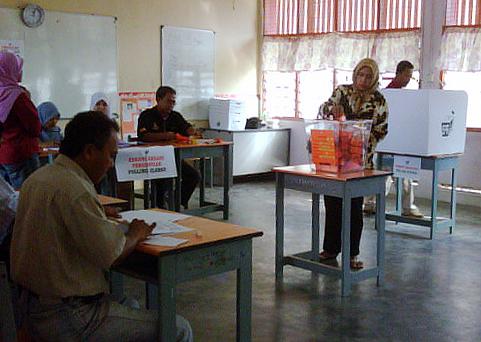 "This phenomenon is also strongly attributed to the race-based voting trend and lack of mechanisms in determining racial diversity in representation in the legislature," the report states.
The audit also studied the accuracy of voters' MyKad and found that most details listed in there were accurately captured in the electoral roll, except in only a few cases with typo errors and one unique case where two voters shared the same MyKad number.
On the completeness of the electoral roll, the audit found that six percent of voters could not find their names in the latest update.
It could be due to serious administrative oversight, the outsourcing of voter registration process to non-accountable agencies, and lack of monitoring and oversight mechanisms, says the report.
Unregistered high in Sabah, Sarawak
The survey also explored the reasons for those who have yet to register, with 51 percent of them citing lack of time, but 84 percent of them said they planned to do so before the next polls.
It has been found that unregistered citizens are high among Muslim bumiputera and non-Muslim bumiputera in Sabah and Sarawak.
The three organisations listed 14 recommendations in the report.
Among them are the abolition of the ouster clause Section 9A of the Election Act 1958 that prohibits judicial scrutiny of the electoral roll and the creation of a database department at all local council authorities as the primary registrar to record, maintain and manage the electoral roll before it is gazetted by the EC because they are the authorities closest to local development.
Section 9A was passed by Parliament in 2002, after the High Court declared the election result of Likas null and void due to 4,197 questionable names in the electoral roll.
Since then the gazetted electoral roll has been deemed final and immune to court challenges, diminishing the parties and voters' rights to a legal redress.
Other recommendations include:
- Voters seeking to change their address must declare that the address provided is the valid address of actual residence or permanent residency of the their parents or guardians;
- Biometric facilities in the citizens' MyKad be updated with the history of changes in address and voting location, and create a centralised database with similar information for the public to check and verify;
- Provide the EC with a separate office, independent of the Prime Minister's Department compound, and absorb civil society members into the EC; and
- Provide the EC with quasi-judicial powers to investigate, and where appropriate, prosecute cases of violations of election laws.


Are you sure you want to delete this comment?
This action cannot be undone.