




Bar Council: PSC report incomplete, inadequate
The Bar Council has deemed the report by the parliamentary select committee (PSC) on electoral reform to be “incomplete” and “inadequate”.
The Bar Council has deemed the report by the parliamentary select committee (PSC) on electoral reform to be “incomplete” and “inadequate”.
 While acknowledging that some of the 22 recommendations by the PSC are in the right direction, Bar Council president Lim Chee Wee said the committee has failed to make comprehensive and extensive recommendations for effective reform.
The Bar Council's primary concern, he said, is the PSC's failure to deal adequately with issues pertaining to the electoral roll.
In a statement, Lim argued that the system of adding new voters to the electoral roll must be free from fraud, and that the current list needs to be cleansed of accumulated erroneous entries.
“The PSC made only a nominal nod in that direction by referring to a brief audit of the electoral roll by the government agency Mimos, which was conducted within very limited parameters.
“There is a compelling case for a more vigorous and extensive auditing of our electoral roll.
“In India, for instance, the updating of its electoral roll is a continuous process, with revisions conducted partly by way of house-to-house enumeration."
The Sabah conundrum
Lim said problems with the electoral roll were “rampant”, as infamously highlighted in a High Court decision in Harris Mohd Salleh v Ismail bin Majin, Returning Officer & Ors [2001] 3 MLJ 433 .
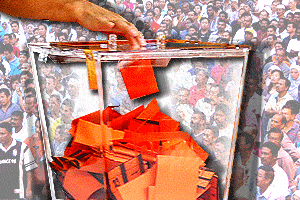 In this decision, the judge had said that instances of non-citizens and “phantom voters” in the electoral roll disclosed during the trial “may well be the tip of the iceberg".
“The exposure of fraudulent practices such as massive registration of phantom voters is time consuming. However, it has to be done if we wish to defend and preserve the meaningful practice of democracy in Malaysia," reads the judgment.
“As custodians of free and fair elections, the (Election Commission) is duty-bound to do it."
The PSC had acknowledged this problem in its interim report and advised the federal government to establish a royal commission of inquiry to look into the problems of citizenship-for-votes scam in Sabah.
Trampling over minority report?
Other issues raised by the Bar Council included PSC’s apparent failure to address the EC’s inertia in implementing reform.
“(This is evident) by its rejection of six out of the 10 interim recommendations made by the PSC,” said Lim.
Lim also pointed out that while PSC fixed a deadline of three months for at least three of the 22 recommendations, it failed to prescribe a timeline for nine recommendations.
“Further, it also failed to propose policies or details with respect to some of its recommendations, for instance fair access to media,” said Lim.
On the Dewan Rakyat’s refusal to accept a minority report to the PSC’s final report, Lim said this was “highly regrettable” and against the parliamentary norms in other Commonwealth countries.
“The PSC comprised nine members, four of whom were not from the governing coalition, including three from Pakatan Rakyat.
“A minority report was prepared to draw attention to points of disagreement and dissension,” explained Lim.
PM must intervene
Lim said that House speaker Pandikar Amin Mulia’s refusal to allow the minority report to be appended had led to the PSC report failing to reflect divergent views and an absence of consensus.
“For the speaker to have disallowed it means that the PSC’s final report fails to reflect the diversity of views expressed within the PSC,” said Lim.
In view of these inadequacies, Lim said the Bar Council urged Prime Minister Najib Abdul Razak to exercise political will and pursue holistic solutions towards rectifying problems with the electoral roll and immediately implementing all of PSC’s recommendations before the next general election.
He said the PSC should have rightfully identified best practices from around the world and implemented the most appropriate solutions in order to strengthen the democratic process.
This would have met public expectations on the government because it had given the impression, after the July 9 Bersih 2.0 rally last year, that it was the government's intention to transform the electoral system and bring about a real and permanent positive reform.


Are you sure you want to delete this comment?
This action cannot be undone.