




Beng Hock documentary brings the dead to life
COMMENT Teoh Beng Hock was the man who died while in the custody of the Malaysian Anti-Corruption Commission (MACC) headquarters in Shah Alam.
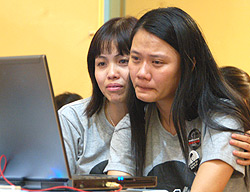
We read about him, we saw his photo in the news, and we remember the emotive images of his sobbing sister.
 We knew him as a political worker.
He was law-abiding and trusting of the MACC, a government anti-corruption agency - the good guys who go after the bad guys.
It was Teoh's fatal mistake in trusting them.
He had gone to their office to help in their investigation over a minor expense, RM2,400 to be exact, incurred by his boss, a state assemblyperson who is a member of the Selangor cabinet.
We know the rest of the story...
COMMENT Teoh Beng Hock was the man who died while in the custody of the Malaysian Anti-Corruption Commission (MACC) headquarters in Shah Alam.
We read about him, we saw his photo in the news, and we remember the emotive images of his sobbing sister.
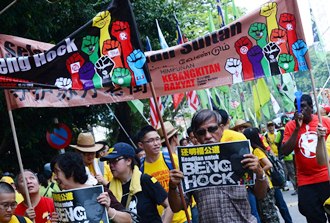 We knew him as a political worker.
He was law-abiding and trusting of the MACC, a government anti-corruption agency - the good guys who go after the bad guys.
It was Teoh's fatal mistake in trusting them.
He had gone to their office to help in their investigation over a minor expense, RM2,400 to be exact, incurred by his boss, a state assemblyperson who is a member of the Selangor cabinet.
We know the rest of the story.
We saw the haunting photo of his body sprawled on the fifth floor of the Plaza Masalam building where the MACC office was located.
We saw the torn pants and I imagined his last thoughts moments before he hit the ground and his young life ended.
A picture paints a thousand words. A sad one draws a thousand tears and makes the widow cry.
Teoh's loved ones, his parents, his sister, and his wife made a widow after a posthumous marriage, still can't talk about Beng Hock without choking and we sense their grief and despair.
I could feel their pain as Teoh's widow wiped the tears from her eyes with her gentle finger and could not answer a question. Such sorrow you cannot hide from the camera.
The big cover-up began long before the news of Teoh's death got out.
To the countless number of Malaysians, including myself, who still point fingers at the MACC, Teoh was a stranger to the public, another cog in the political machinery where part-players are never in the limelight.
Timely exploration by an insider
Tricia Yeoh, in her award-winning documentary on Teoh Beng Hock titled 'Rights of the Dead' , released late last year, has brought him closer to us.
It is a timely work because like so many who died in mysterious circumstances, Teoh can easily slip out of the public psyche into history.
"I really wanted to show how the family suffered through it..." said Yeoh at a Freedom Film Fest (FFF) gathering.
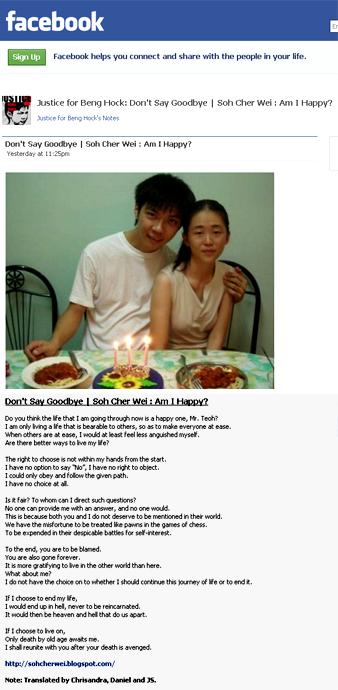 Her first-hand knowledge as a staffer of the Selangor government had given her an intimate knowledge of the ‘unresolved case'.
The short film provides a succinct account of events before and after Teoh's death, and still leaves the viewer with the nagging proverbial question - "Who did it?"
After watching Yeoh's documentary that won the Justin Louis Award FFF2012, I realised that more than feeling chagrin at the government for his death, we owe Teoh Beng Hock the moral obligation to finish what he had set out to do.
He wanted his country to be a better place.
I got to know more about the man who the public still think was murdered, despite an official inquest and a royal commission of inquiry into his death that resulted in an open verdict.
Teoh was a true Malaysian, a promising young man who felt that working for a politician was one way he could put conviction to work.
Unlike those who only complain, he acted and got involved in helping a politician to change the country he loved.
It was a noble desire for which he paid the ultimate price.
Many Malaysians hold the government responsible for the deaths in MACC and police custody, and which have not been justly dealt with.
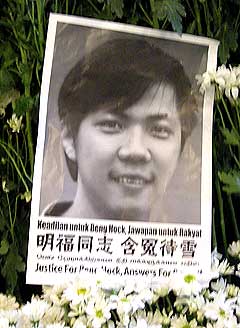 The culprits still roam free. The MACC man in charge of Teoh's case was promoted away from where Teoh had died.
As for the police, they refused to act on the recommendations of a royal commission to enhance police standards and accountability.
This act of omission has signed the death warrants of more who will die in police custody, because some think that a police uniform is licence to act above the law.
But Teoh did not die in police custody because he was a suspected criminal.
He died in the custody of the government's anti-corruption agents whom he had gone to help.
Teoh's death sounded the warning bells that something is drastically remiss with the MACC's modus operandi.
Any Joe Public could fall victim
"It can happen to anyone, including me," said Yeoh in an interview.
The royal commission blamed the MACC officers for their modus operandi that caused Teoh to die, short of saying that they killed Teoh.
But we are none the wiser, because the royal commission's final decision was neither homicide nor suicide. An earlier inquest gave a verdict of suicide that was opposed by Teoh's family and the public.
 It left many unanswered questions. To many in the public, they know why Teoh died, but they do not have the smoking gun. And circumstantial evidence, while compelling, is not enough to make the government, often seen as partial to the police, to bring about any criminal charges.
In her short documentary, Yeoh succeeded in drawing the viewer closer to Beng Hock, the man of conviction, not just the victim of murder.
And viewers are poignantly reminded that they "cannot be neutral" in light of injustice, said Yeoh in an interview.
Maybe I have a soft spot, but who could be so heartless as to not be affected when a film allows you to take a closer look at someone's untimely death. It could have been someone close to us - it could have been you or me, as Yeoh did not forget to remind us.
The video brought the truth closer to my heart and tears to my eyes. It was such a gratuitous and senseless death, and I keep asking myself ‘Why?' over and over again.
Why do Malaysians die in government custody - in the local police lock-up, in the prisons, in the MACC office?
Why are there so many deaths in custody, and still no royal commission into those deaths? There is no public outrage, no taking to the streets. No indication that it is all going to stop.
Many holes in MACC's story
If the "system sucks" as they say, it is because we allow it, and do not protest enough. And Yeoh makes her point in a polite, but poignant way.
"I guess we can't demonstrate over every single act of injustice, because many believe a change of government and the purge of corruption may make a radical difference.
"To cure any sickness, you have to treat the cause, not the symptoms, and you can't be indifferent or neutral. He or she who is not against evil abets it, and may be its victim."
 Yeoh could not remain neutral because the system compels us to take political sides, and it is not the political party, but what it does that wins our support.
Teoh Beng Hock did not deserve to die - no Malaysian deserves to die when in the supposedly safe hands of the police or enforcement officers who are trained to uphold the law and protect the public.
No one can convince me that Teoh was not tortured or roughed up as to want to hang around the MACC office when he could have left after the interview, if in fact, we should accept the MACC explanation.
The official story did not stack up.
The answers to deaths in custody never do. And the victims and their loved ones never get justice in most cases. Those who create fiction to cover up facts and their culpability will eventually have to own up, hopefully, not always on their death bed.
If indeed, it was true that Teoh asked to stay back, he must have needed to recover from his ordeal, which might have included physical abuse. It explains why Thai pathologist Dr Pornthip pointed to the unexplained pre-fall injury on Teoh's neck, and her opinion that he was 'murdered'.
And the anecdotal testimony of someone interviewed in the documentary, who was once roughed up by the MACC, backs the suspicion of Teoh's own treatment at the hands of his interrogators.
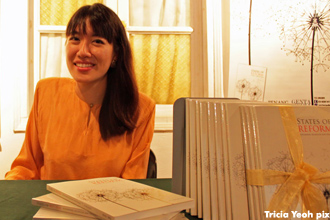 Yeoh (
left
), a first-time filmmaker, wove a simple storyline using news footage and personal interviews and guided us through a labyrinth of witnesses, including a former top government crime investigator who spoke of the shortcomings in police investigations into Teoh's death.
Yeoh (
left
), a first-time filmmaker, wove a simple storyline using news footage and personal interviews and guided us through a labyrinth of witnesses, including a former top government crime investigator who spoke of the shortcomings in police investigations into Teoh's death.
What left an impact on me was not the brilliance of its production, much of it was a simple ‘point and record' single camera work, but the authenticity and poignancy of Teoh's death itself, and the little details like his desire to serve his country that filled the pieces in the jigsaw for me.
Yeoh got to the point, and there's only so much you can cover in a short film, and she succeeded in her aim.
Beng Hock was 'collateral damage'
If there was a crucial missing piece, it is 'Why?' the nagging question.
Why take away the life of someone who did not play any pivotal role in politics? Why did Teoh Beng Hock have to die?
Because we know he would not have killed himself when he had so much to live for - an imminent wedding and new role as a husband, and the thought of having a son would be enough reason for any man to want to live.
There are many hypotheses on Teoh's death, but there is one foregone conclusion: Teoh was the collateral damage in what now appears to be a political witch-hunt.
The truth of how he died may emerge some day, as it often does in Malaysia because scandals are often buried in shallow graves, and the skeletons will rise to tell the truth.
Cover-ups have always been the way of evading the truth. And it is young people like Yeoh who will keep the fire for justice burning.
 Teoh Beng Hock is a political martyr. Yeoh's documentary has certainly made it possible and easier to continue to tell Teoh's story and to seek eventual justice for him, his family and friends.
But there is no video of Teoh's interview with the MACC officers.
A recording would have saved his life, and I trust it is standard procedure now for the MACC, and it should also be the same in places where people are held in custody.
A documentary film of this nature was not made with the singular aim to win awards at film festivals. Films of this genre are not made to entertain us and impress us with its artistry in the making.
I may not be presumptuous that Yeoh, a talented and concerned young Malaysian, a fine woman of conscience had meant that we take the message of the film to heart and act on it.
It was a story that had to be told. It is a film that deserved to win the award and Yeoh succeeded in her goal. Its message to me is that we need to vindicate Beng Hock's death by bringing his murderers, whether intentional or otherwise, to justice, and to ensure that it can never happen again.
Justice is unlikely to be given under the incumbent government and another death did happen again, not long after Teoh's.
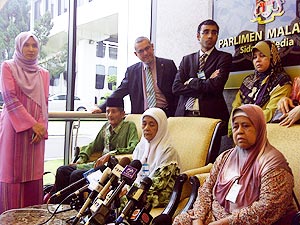 Ahmad Sarbaini Mohammed, a Malay custom officer, was the victim this time, and Malaysians must have felt a sense of deja vu, because like Teoh, he too, fell to his death while in MACC custody.
We know even less of this man's death than we do of Teoh's. He deserves to have his story told as well.
The least we can do for Beng Hock is to ensure that his young son will get a life his father would have given him had he returned from the MACC office that fateful day.
"Your daddy was a hero, he died serving his country," we must tell the boy.
Whatever our feelings on politics or our allegiances, justice must be the master.
Putting 'the system' under scrutiny
Justice delayed is justice denied, and justice denied is a crime unpunished, and a victim doubly victimised while the perpetrator gets off scot-free.
And I hope the families of A Kugan, the most well-known of Indian deaths in police custody, and others who also died in custody, will get the justice their families and friends demand and deserve, and that the public want to see.
Corruption is the country's cancer, but a government that does nothing about deaths in custody, and in fact, promotes those responsible for Beng Hock's death, sends the wrong message.
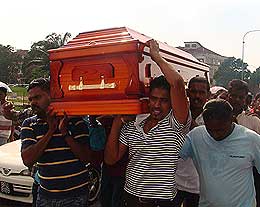 Teoh Beng Hock, A Kugan, Ahmad Sarbaini Mohamed - their unjust deaths have come to symbolise the tyranny of evil that must be challenged, for under close scrutiny, it is the same bloody evil that gave us the murders in the killing fields that shocked us to the core.
Evil rears its ugly head in different ways and different places, but the victims always suffer an unjust and untimely death, and their loved ones get a life sentence of suffering and sorrow.
Whoever we are, we simply cannot stand by and watch others die at the hands of sanctioned criminals, whoever they are, who abuse the power we gave them.
We are our brother's keeper and we are responsible to prevent the widow's tears.
The system must change. The corrupt must go.
We must work for good governance, because corruption results in the deaths of innocent Malaysians, and any death in the custody of the government is one death too many.
The ‘Rights of the Dead' is a documentary every Malaysian should watch and realise that you can never trust any government agency while you are in their custody because of what happened to Teoh Beng Hock.
It is a warning not to be treated lightly, that those who are unfortunate enough to be placed in the custody of the authorities over the most minor matters, may end up dead.
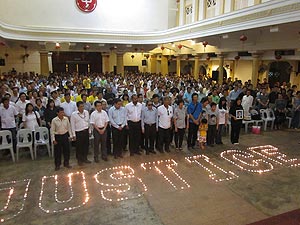 It is not to cow us, but to compel us to bring the culprits to court, and to ensure that evil never triumphs, because the good will do something.
The only safeguard is to ensure only the trustworthy get to hold office, and the system makes any lawbreaker accountable, and no one is allowed to be above the law.
Responsible leadership and responsible systems are a country's best safeguards.
I am glad that Yeoh did the film, and look forward to more of such films, as I believe that the Freedom Film Festival people are a real asset to humanity and the film industry, and I applaud them.
A vote for Teoh Beng Hock is the least we can do for him and the country he loved. A vote for Teoh is a vote for the change he wanted.
Change will better safeguard the rights of the living.
Watch Rights of the Dead l 26.55 mins
STEVE OH is a singer and composer and also author of the book 'Tiger King of the Golden Jungle' . The above article was first published by the Centre for Policy Initiatives .


Are you sure you want to delete this comment?
This action cannot be undone.