




Opposition manipulated Umcedel study, claims prof
An academician has accused the opposition of manipulating the Universiti Malaya's Centre for Democracy and Elections' (Umcedel) finding that voters see opposition leader Anwar Ibrahim as more prime ministerial than incumbent Mohd Najib Abdul Razak.
An academician has accused the opposition of manipulating the Universiti Malaya's Centre for Democracy and Elections' (Umcedel) finding that voters see opposition leader Anwar Ibrahim as more prime ministerial than incumbent Mohd Najib Abdul Razak.
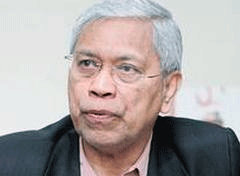 Prof Zainal Kling (
right
), the Tun Abdul Ghafar Baba fellow at the Universiti Pendidikan Sultan Idris, said this in a national news agency
Bernama
report yesterday, rebutting the study's conclusion a day after it was announced to the press and academia.
Prof Zainal Kling (
right
), the Tun Abdul Ghafar Baba fellow at the Universiti Pendidikan Sultan Idris, said this in a national news agency
Bernama
report yesterday, rebutting the study's conclusion a day after it was announced to the press and academia.
Zainal reportedly suggested that the study was a diversionary "opposition tactic" to obscure issues such as hudud law, sex video clips allegedly of opposition leaders and the overlap of candidates.
"They can do a lot of things. This is one of their psychological warfare tactics because their morale has plummeted..."
‘It is possible that the opposition planted the respondents from among the university students," accused Zainal, warning incumbent ruling party BN to prepare for more such psy-war attacks.
He also suggest that the methodology used by the study is suspect.
The article also quoted Universiti Teknologi Malaysia geostrategist Prof Azmi Hassan who questioned the profiles and location distribution of the respondents as well as the sampling size.
"Based on the number of eligible voters in the 13th general election, the study is too small as the respondents form only 0.010 percent of total voters," he said
He argued the study cannot "represent the people's aspirations" as its 1,407 sample size is not sufficient to represent the nation's 28 million population and the more than 13 million voters.
Azmi labelled the findings "illogical" and urged the people not to believe it. He said there was turmoil within the opposition and this was a reflection that Anwar was unfit to lead the nation.
‘Umcedel regrets confused, half-baked comments'
However, Umcedel is standing firm on its study, blaming the criticisms on "confusion" over the connection between the term "population" and "sample" and certain quarters making "half-baked comments" without academic merit.
In a statement today, Umcedel's secretariat explained that a sample is a small number chosen to represent a population and does not have to be as large as the population.
It maintained that the standards used to select the sample and determine its size were on par with international pollsters such as MORI, YouGov and Gallup.
"The closest example is that a doctor does not need to drain a large portion or all of a patient's blood to diagnose for disease, one drop of blood can suffice."
Umcedel disclosed that the methodology it used was face-to-face interview using structured questions as per international standards.
Umcedel: We are transparent, accountable
Umcedel also defended its integrity, transparency and accountability, stressing that it is an independent university-funded academic institution and is not aligned to any individual or political interest.
The centre said that it was not as influential as political analysts in the field who look at politics in the eye, day-to-day, and it would be those reports that the public will look to more then scholarly observations by academia and studies reported in the media.
Umcedel invited critics to study the findings available online at its website before making further allegations, adding that it was willing to discuss the study with anyone, transparently.
"Half-baked views and comments made without academic merit, without referring to the actual study is regretted."
The survey, involving 1,407 voters residing in Peninsular Malaysia in early April, indicated that 43 percent of the respondents believe Anwar was qualified to be prime minister while 24 percent of voters disagreed and the rest were unsure.
As for Najib, 39 percent of voters said he was qualified to be prime minister, while 31 percent disagreed. Another 30 percent were unsure.
The study also found that voters saw Najib as more approachable and having better administrative credentials, but believe Anwar has the better vision for uplifting the country and is also seen to be more Islamic and untarnished by the sex-video allegations.


Are you sure you want to delete this comment?
This action cannot be undone.