




The invisible poor in our midst
COMMENT If one concern hardly ever gets a mention in the news, it is the plight of the destitute - the invisible street people you may pass by without noticing.
We know about the rural poor and even the urban poor and the problems of the rainforest people like the Penans of Sarawak but we hardly hear about the invisible poor.
Yet they walk past us and we may not even notice.
Just yesterday I received an email from an old schoolfriend, a compassionate woman who wrote to her friends highlighting their plight...
COMMENT If one concern hardly ever gets a mention in the news, it is the plight of the destitute - the invisible street people you may pass by without noticing.
We know about the rural poor and even the urban poor and the problems of the rainforest people like the Penans of Sarawak but we hardly hear about the invisible poor.
Yet they walk past us and we may not even notice.
Just yesterday I received an email from an old schoolfriend, a compassionate woman who wrote to her friends highlighting their plight.
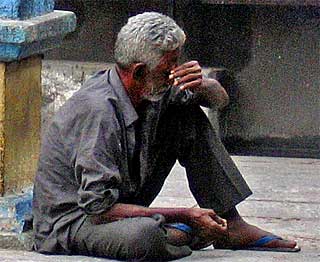 "Just want to share with you all the plight of the poor and the destitute in the inner city of Kuala Lumpur. The poor in this country is increasing in numbers and social ills are also on the rise.
"Most of us on this email list," she continued, "are all blessed and living comfortable middle class lives. Poverty, destitution, human misery are what other less fortunate people have to contend with, not us.
"A good friend of mine has been quietly and willingly taken it on himself and his team of volunteers to go help those in need."
She further explained, "This has been going on for some years now and despite all the setbacks, they persevere year after year without expectation of getting anything in return.
"My friend and his team practise true charity and dispense hope and comfort to all who come in need regardless of whether they are Muslims, Christians, Buddhists, Hindus, atheists, etc, be they Malays, Indian, Chinese, etc. They are doing a tremendous job and very consistently, too.
"It is with people like them and many more unnamed and unknown that there is hope," my friend wrote. She ended her email unabashedly with an appeal to all her friends to help.
I scrolled down her email and there was a write-up on Global Street Mission, the NGO helping the poor in the streets her friend was involved with.
This NGO does not get any financial support from the government or any organisation but raises its financial needs from the public and receives food donations from supportive businesses.
I learned that they are having a fund-raising dinner today, Oct 25, and to cut the story short those who can and want to help should contact Tan Koay Lye +6012 326 6180, John Lim + 6012 641 8747, Joshua Ponnudurai +6010 355 7885 and Jenny Wong +6016 355 7885 and find out more about the function.
It is short notice they apologised but better late than never, I guess.
If people can't attend they can still help in ways they know best and allay the costs of running the many centres that cost more than RM20,000 a month, a figure that often runs short of donations thus placing the residents at risk of eviction.
Surviving at society's ground zero
If there is one question that I have asked friends when I am in Kuala Lumpur or Penang, it is where are the poor people?
I ask where the poor are because I believe we have a divine charge and a human obligation to help those who have fallen on hard times.
When we were living in Malaysia, my wife and I with some others made friends among the poor squatter Indians in Kampung Kayu Ara but their poverty is incomparable to that of the street people.
Squatter people have shelter and food but street people often do not have those relative 'luxuries'. To be a street person is to be barely surviving at society's ground zero.
Our conscience will be touched by the plight of the destitute if we knew some people first hand, but out of sight often means out of mind and we miss the opportunities to do something - I figured my old schoolfriend knew that and took the trouble to stir us to do something.
Global poverty statistics are mind-boggling but we quickly get de-sensitised like the killings and sufferings of men, women and children burnt by chemical bombs in Syria and in other war-torn places we watch every evening on the news.
Still we are bogged in inertia.
According to Unicef, 22,000 children die each day due to poverty. Almost half the world - over three billion people - live on US$2.50 a day. I can go on and on about statistics on the poor and the destitute.
"Live simply so that others may simply live," is an axiom we should try to follow.
But it is not to make us feel guilty when we enjoy the rewards of our hard work. We are to enjoy the fruit of our hard work - it is a divine reward as much as a result of diligence - but we have to learn to share.
We are our brothers' keepers and we have the onus to help one another and not squander our money only on ourselves but to share with the genuine poor and desperately needy.
For this reason, I earnestly urge the government to spare a thought for the poor and destitute and perhaps postpone its second space trip and do something concrete and down-to-earth for the poverty-stricken.
Malaysians crying for help
A rich country like Malaysia ought to be able to help its destitute. After all there are many Malaysians crying out for help and the government should take the lead in helping them and not ignore their plight.
The government-linked companies (GLCs), instead of investing in swanky London real estate as reported in Malaysiakini, ought to use that money to build houses for Malaysians that find it hard to find a shelter over their heads.
The Goods and Services Tax (GST) will hurt the poor because they will be paying the same dollars (of more value to them than the rich) for the same items as the well-off.
And poor people don't enjoy the benefit of reduced income taxes from higher marginal income tax rates.
But for the compassion of people like my old schoolfriend and a humanitarian group like the GSM, many street people would be dead by now and not just having a tough time.
Being a developed nation is no safeguard against poverty. The wealth of developed nations as in developing countries often lie in the hands of only a small number of people.
Many streets of London today are lined with countless homeless economic refugees from Eastern Europe. And every city in the developed countries have homeless people that make the streets their home.
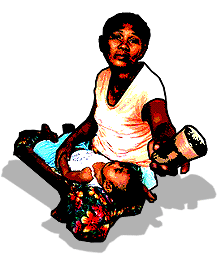 Even in relatively wealthy Australia, there is a growing underclass of poor people.
I know because I have seen those people in Europe and Australia, I have talked to them, I have touched them, and I feel sorry for them, and even if I emptied my wallet each time, it is a drop in the ocean.
But like the starfish among millions in the anecdote that was helped back into the sea by a do-gooder, it was all that mattered - someone cared and someone made the crucial difference to its survival.
If one can help one it eventually adds up.
There may be many in need but it matters to the one that gets helped and for the specific helper it may be all that matters being able to help someone than doing nothing.
I hope we can all make the crucial difference to someone whose barometer in life reads danger so that being destitute and living in the streets is not a death sentence but a passing ordeal and a transition to fresh hope and a positive turn.
STEVE OH, who now resides in Australia, believes every Malaysian has a duty to work constructively to help eradicate poverty, corruption and injustice so that the quality of life of every Malaysian will improve. He is a singer and composer and also author of the book 'Tiger King of the Golden Jungle'.


