




Local turtle populations 'on brink of collapse': scientists
Several populations of sea turtles in Malaysia are on the brink of collapse and could soon be extinct unless urgent action is taken, scientists warned today.
Several populations of sea turtles in Malaysia are on the brink of collapse and could soon be extinct unless urgent action is taken, scientists warned today.
"There has been a dramatic decline in the number of Malaysian sea turtles in recent years," the scientists said in a statement after a conference in Kuala Terengganu.
"Many populations are in danger of extinction and could be gone in a few years if there is not urgent and effective action."
 The most vulnerable species are the leatherback, olive ridley and hawksbill, international travellers whose ancestors have roamed the seas for more than 200 million years.
Malaysian leatherbacks were once one of the most abundant populations in the world and the Terengganu state coast here was one of the 10 principal nesting sites globally for the gentle giants among shelled seafarers.
"The number of leatherback nests in Terengganu has fallen to alarming levels: from over 10,000 a few decades ago to less than 10 in recent years, while populations of olive ridley and hawksbill in other parts of the country are at critically low levels," the experts said.
Harvesting turtle eggs
The conference was called by the Worldfish Centre, an international research group based in Malaysia and funded by private foundations and governments, to draft a national action plan as part of a global drive to prevent the extinction of some turtle species.
The conference was attended by more than 40 specialists from Malaysia, the Philippines, Indonesia, Thailand, Australia and the United States, with delegates emphasising the need for international cooperation as the turtles know no national boundaries.
A major theme of the conference was that while Pacific sea turtles were "in serious trouble ... they can still be saved."
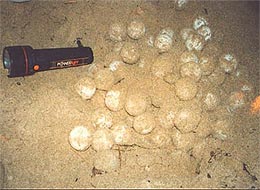 One of the biggest problems in Malaysia is the harvesting of turtle eggs laid on the beaches. If hatchlings do make it to the water they face a myriad of threats from entanglement in fishing nets, illegal harvesting for food and shells and the destruction of their feeding grounds.
However, the scientists point out that experience in other parts of the world shows that "sea turtle populations can bounce back with proper management", citing success stories with protected beaches in the Gulf of Mexico and South Africa.
While the Pacific leatherback "is today the most endangered sea turtle in the world," protecting eggs at St Croix in the Caribbean "has resulted in an exponential increase in the number of nesting leatherbacks" - from about 20 in 1982 to hundreds now."
Effective laws
The scientists suggested a 15-point strategy for Malaysia, including better efforts to provide alternative sources of income for those who harvest turtle eggs for sale, "effective laws and strategic policies" and establishing more nesting sites as sanctuaries.
They noted that the state government of Terengganu had agreed to gazette 60 hectares of beach and coastal habitat at the Ma'Daerah rookery near here as a sanctuary. The beach is used mainly by nesting green turtles.
The scientists conclude that "while there is still hope, it is critical for Malaysia to safeguard the populations of its green, hawksbill and olive ridley turtles before they suffer the fate of the leatherbacks."


Are you sure you want to delete this comment?
This action cannot be undone.