




M'sia demonstrates lack of leadership in climate change
COMMENT On Sept 23, 2014, in his address to the United Nations Climate Summit in New York, Prime Minister Najib Abdul Razak not only reiterated his promise made at Copenhagen in 2009 to reduce Malaysia’s carbon emissions by 40 percent by 2020, he stated that Malaysia had already achieved a more than 33 percent reduction in emissions intensity.
Unfortunately, we were never told where these emission reductions came from.
Indeed, one doubts the authenticity of these numbers as well as Malaysia’s commitment to reducing carbon emissions moving forward especially given our continued reliance on coal powered electricity generating plants.
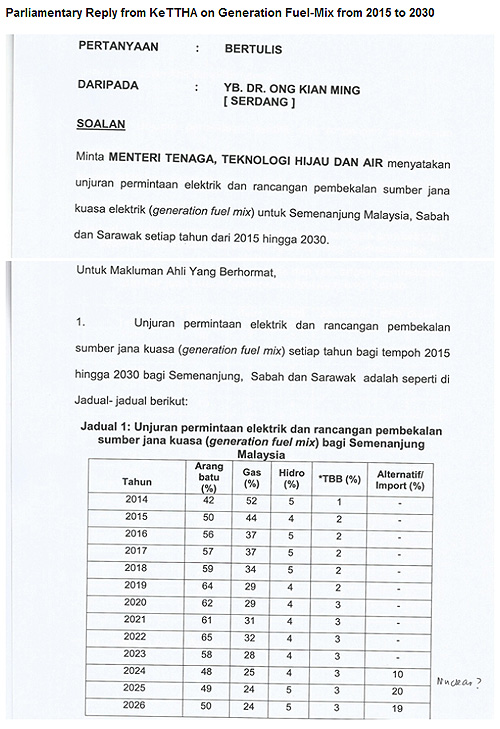
From a parliamentary reply I received from the Energy, Green Technology and Water Ministry, it is projected that the generation fuel mix from coal power plants (which contributes far more towards carbon emissions compared to gas fired plants) would increase from 50% in 2015 to 65% in 2022. The percentage of electricity generation from renewable sources is projected to be at a measly 3 percent by 2020.
In contrast, President Barack Obama’s recently announced Clean Power Plan provides strong regulations and incentives to reduce the United State’s reliance on carbon intensive power plants (especially coal power plants) and move towards renewable energy sources.
While it is acknowledged that Malaysia and the United States are a very different stages of economic development, it is nonetheless shocking to see the lack of leadership in Malaysia on the issue of climate change.
The most recent example of this lack of leadership is the fact that Malaysia, together with Brunei, are the only two countries in Asean which have failed to, as of Oct 1, 2015, to submit its Intended Nationally Determined Contributions (INDCs) to the United Nations Framework Convention for Climate Change ( UNFCCC ).
The INDCs are an essential component of the process leading up to the Conference of Parties 21 (COP 21) which is scheduled to take place in Paris in December where an ambitious agenda to tackle climate change will be negotiated.
Give an explanation
As of Oct 1, 119 countries (out of 167) have submitted their INDCs including big developing countries such as China, India, Brazil and Indonesia and other smaller developing countries such as Liberia, Zimbabwe, Kazakhstan and Mongolia.
Malaysia finds itself among countries such as Afghanistan, North Korea, Nigeria, Pakistan and Venezuela as those who have not yet submitted their INDCs.
This not only puts Malaysia in a poor light especially given our position as the chair of Asean for 2015 but also calls into question Malaysia’s preparedness heading into COP 21.
This is also part of a larger problem in demonstrating lack of leadership in addressing the most important environmental problem facing the country now which is the haze issue.
Resolving this issue requires strong leadership by Malaysia especially in our dealings with Indonesia and how we leverage the Asean framework on this matter. I call upon our new Natural Resources and Environment Minister, Dr Wan Junaidi Tuanku Jaafar, to give an explanation for this embarrassing lack of leadership on the part of Malaysia.
ONG KIAN MING is the MP for Serdang.


Are you sure you want to delete this comment?
This action cannot be undone.