


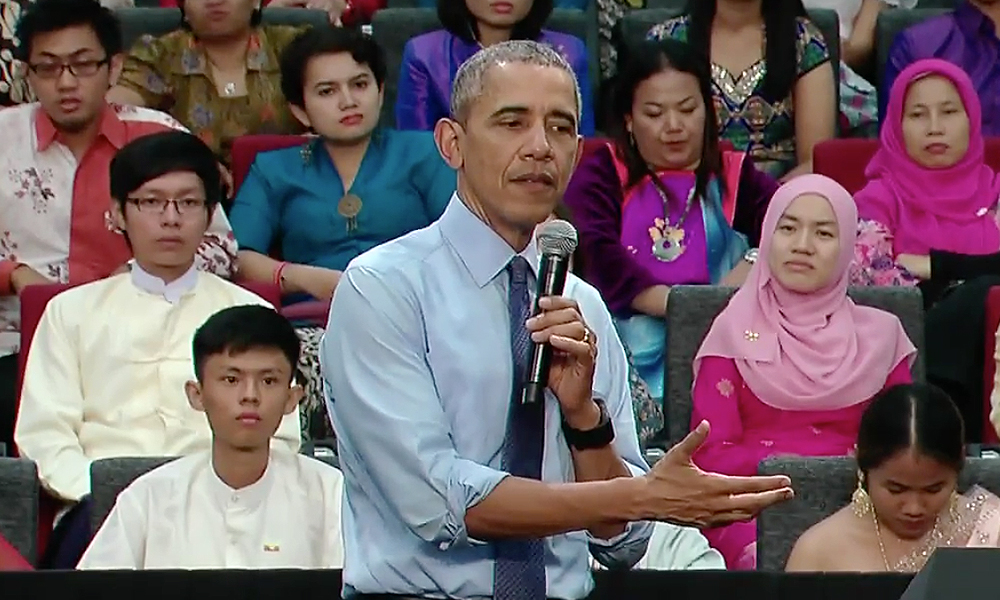

Obama: TPPA protects access to low-priced generic meds
United States President Barack Obama said the cost of drugs is expected to fall over time in many countries with the removal of trade barriers.
He said although the Trans-Pacific Partnership Agreement protects pharmaceutical companies' intellectual rights, it also protects access to low-priced generic medicine for the low income.
United States President Barack Obama said the cost of drugs is expected to fall over time in many countries with the removal of trade barriers.
He said although the Trans-Pacific Partnership Agreement protects pharmaceutical companies' intellectual rights, it also protects access to low-priced generic medicine for the low income.
He said protection for drug-makers is crucial for innovation, or else no one would want to invest and develop better drugs.
"So we said we have to protect some. But we're very explicit in the chapter on this to say that we have to protect generics for low-income persons, for - in fact, we need to eliminate tariffs on some things like penicillin and basic drugs that have been on the market for a very long time.
"And over time, we actually believe that the cost of drugs are going to go down in many countries that currently have a lot of barriers in terms of those drugs," he said.
Malaysia does not impose any tariffs on the import of medicines.
Obama was speaking at the Young South East Asean Leaders Initiative (YSEALI) town hall session at Taylor's University on Friday.
He said the many drug companies in the United States are unhappy with his position on this.
"And what I said to them is, well, part of our job is to promote the U.S. drug industry, but part of our job is also to be good partners with countries that have people who are sick.
"And we've got to make sure that they also are able to get access to drugs," he said.
According to previously leaked drafts of the TPPA text, US negotiators had been pushing for a 12-year data exclusivity period for a new class of biologics, which would be in line with current laws in the US.
The final text stipulates at least an eight-year protection, or in the alternative, a five-year protection coupled with other measures that would deliver equivalent results. The Malaysian government has indicated that it is going for the latter option.
The participant, who introduced himself as Rizal, raised concerns that the TPPA is an “elitist deal” that will burden the majority of Malaysians, especially those from the lower-income group.
In context of Malaysia, Rizal asked Obama to explain how the expected increased burden on indigenous people, women and others from the lower-income group, falls in line with the US principles of leadership.
While acknowledging Rizal’s concern, Obama said some of his assertions on increased prices of medicine were “inaccurate” as pharmaceuticals are an area that has been subjected to a lot of scrutiny, given that the US pharmaceutical industry is the most prominent in the world.
Still subject to review
Obama also pointed out how terms of the TPPA were still subjected to review before being passed by the governments of its 12 member countries.
“I’ve still got to get it passed in Congress. There are going to be some people who think it is a good deal, some people who think it is a bad deal, and I believe that it is a good deal and we'll get it done. There is no guarantee,” Obama said.
The Dewan Rakyat is scheduled to debate terms of the TPPA in January next year and Prime Minister Najib Abdul Razak said on Wednesday that the trade pact could be signed in New Zealand in February.
Separately at a press conference in Petaling Jaya this morning, Klang MP Charles Santiago rebutted the Institute for Democracy and Economic Affairs' (Ideas) claim that TPPA would not lead to costlier medicines .
While the Ideas report data showed that Canadian spending on medicines had not significantly changed and had in fact dropped slightly since introducing a data exclusivity clause, Charles said most of the drugs accounted for in the figures were actually generic drugs instead of patented drugs.
In addition, Canadian provincial governments had regulations in place to ensure that generic medicines are brought to market quickly.
“This has nothing to do with free trade agreements. This is government pressure to lower the cost of medicines. So the example they had used is wrong,” he said.
The Bantah TPPA coalition had similarly criticised Ideas' use of Canada as an example, pointing out that many top-selling patented drugs had their patents expire during the time the data was collected.
In addition, the data exclusivity provisions only come into effect this year, and would not have a financial impact until a few years later.
The group also pointed to several studies showing that stronger intellectual property protections for pharmaceuticals similar to TPPA’s provisions would lead to higher medicine costs, including in Canada by 2023.
Additional reporting by Koh Jun Lin.
Editor's note: Malaysiakini earlier reported that Obama said prices of patented drugs will go up. We regret the error.
Related report


Are you sure you want to delete this comment?
This action cannot be undone.