



Runnymede Hotel still intact, other buildings demolished
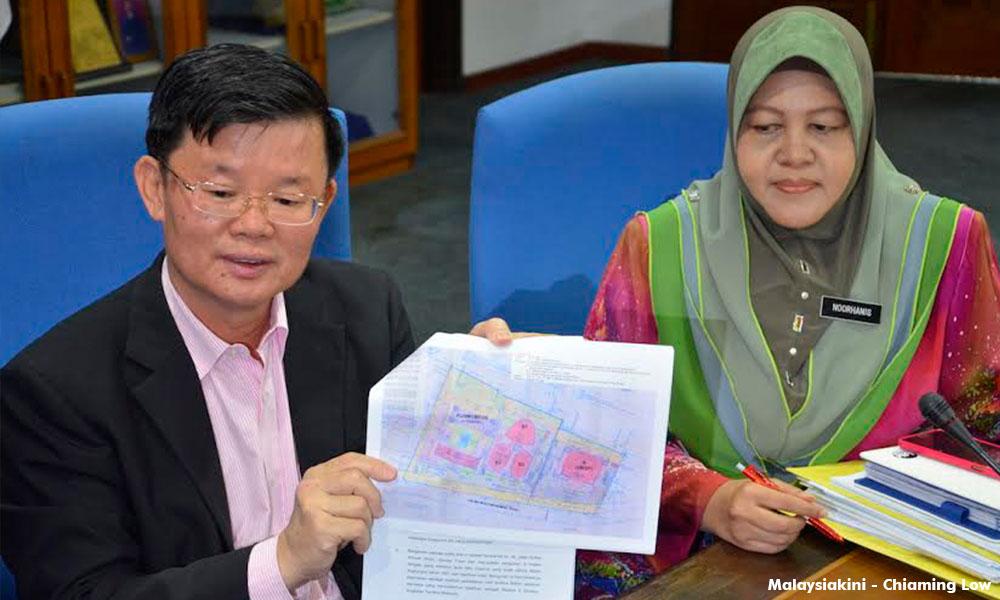
The demolition of several ancillary buildings to the iconic Runnymede Hotel in Penang were according to the planning permission granted to the developer by the Penang Island Municipal Council (MPPP) in 1999, said state executive councillor Chow Kon Yeow.
Runnymede Hotel, located on the seafront of Jalan Sultan Ahmad Shah (formerly Northam Road), was reportedly home to Sir Stamford Raffles in the 1800s before he left for Singapore.
Save for the Runnymede Hotel, the other buildings were demolished on the second day of the Chinese New Year, on Tuesday.
Heritage activists were up in arms over the incident, with some questioning when the approval was given for demolition works.
Chow said the MPPP – which was then run by the BN administrations – granted the planning permission for mixed development to developer Warisan Pinang Sdn Bhd on Nov 10, 1999, for lots 131, 132 and 133.
“The developer has applied for a new planning permission on lots 132 and 133 for a mixed development project in June last year,” Chow said at a press conference in Komtar today.
“However, this application was withdrawn by the developer in November last year,” he added.
Chow said the development consists of Block A (office on level 23), Block B (Tower B1 – office on level 23), Block C (21-storey hotel), and an existing three-storey building (Runnymede Hotel).
The plot where Runnymede is built remains outside the George Town World Unesco Heritage site.
Runnymede was constructed in neo-colonial style in 1921, with several other ancilliary buildings.
This building was formerly used as the administration and military operations centre of the British before Independence.
Chow said the approval to commence work was given on July 28, 2000, for the construction of Block A (on lot 131), which is now the Penang branch of the Employees Provident Fund building.
He added that other developments under the planning permission have not begun yet.
“However, this planning permission is still valid as part of the development under it had been carried out according to Section 24 (1) and (2) of the Town and Country Planning Act of 1976,” Chow said.
“On Feb 13, MBPP was notified of the developer’s plan to demolish the existing buildings near the Runnymede Hotel, and this is allowed under the planning permission,” he added.
“The developer was then asked to comply with the conditions under the planning permission, which is to maintain the three-storey Runnymede Hotel,” Chow said.
'Mere fines won't do'
Penang Island City Council secretary Ang Aing Thye said a notice, however, had been issued to the developer for carrying out demolition works on a public holiday.
Ang said according to the planning permission, demolition was not supposed to be done on weekends and public holidays.
“We are giving them two weeks to explain why the works were carried out on the second day of Chinese New Year,” he added.
Meanwhile, Consumers Association of Penang president SM Mohamed Idris urged the state and local authority to clarify the demolition and approval given to the developer.
“What action will be taken against the developer? Mere fines will not do as in the case of the Bukit Botak (Relau) saga,” he added.
In the 'bald hill' saga, the developer which illegally cleared the hill was merely fined RM30,000, which activists felt was not effective to prevent a similar incident from recurring.
Idris said besides conserving its physical heritage, the state government should ensure that Penang’s natural heritage is also protected, urging the present leaders not to bow down to developers.
“It looks like nothing is left sacred in Penang – from our hills to our seas and now our heritage buildings.
“There seems to be no limits to planning and approvals, and the developers benefit the most from this uncontrolled pursuit for development,” he added.


Report this comment
Are you sure you want to delete this comment?
This action cannot be undone.