




Minimum wage campaign taken to Batu Caves on Thaipusam
Activists are working the massive crowds attending Thaipusam at Batu Caves, seeking support for a campaign to ensure that factory workers get a minimum wage.
Activists are working the massive crowds attending Thaipusam at Batu Caves, seeking support for a campaign to ensure that factory workers get a minimum wage.
Members of the Marginalised People's Network (Jerit) set up a booth outside the main entrance to the temple on Sunday, looking to attract additional signatures to the 100,000 collected since the campaign was launched in December 2003.
The move, spearheaded by Jerit and the Gabungan Pekerja Kilang dan Kesatuan (GPKK), is to secure a minimum wage for factory workers mainly from the electronics and plastics industry.
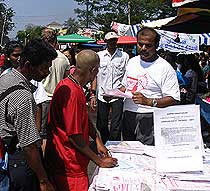 At Batu Caves, Hindu devotees and visitors are being urged to sign postcards that will be handed over to premier Abdullah Ahmad Badawi when the collection touches the 200,000 mark. The booth is manned by 30 volunteers working in shifts.
"I'm not too sure how many exactly we've collected here, but it is in the range of 20,000 so far," said rights activist S Arutchelvan.
Campaign co-ordinator Sevan Doraisamy, speaking over a loudhailer, spoke to the crowds in Tamil: "We're not asking you for money, we just want your signature to help secure a fair wage for workers."
Long hours, low pay
GPKK, supported by some 200 factory unions mainly from Selangor and Perak, is calling on the government to enact minimum wage laws specific to factory workers.
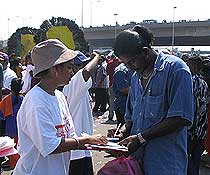 Sevan said the group's research shows that most factory workers get between RM300 and RM450 a month for more than eight hours of work.
"Some are now forced to work three hours of overtime without proper compensation. There are those who work 12 hours and get only a marginal sum," he said.
"The unions also want two months' bonus each year, a basic wage of RM900 and yearly increments."
Expatriate Christina Bodor from the Netherlands commended the group for its efforts, saying it is good for foreign tourists to be exposed to real issues, apart from cultural dimensions.
"I'm sure many here can relate to calls for minimum wage," said Bodor, who was witnessing Thaipusam with three friends for the first time.
She noted the presence of several organisations promoting good causes during the festival, including those collecting donations for survivors of the tsunami, but said she herself would only donate to "reliable funds".
Groups in action
Sri Agathiar Sanmarka Gurukulam Malaysia, which was among the charitable bodies at Batu Caves, intends to distribute some 130,000 food packets.
Chairperson B Panir Selvan said he was using public funds donated to his organisation "to return God's kindness".
"Last year, we distributed 132,000 packets of vegetarian food. We had to prepare extra as the demand was high. We derive satisfaction from serving the people," he said, adding that some volunteers have been working non-stop.
"Thaipusam is a very spiritual celebration. It is not a carnival. Our act is a a spiritual one, which is very important during Thaipusam."
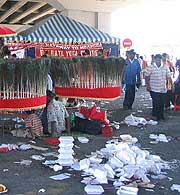 However, Selvan also said he was upset with those who litter the temple grounds and surrounding areas.
"If they take our food packets and eat around here, we can clean it up. However they take it away and then throw it somewhere else. There are not enough dustbins."
Selayang Municipal Council and Alam Flora personnel were stationed at the grounds, doing their best to cope with cleaning up the garbage, including styrofoam boxes, cups, plastic bottles and plastic bags.
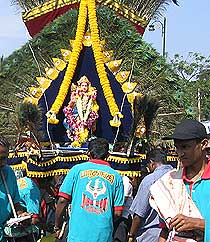 Volunteer Dr Malliga Vadiveloo of the Thabaranam Welfare Society of Malaysia condemned the pollution as blatant disregard for the environment and as disrespect for the occasion.
"My guru (religious leader) is upset that human beings have no care for cleanliness and mother nature," she noted.
Malliga also said the group, which has collected cans for recycling, has found that a large number of these are beer cans.
"It's despicable. Even some of the boys carrying kavadi were drinking the night before," she claimed.
The group was also collecting donations to set up an ashram (centre for retreat) which will be environmentally friendly in its operations.


Are you sure you want to delete this comment?
This action cannot be undone.