



Save M’sia - out of the frying pan, and...?
COMMENT Let’s say we succeed in removing Prime Minister Najib Abdul Razak. What happens next?
This is not an article debating the pros and cons of allying with Mahathir Mohamad and friends, or whether doing so is ethically justifiable.
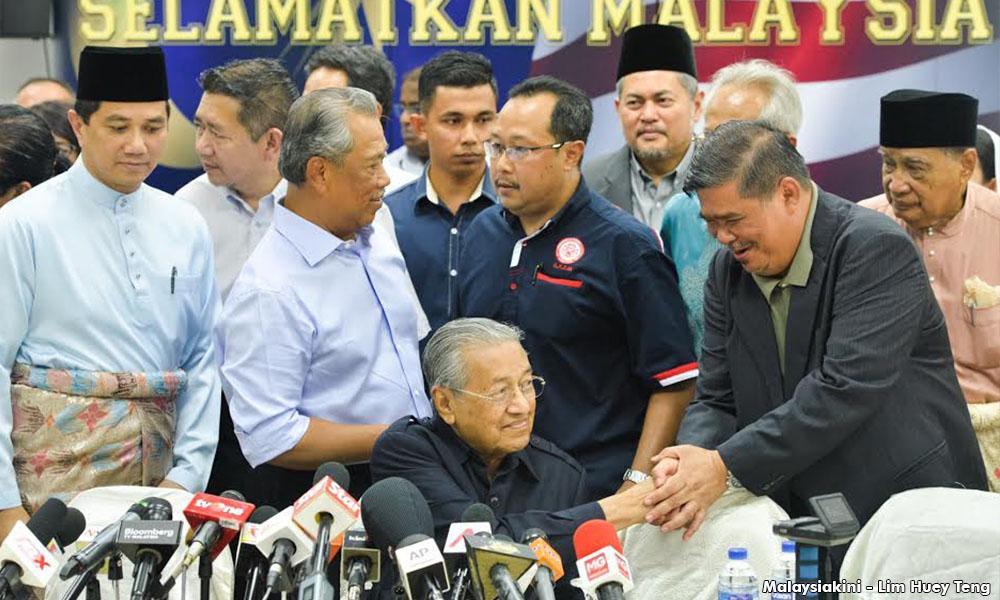
The signing of the Deklarasi Rakyat is indeed historical, and was no doubt a colourful and interesting collection of people that has intrigued many.
COMMENT Let’s say we succeed in removing Prime Minister Najib Abdul Razak. What happens next?
This is not an article debating the pros and cons of allying with Mahathir Mohamad and friends, or whether doing so is ethically justifiable.
The signing of the Deklarasi Rakyat is indeed historical, and was no doubt a colourful and interesting collection of people that has intrigued many.
Recently, one of its staunchest proponents, Zaid Ibrahim, wrote that we should set aside our differences and “stop bickering” about who should replace Najib, emphasising instead that the important thing is that he be replaced.
Shoot first, ask questions later?
Not to be an effete snob , but perhaps the idea that we can remove Najib first, and worry about who will replace him later, might be worth examining a little closer.
The presumption behind this approach is either that a) essentially any situation in Malaysia is better that having Najib continue as PM, or b) it’s not practical discuss his replacement now, but everything will be fine if we just discuss it later on.
Let’s examine a) first. Is any situation really preferable to having Najib continue as PM?
I share the sentiment that Najib is a terrible PM. At this stage, perhaps the most alarming situations is rampant abuse of power and circumvention of checks and balances.
Surely it cannot be a good thing if a prime minister is allowed to simply remove anyone whatsoever within the government who appears to be a threat of any sort, or who is unwilling to toe the line.
Zahid next?
If, against one in a hundred odds, we do create enough pressure for Najib to step down though, realistically speaking, who is most likely to replace him?
In Malaysian history, not every deputy prime minister has become prime minister; their failure to do so has often been a bloody one (in at least one case, literally so). That said every single prime minister in Malaysia was previously a deputy prime minister. This queue has never once been jumped.
If we assume precedent remains, and Umno continues to be the dominant party in Parliament, then surely we cannot discount the likelihood of Ahmad Zahid Hamidi becoming the next prime minister.
Is a Zahid premiership superior to a Najib premiership? Where Najib has been often criticised as being soft, indecisive, and politically flabby, Zahid has a reputation for toughness, heavy handedness, and an overall more ‘ultra’ outlook.
Will Malaysia be better off under Zahid? Will race relations be better? Will the press be freer? Will activists be given freer rein? Will there be less corruption?
Squabbling over the premiership
Many would say it’s not a certainty that Zahid will succeed as PM. Fair enough. Who then?
The political landscape suggests that there is not a single person that all parties could conceivably agree to.
Anwar Ibrahim, Muhyiddin Yassin, Hadi Awang, Azmin Ali, et cetera, are all figures that are far too divisive to command a majority of support. The former is not even remotely legally qualified at this point to assume the post anyway.
Some wild dreamers might start mentioning names like Tengku Razaleigh Hamzah or some Independent MP.
What is clear is that there is no unity on this question.
You don’t have to read too hard between the lines to see that even PKR president Wan Azizah Wan Ismail and vice-president Nurul Izzah Anwar are nowhere near convinced of the merits of working with Mahathir on anything, much less agreed with him on candidate for prime minister.
The truth of course is that if there was an obvious choice, or a truly likely candidate, then it would by now have been, well, obvious.
It’s all well and good to agree on many common goals. Within Malaysia’s all or nothing political structures however, a dispute over who becomes the next PM would eventually supersede any and all short term alliances. Any unity we see now, will likely dissolve, creating a political vacuum, and inevitable chaos.
Releasing dragons
While by far a perfect analogy, one of the closest examples of such chaos in recent memory would of course be the situation precipitated by the Kajang Move.
We have one group of people (the initiators) intent on replacing the chief executive with their candidate. We have a group of people intent on retaining the chief executive. Then we have various other parties lurking in the wings, with their own different agendas. Further, we have various other factors beyond anyone’s control, such as the monarchy.
The situation drags on and on, and government screeches to a halt for an indeterminate period.
We can debate whether Selangor is better off now than it was before, but what is clear is that the initiators of the Kajang Move got a very different result than they intended - arguably the exact opposite even.
Some say the Kajang Move brought the downfall of Pakatan Rakyat. Perhaps the downfall of Pakatan Rakyat was sowed much earlier, in the lack of investment of time and effort into building a common vision that all component parties could truly agree on.
Such a vision would have been the bedrock of a sustainable alliance. Instead, all the charges of a ‘marriage of convenience’ that so many of us fought to disprove, turned out to be closer to the truth than not.
Perhaps these experiences are food for thought. People often release dragons, and soon find their assumptions about who will end up riding who sorely misplaced. Other times, coming back to possibility b) mentioned earlier in the article, a ‘we’ll wing it as we go along’ attitude results instead in very prematurely clipped wings.
Will Umno rock the boat?
The biggest upside of a ‘citizen’s’ movement (parentheses included as most of the initiators of the movement appear to be politicians rather than the ‘ordinary citizens’ they identify as), is to demonstrate conclusively that Malaysians have the power as citizens to remove a premier deemed to be corrupt.
Such a demonstration would be powerful indeed; if, of course, it succeeds.
The Citizens’ Declaration is clear on a number of things: the details of what Najib has done wrong; that Najib should be removed; and that he should be removed via legally permissible ways.
It is less clear on exactly which legally permissible ways will be pursued. Not many at this point seem poised for success. Umno remains firmly in control of the government, and Najib remains pretty firmly in control of Umno.
Most of the real holders of power and influence within Umno have little interest in rocking the boat. As long as they are sufficiently fed (and those in power are very good at feeding, and feeding well), the chaos that would undoubtedly ensue should Najib be removed is the last thing they want.
A twenty-year plan, not a twenty-week plan
Having Najib as prime minister is frustrating. Everyone gets that; and yes, for damned sure we should do something about it.
The question is what?
I think Malaysian history has demonstrated any number of times by now that ‘getting rid of the current guy’ is not a sufficient rationale or binding element for a sustained movement for change.
Perhaps the best way to not only get rid of Najib, but to prevent anyone and everyone that would ever behave as he did to rise to power again, is to focus our efforts on designing and implementing a completely different political paradigm.
I believe in the intelligence of the Malaysian people; and perhaps intelligent people would be most attracted by a viable long term alternative, rather than short term excitement without a clearly defined, comprehensive roadmap.
For instance, instead of focusing on removing Najib only, which remains an uncertain endeavour at best, what about preparing for a certain eventuality - the upcoming general elections. No one knows if or when Najib will be removed, but we can say with fair certainty that we will face general elections sooner or later.
The only question is, what will the landscape be then? One on one fights like we had in 2013? Three corners in every seat, with PAS’ new alliance coming into the fray? Or some free-for-all chaos?
Maybe that is a more productive area to work on, then haphazard new alliances with uncertain directions.
We’ve failed to remove Barisan Nasional thus far. As a Malaysian, I accept equal responsibility for this failure as anyone else.
If we want to turn that failure to success however, perhaps it’s time we stop trying out the same strategies again and again. Perhaps it’s time we look at five-, ten- or even twenty-year plans, and start building on that basis.
Perhaps it’s time we plant a real carrot patch of our own, nurtured in fertile soil, rather than always chasing after a carrot dangling in front of us that always seems just out of reach.
NATHANIEL TAN is a former member of the Malaysiakini Team.


Are you sure you want to delete this comment?
This action cannot be undone.