


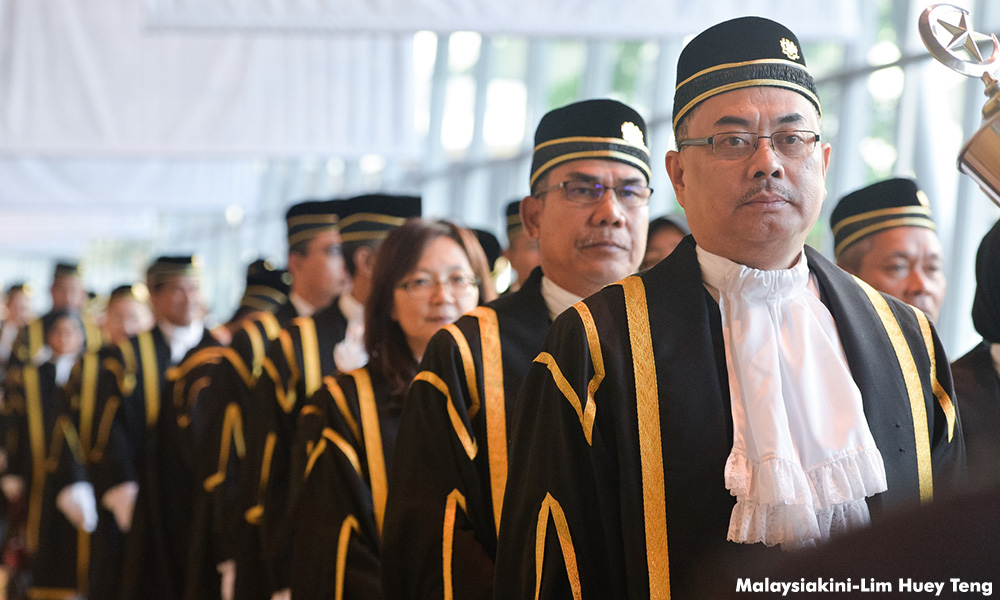

Chief justice, senior judges get 'hefty' pay hikes
Senior judges, apart from those sitting in the Sessions Court, have received a pay hike. This includes the chief justice, president of the Court of Appeal, chief judge of Malaya and the chief judge of Sabah and Sarawak.
The fifth schedule of the Judges Remuneration Act also sees an amendment to salaries of judicial commissioners of the High Court, where the figure RM16,200.21 is replaced with RM25,500, suggesting an increase of more than RM9,000 or over 50 percent.
Their increments were approved on March 11 by Prime Minister Najib Abdul Razak, who also oversees the finance portfolio, and backdated to July 1, 2015, according to a government gazette.
This means judges who retired after July 1 are also entitled to receive the increments. Among them is attorney-general Mohamed Apandi Ali, who was a Federal Court judge.
Apandi replaced Abdul Gani Patail on July 27, 2015. Abdul Gani was ostensibly removed on health grounds.
However, allegations surfaced that he was dropped in an attempt to derail an investigation into the 1MDB and RM2.6 billion twin scandals, especially since the move came weeks after an explosive report in The Wall Street Journal that detailed the money trail to Najib’s personal bank accounts.
Putrajaya had repeatedly dismissed the allegations, while Apandi subsequently cleared the prime minister of any wrongdoing.
In addition to their basic salaries, the senior judges also receive other perks, including entertainment allowance, cost of living allowance, fully-furnished houses, an official car and driver.
It remains uncertain when was the last pay hike for the senior judges and therefore, a quantum of the current increment cannot be tabulated.
However, based on an online search on the Akta Saraan Hakim (Judges Remuneration Act 1971) effective Jan 1, 2004, the new and 2004 rates are as follows. [See table]

There are 10 Federal Court judges, 29 Court of Appeal judges and 52 confirmed High Court judges.
There are 35 High Court judicial commissioners around the country.
Since the time of former prime minister Dr Mahathir Mohamad, the judiciary has often been accused of being subservient to the executive.
In 1988, a judicial crisis erupted and Mahathir was said to have orchestrated the dismissal of then lord president Salleh Abas.
This incident is widely considered to be the catalyst that triggered a marked reduction in the independence of the judiciary.
Allegations of the judiciary being impartial continue to persist, and Mahathir now finds himself on the opposite side of the fence, having filed a flurry of lawsuits against Najib.
In the statement of claim in one of the lawsuits, which accused Najib of breaching fiduciary duties and misfeasance in public office, Mahathir alleges that key institutions have been compromised under the current administration.
Pay increase for judges ‘adequate’, says opposition lawmaker


Report this comment
Are you sure you want to delete this comment?
This action cannot be undone.