



The three corners of a political one-night stand
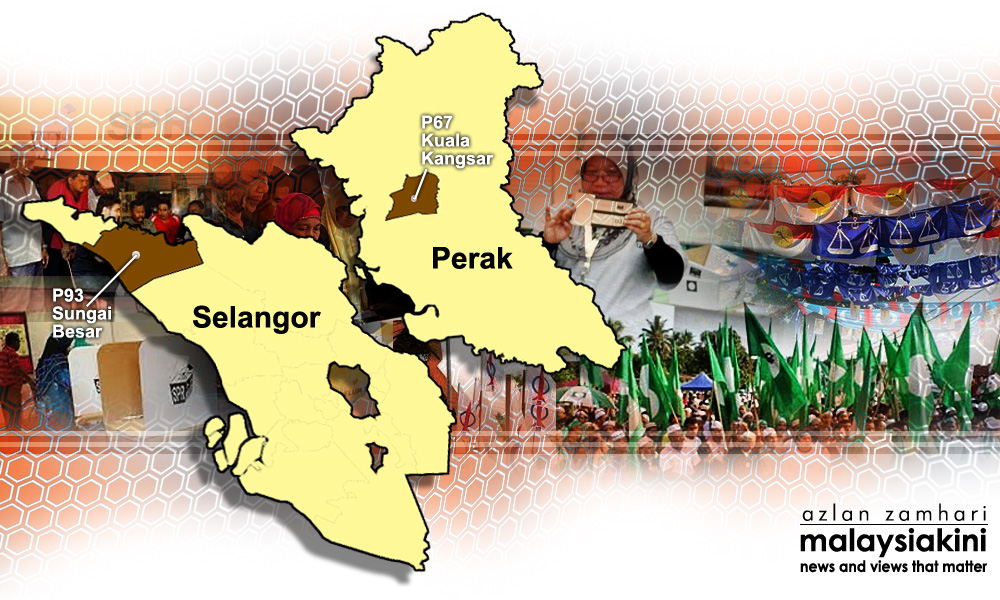
COMMENT Sarawak is over, Sungai Besar and Kuala Kangsar loom on the horizon.
There are questions on the mind of every Malaysian hoping to see an end to Barisan Nasional rule in our lifetimes.
Will we see more three-cornered fights? Are the opposition actually serious about forming the next government? Or are they content to with the benefits of riding discontent from the backbenches?
COMMENT Sarawak is over, Sungai Besar and Kuala Kangsar loom on the horizon.
There are questions on the mind of every Malaysian hoping to see an end to Barisan Nasional rule in our lifetimes.
Will we see more three-cornered fights? Are the opposition actually serious about forming the next government? Or are they content to with the benefits of riding discontent from the backbenches?
The three-cornered factor
Observers note that in seats where DAP and PKR both contested against BN in Sarawak, the total number of votes won by the two parties were less than those won by BN.
Some thus conclude that three-cornered fights were not the reason BN won those seats.
Many of course have spoken about other major reasons behind the BN landslide in Sarawak - attitudes West Malaysians have about East Malaysians, failed strategies and so on.
These factors were indeed major, possibly even the decisive ones. At the same time though, perhaps some of us are underestimating how having three corner fights affected the overall ‘meta’ electoral dynamic.
One of the more prominent aspects of the Sarawak elections was the low turnout rate.
Follow live coverage of the elections, one could almost feel many urban opposition candidates deflate as the turnout statistics started coming in.
Prioritise party? Or prioritise rakyat?
Perhaps one major reason for the low turnout and resulting BN victory is increasingly widespread cynicism and a failure by the opposition to truly capture the electorate’s imagination.
A three-cornered fight communicates one thing and one thing only to voters - individual party interests are more important than replacing BN.
Party insiders usually try to persuade us that it’s more complicated than that (or simply blame the other party), but at the end of the day, it really isn’t.
The three-cornered fights weren’t even between Pakatan Harapan and the PAS-Ikatan coalition, they were between parties who had been so eager to kick PAS out of Pakatan Rakyat and form this much-hyped Pakatan Harapan.
The moment Harapan failed to ensure one-to-one fights in Sarawak, their share price among the national electorate (especially those who might be undecided) probably plummeted more than 50 percent.
Marriage or one night stand?
One might go so far as to say that the central problem of politics anywhere is the degree to which politicians are able to put the interests of others before themselves.
This may seem an oversimplification, but I believe the empirical evidence suggests otherwise.
In Sarawak, negotiations between PKR and DAP were probably largely influenced by the ego and pride of their two respective young godfathers.
Whatever the case, they ultimately had a choice: prioritise party interests, or prioritise a united front. They chose poorly.
Again, no doubt excuses abound: one party betrayed the other, there was a need to safeguard the interests of local party members, and so on.
It is doubtful the average Malaysian really cares; nor do I think it is reasonable or wise to expect them to.
Perhaps the parties knew that there was no real chance of forming the government in Sarawak, and thus decided the advantages of prioritising party interests outweighed the advantages of one to one fights.
The thing is, voters pick up on that reasoning, and thus see little reason to bother supporting an opposition with ‘no real chance’. Again, failure to capture imagination, and failure to gain trust.
Hype, fiery ceramah language, excuses and accusations only take one so far; in the end, it’s like telling the difference between someone who is courting you for a serious long term relationship, or merely trying to sweet-talk you into a one night stand.
Lessons from Perak and Selangor
Throughout Malaysia’s political history, a recurring question has always been whether the opposition was a) a viable alternative government or b) disorganised rabble-rousers content to make shallow political gains off voter discontent.
It feels like career politicians, nose deep as they are in the daily nitty-gritty and mudslinging, repeatedly underestimate the intelligence and political acumen of everyday voters in judging whether the truth is closer to a) or b).
When a coalition fails to work on ensuring one to one fights in the months and years that precede an election, it communicates loud and clear - we have no serious commitment to a long-term vision, and are little more than a marriage of convenience.
From 2008 onwards, there were real opportunities for the opposition to prove themselves as viable governments.
The formation of new state governments, especially in the ethnically diverse states Perak and Selangor, gave rise to palpable excitement.
Sadly, said excitement was short lived. Perak collapsed, while Selangor endured an unprecedented political crisis in 2014, and now exists as an awkward ‘coalition’ of frenemies in some sort of strange vacuum apart from the rest of national politics.
It appears the opposition can rule a state stably - but only if that state and its government is largely homogenous.
The lesson is simple - a movement truly grounded in values will weather many a storm; a movement vulnerable to petty politicking and excessive self-interest will crumble and collapse at the slightest pressure.
Every day a new opportunity
I am not one however, to write articles preaching cynicism. This is merely the reality up to now.
One of my favourite authors talked about how “the universe is, instant by instant, recreated anew”.
Due to a truly tragic disaster that must have caused so many families so much pain and suffering, we are now faced with two upcoming parliamentary by-elections.
Thus once again, opposition politicians find themselves with an opportunity to demonstrate what their real priorities are: making a name for themselves, or getting serious about replacing BN.
It is heartening to hear at least some talk of re-merging the main opposition blocs, challenging though such prospects are.
Finding the formula
Even if a reunification does not come to pass in this short timespan, the bare minimum Malaysians should be able to reasonably expect from the opposition is one to one fights in both Sungai Besar and Kuala Kangsar.
If Harapan wants to be gracious and smart about conserving political resources, perhaps they can give way to PAS in both seats which have traditionally been theirs.
If they are (understandably) worried about increasing closeness and machinations between Umno and some elements of PAS’ leadership, then perhaps an even split where PAS will contest one seat and Harapan another would also suggest good future prospects for a united opposition and inspire some much-needed confidence.
Either approach makes significant sense on a number of strategic levels. On the other hand, what would likely destroy any prospects of replacing BN in the near future is any sort of three-cornered fights in either of these seats.
Ultimately, should the opposition fail to accomplish the bare basics of ensuring one to one fights here on their peninsular home ground in two simple by-elections, who could reasonably expect any Malaysian to take them seriously?
NATHANIEL TAN is a big fan of Terry Pratchett.


Are you sure you want to delete this comment?
This action cannot be undone.