



Harapan, PAS demand gov't to retract CPC Bill
PARLIAMENT Despite reappearing in the Dewan Rakyat with an improved version, Pakatan Harapan and PAS still demanded that the government retract the Criminal Procedure Code (Amendment) Bill 2015.
This follows concern raised on a wide range of powers given to the public prosecutor during the debate.
PARLIAMENT Despite reappearing in the Dewan Rakyat with an improved version, Pakatan Harapan and PAS still demanded that the government retract the Criminal Procedure Code (Amendment) Bill 2015.
This follows concern raised on a wide range of powers given to the public prosecutor during the debate.
They claimed the Bill will curtail the discretionary powers of the court, particularly in trials involving organised crime.
"We must ensure that the innocent people will not be wrongly convicted, this is the principle that we need to uphold.
"This Bill, however, showed that such principles have eroded gradually," said N Surendran (PKR- Padang Serai).
The amendment to Section 98 of CPC will allow the public prosecutor to appear before magistrate when dealing with the issuance of an order in urgent case of nuisance.
"Section 98 of CPC has been abused numerous times by the authority to restrict peaceful assembly to obtain an order to bar the organisers and participants from entering certain venues.
"It was used during the Bersih 3.0 rally and the Perak crisis.
"There is an attempt now to get the public prosecutor to appear in a magistrate's court," he said when debating in the House.
 When met outside, Surendran (photo) said: "There is a trend in the recent legislation of the government to take away the discretion of the court in passing sentence and on evidential matters.
"The discretionary power of the court to impose a lighter sentence will be taken away in certain serious crime.
"What we say is, that should be the call of the judge. An experienced judge would be able to assess the merit of each case."
Khalid Samad (Amanah-Shah Alam) has questioned an amendment that allows statement to be taken from a witness 'in camera' (meaning in private), in the absence of the accused and counsel.
"The identity of the witnesses may be kept away from the accused and the counsel. This downgrades justice.
"The accused has the right to know the witness. This may be important in his defence as he may say that the witness had fought with him and the witness may go to the extend of slandering the accused in court," he told the House.
Their views were shared by M Kulasegaran (DAP-Ipoh Barat), Ramkarpal Singh (DAP-Bukit Gelugor) and Takiyuddin Hassan (PAS-Kota Bharu).
"I wish the government retract and amend the Bill," said Takiyuddin, adding that the amendments seem to place the prosecutor in an advantage during criminal trials.
The accused will have a heavier burden to prove his innocence once the Bill is passed, he added.
Forced confession
Meanwhile, Ramkarpal pointed out that the amendment to the CPC will also force the court to accept evidence provided by an expert without question.
This will reduce the discretionary powers of the court, he said.
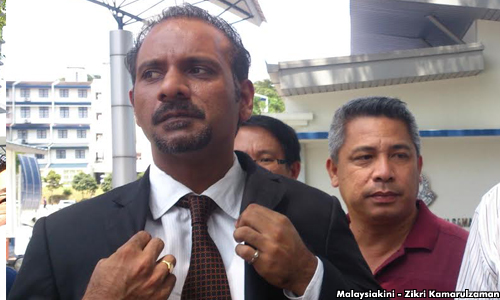 Ramkarpal (photo) also noted that the forced confession of an accused can be accepted in the court as evidence, which is not a practice now.
He also voiced his concern over an amendment which allows for a trial to continue in the absence of the accused and defence counsel.
The existing law is enough to deal with such situation when an accused absconds, Ramkarpal said.
"The accused may be given 'discharge not amounting to acquittal' (DNAA), and the trial can resume after rearrest," he added.
Kula pointed out that the public prosecutor may take over the role of investigator, judge and prosecutor as he will be allowed to appear in magistrate's court on remand hearing.
The three roles should remain separated, he said yesterday.
The CPC Bill was part of the 11 new and amended Bills that were tabled in 2013 to fight organised crimes.
It, together with Evidence (Amendment) Bill, were later withdrawn from the House following protest by lawmakers from both sides of the political divide.
Minister in the Prime Minister's Department Nancy Shukri tabled the Bill for the second reading or policy debate yesterday.


Report this comment
Are you sure you want to delete this comment?
This action cannot be undone.