



Above the din of spin - one-to-one fights not the magic potion?
COMMENT Liew Chin Tong is an intelligent man.
I remember many years ago, I think at a fun Chinese New Year party of another current DAP MP, he shared one of the most memorable, incisive things I’ve ever heard him say: “The first rule a politician must observe is, never fall for your own propaganda.”
The current DAP line he is espousing, echoed by Lim Kit Siang himself, is that one-to-one fights are not the ‘magic potion’ to defeat BN.
COMMENT Liew Chin Tong is an intelligent man.
I remember many years ago, I think at a fun Chinese New Year party of another current DAP MP, he shared one of the most memorable, incisive things I’ve ever heard him say: “The first rule a politician must observe is, never fall for your own propaganda.”
The current DAP line he is espousing, echoed by Lim Kit Siang himself, is that one-to-one fights are not the ‘magic potion’ to defeat BN.
The ‘good news’ of hearing this line being pushed out aggressively is that Harapan is likely feeling the heat and dissatisfaction of supporters after the results of the three-cornered by-elections.
The bad news of course is that once again, we are being taken for fools.
Liew uses a quote he (mistakenly) attributes to Einstein, about insanity being defined as doing something over and over again while expecting different results.
Presumably he means that some sort of one-to-one fight-based coalition has been formed again and again throughout Malaysian history to defeat BN, without success.
He perhaps forgets that the opposition splitting up (basically failing to stay together past a single failed election) and trying to take on BN separately has also been tried again and again without success.
The Amanah/MCA equivalency
A year and two weeks ago, I wrote a piece entitled: ‘PasMa to end up as Pakatan’s MCA?’
PasMa faded to be replaced by Amanah, but nevertheless, some of the statistics highlighted by journalist Nigel Aw in an incisive piece (that inspired me to write this one, despite the brickbats sure to be spammed), drive home this point.
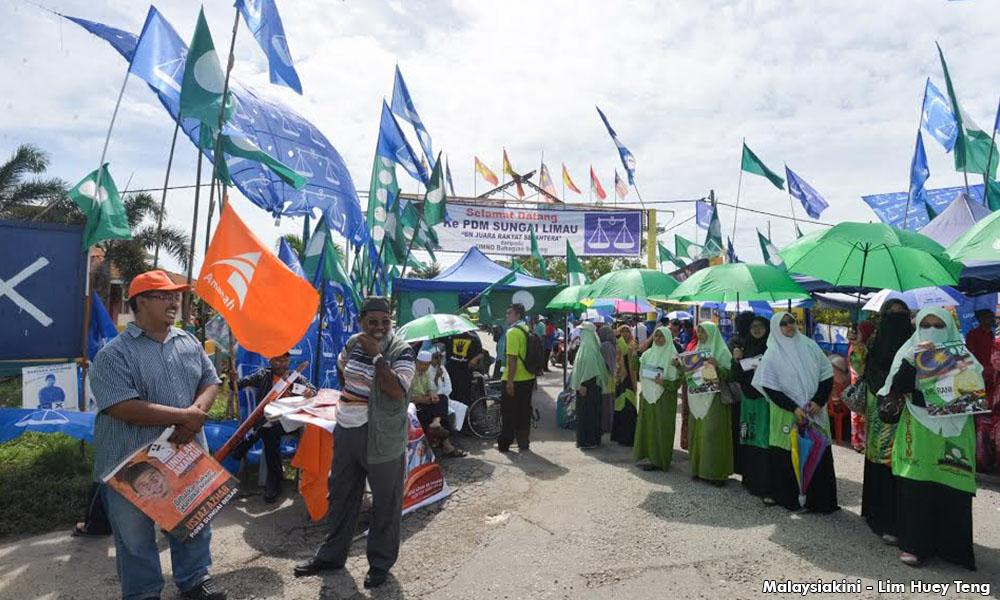
“In the Sungai Besar by-election, Amanah captured a meagre seven percent of votes in the polling district of Parit 13 Sungai Nipah compared to PAS’ 47.2 percent and BN’s 45.8 percent.
“This polling district is a litmus test for Amanah as it is one of the few Malay rural heartlands won by PAS in the last general election, where more than 90 percent of the voters are Malays.
“In the 13th general election, PAS won 52.4 percent of the votes compared to BN’s 47.6 percent in this polling district.
“Likewise, in Kuala Kangsar, Amanah polled 5.5 percent of the votes in the polling district of Kampong Mesjid, which also comprises more than 90 percent Malays.
PAS polled 44.6 percent of the votes while BN received 49.9 percent.”
The Lion/Mosquito dichotomy
Seven percent and 5.5 percent respectively, in rural Malay areas - the one demographic that has been the biggest obstacle to opposition victory.
Despite Mat Sabu’s boast, coming off the back of Amanah winning like a lion in Chinese majority areas, that they are “not a mosquito party”, they certainly seem to be a mosquito party in the areas that matter most.
I say this without malice or disrespect. I like many of the individuals in Amanah, but single digit results are single digit results.
The point of my piece last year is that Amanah/Harapan may end up in a situation like BN in recent elections, where MCA survives only by the grace of Umno delivering them Malay votes, while MCA themselves completely fail to deliver any substantial portion of Chinese votes.
This is why MCA is the butt of all our jokes.
A cursory analysis of the by-election results would suggest that the few thousand votes that Amanah got were from a largely non-Malay, urban base.
Aw is on the money when he says: “If Amanah is to rely on Chinese voters to achieve its so-called success against PAS, DAP may as well contest the election itself.”
So the question raised by this breakdown of the votes is: what value does Amanah add? Will they be perceived as a lackey, token representative party, just like MCA? How does this help the opposition where it needs the most help - in the rural Malay heartland?
The PAS/Umno confluency
The tough thing about writing about Malaysian politics nowadays it’s that it’s difficult to stay upbeat, positive and hopeful.
Circumstances and all around mule-headedness suggest that things will get worse before they get better (but they will get better eventually, I always believe).
By this point, even I am willing to admit that most of the top leaders currently in power in PAS seem to have strong Umno leanings. Perhaps deals have already been made, that will only come to light during the general election.
I highly doubt this pro-Umno sentiment is shared by the majority of PAS grassroots, or even all of the top leaders, but in a party like PAS, a lot of power is concentrated at the top of the pyramid.
I agree with Aw that the best would probably have been for the progressives to stay in PAS and fight on instead of splintering, but all that is spilt milk under the bridge.
The PAS/Amanah redundancy
One thing worth noting regarding long term strategy vis a vis PAS’ popularity among non-Malays, based on past results:
If (and this can be a big if) PAS is not going full extremist crazy in its statements and positions, a good number of Chinese will vote for whoever DAP tells them to vote for - be it PAS, Amanah, Ikatan, PSM, PCM, MIC, KEY, MOUSE, etc.
Then again, even if a hundred percent of the Chinese in Malaysia voted for who DAP told them to vote for, we would essentially be no closer to realising our goal of toppling BN. That is not hubris, that is simple electoral mathematics.
Politics is about the big picture. The general populace neither cares a great deal about, nor pays attention to details and spin - spin like “it’s not actually about the one-on-one fights”.
And the big picture is this: Is there a chance to topple BN or not?
The Din/Spin discrepancy
It is a truth, universally acknowledged, that three-cornered fights make replacing BN absolutely impossible. Thus, I don’t think anyone can be surprised at the low voter turnout and general apathy.
The director of PKR’s think-tank Ooi Heng at least has the grace to acknowledge this.
He alludes to another central, fundamental fact that rings clear above the din of spin - that opposition parties all around have elected to serve narrower interests closer to their base then focus on common ground to defeat BN.
In a playground fight, most kids know that parents or teachers aren’t interested or patient enough to find out ‘whose fault’ it is. If there’s any kind of fight at all, it’s everyone’s fault. The first priority is breaking up the fight.
Some will of course argue that one is the purely bad guy who started it, and the other the purely innocent good guy. Those arguing that back and forth can continue expanding all their sound and fury doing so, all the way through BN’s reclamation of a two thirds majority in the next general election.
The 2008/2016 disparity
I will go so far as to agree with DAP that one-to-one fights are not a magic bullet that will ensure or guarantee opposition victory.
That said, I am fairly certain that three- or more-cornered fights are BN’s magic bullet to ensure and guarantee an opposition loss and a BN win.
There is not much point in continuously flaying Harapan’s dead horse. The Harapan project may have made life more pleasant and convenient for DAP and PKR leaders, but it adds nothing to the fight against BN.
The reason Pakatan Rakyat post-2008 was such an exciting project was that it really spoke to the heart of what really ailed Malaysian politics.
Two of our biggest problems - corruption and racial division.
The Pakatan Rakyat formula, in bringing together PAS and DAP (of 2008) with a viable candidate for Prime Minister, was the best hope we for the bridge we needed most badly - one between rural Malay and urban non-Malay, united against a corrupt government.
That unity, more than anything else, gave us our best fighting chance to unseat BN Malaysia has ever seen.
Had we stayed united on that course, in a manner grounded in integrity, principles and the long view, we would have crushed Najib Abdul Razak’s 1MDB-ridden government long ago.
We elected not to, and now, the PAS and DAP of 2016 is now much more extreme, self-absorbed versions of their 2008 selves. Same individuals, different attitudes.
In the meantime, I am not foolish enough to suggest that going back to the exact Pakatan Rakyat formula of 2008 is the only way to go. It may well be too late for that now. That ship, it would appear, has sailed.
As to what other ships are on the horizon? My personal belief is that when we do defeat BN (not if), it will be because we have recreated the same unity that Pakatan Rakyat once claimed long ago - whether via old political players, or completely new ones.
NATHANIEL TAN wonders if anyone knows which TV show’s episode nomenclature served as inspiration in this article. He found these articles: here, here and here informative.


Are you sure you want to delete this comment?
This action cannot be undone.