




Non-Muslims air grouses at Islam Hadhari seminar
Participants attending a seminar conducted by the government-funded Institute of Islamic Understanding Malaysia (Ikim), aimed at enlightening non-Muslims on Islam Hadhari, had a field day questioning the 'new' Islamic principles today.
Participants attending a seminar conducted by the government-funded Institute of Islamic Understanding Malaysia (Ikim), aimed at enlightening non-Muslims on Islam Hadhari, had a field day questioning the 'new' Islamic principles today.
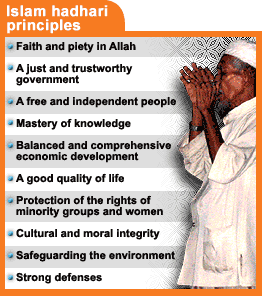
After listening to two papers, presented on Prime Minister Abdullah Ahmad Badawi's 10-principle Islam Hadhari , participants took the opportunity to constructively criticise it during the question-and-answer session.
Human Rights Commission of Malaysia (Suhakam) commissioner Ramon Navaratnam started the ball rolling by asking the panelists - two academics, Ikim's chairperson Ahmad Sarji Abdul Hamid and the premier's Islamic affairs advisor Abdul Hamid Othman - why only one of the 10 principles directly addressed the rights of non-Muslims.
 "As a Christian, I am concerned that out of the 10 principles, only one refers to the protection of the rights of minority groups. And that in itself is incorporated with protection of women's rights," said Ramon who said he was speaking in a personal capacity.
"I am concerned that this has been insufficiently taken into account and that there is a lapse between the (government) policies and its implementation. What monitoring systems are there to protect minorities?" he asked.
Ramon cited an example of how he has come to know of certain editions of the Bible that were not allowed into the country despite the premier's intervention. He also raised issues surrounding apostates in Malaysia.
Public funds
In Malaysia, the law restricts Muslims from leaving the religion or converting to other religions.
Ramon was among the 300-odd participants who attended the half-day seminar held at Ikim's centre in Kuala Lumpur. They were made up of primarily non-Muslims from various religious, government, non-governmental and political bodies.
G Vimalah Nair of the MIC followed up on the questions by commenting that despite Islam Hadhari's principles, which respect the equality and rights of women, it is not practised in reality.
 The panellists were then taken aback when V Harcharan Singh - Malaysian Consultative Council on Buddhism, Christianity, Hinduism and Sikhism president - questioned if the 'justice' preached in Islam Hadhari is being applied to all religions.
"Is it justifiable that public funds are spent on this seminar... and should it not be spent just on Islam but on all other religions as well? In a government elected by all races and religions in Malaysia, is it justified that emphasis is only given to Islam?" asked Harcharan.
Malaysia is a democratic secular state with Islam as its official religion.
The hard-hitting questions did not stop there as the Malaysia and Singapore chief Buddhist prelate K Sri Dhammananda Nayaka asked Ikim if it, in turn, planned to invite non-Muslims to talk to Muslims about their various religions in its seminars.
Pure Life Society President Mother A Mangalam rounded off the first set of questions when she asked if punishments accorded to criminals, such as whipping and the death penalty, were going to be maintained by the government and if they were addressed in Islam Hadhari.
Educate the people
Some of the questions were answered by Prof Mohd Kamal Hassan and Prof Mohammad Hashim Kamali, from the International Islamic University Malaysia (IIU), both of whom had earlier presented papers on Islam Hadhari principles.
However, they clarified that these were merely their personal interpretations and not an official response from the authorities and were not competent to answer questions on implementation.
"The focus for now is to educate and make people understand Islam Hadhari. My personal feeling is that the government is aware of these issues and must address these concerns," said Mohd Kamal.
"As for women's rights, there are many views and perspectives from Muslims and non-Muslims but as far as the religion is concerned, women are given deserved rights. The problem may lie with its implementation."
Prof Mohammad Hashim also responded by saying that the rights and concerns of non-Muslims are not just confined in one of the 10 principles but were incorporated in all as the values found in Islam Hadhari are non-partisan.
Ikim chairperson Ahmad Sarji however assured the participants that the seminar proceedings were documented and these questions and comments will be forwarded to the government, in particular to Minister in the Prime Minister's Department Abdullah Mohd Zin.
"As for other religious representatives being invited to speak at our seminars about (their) various religions, plans are being made and there will be avenues for that during the year," he said.
Ikim, a government funded non-profit organisation, has lined up numerous nationwide seminars on Islam Hadhari throughout the year. It is also conducting research on the 'conflicts between civil and syariah (Islamic) law'.
The panelists submitted that the principles in Islam Hadhari were not 'new' but an extension to existing Islamic principles. It is also in line with policies from the previous administration.


Report this comment
Are you sure you want to delete this comment?
This action cannot be undone.