
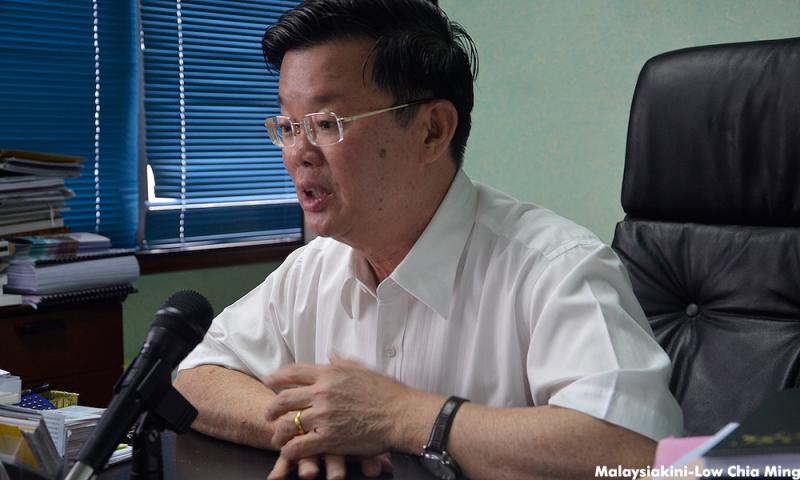
INTERVIEW State executive councillor Chow Kon Yeow has denied that his party DAP has made Penang a haven for developers, although concerned citizens and civil society have often made that observation.

Former Penang Island City Councillor from PAS, Iszuree Ibrahim, was sacked from his post after lamenting in the party’s muktamar that DAP should not follow in the footsteps of the BN prior to 2008, especially in cases involving eviction of villagers.

DAP leaders might find this irksome but with high-rise condominiums and hillslope developments mushrooming on the island, the DAP has often been labelled as “Developers Action Party” instead of Democratic Action Party.

Chow, who is seen as the person most likely to replace Chief Minister Lim Guan Eng if he is convicted and jailed for his two graft charges, said developers complain that the state has imposed many conditions on them.

“Many don't understand that while developers are out to complete their projects, they also lament that the state imposes a lot of conditions. They have to provide contributions and pay development charges that the state government puts to good use,” Chow said.

“These are used to build road infrastructure and refurbish markets and hawkers’ facilities,” he explained in an exclusive interview with Malaysiakini.

“Low-cost housing is also one of the obligations imposed on developers. Yes, they complete a lot of projects, but all these conditions are also imposed on them, so that the needs of society are taken care of,” added Chow, who has been Penang DAP chief since 2000.

Chow thinks the view that Penang is overdeveloped is merely a perception, although environmental and social activists would disagree.

“If you look at the terrain of Penang, especially on the island, there are restrictions on hill development, Chow noted.

“Although there had been some illegal hill clearing incidents, these were done by small time farmers. It is not because of government approval, except for a few carried out during the previous administration,” Chow said.

“So the hills are practically intact and the restriction of no development above 250m is still on. In the heritage areas, there cannot be much development, other than refurbishment of existing houses, and if there is new development, it will be limited to 18 metres,” he added.

Penang Transport Master Plan

Chow has been given the sole responsibility to implement the much-discussed RM27 billion Penang Transport Master Plan (TMP).

He is in charge of forming the Penang Transport Council, overseeing the Halcrow Report and the appointment of the TMP project delivery partner, SRS consortium.

The project, which involves buses, light rail transit systems, highways and an undersea tunnel linking the island with Butterworth on the mainland, has been criticised for its reclamation projects which involves some 4,000 acres on the southern post of the island.

The money derived from reclamation projects will be used to fund the massive TMP, which is slated for total completion in 2025.

“These are all under my portfolio (which covers local government, traffic management and flood mitigation). I work together with my team, but basically it is my baby,” Chow said, his face beaming with some pride.

Despite criticism that the TMP will move cars instead of people, contrary to suggestions in the Halcrow Report, Chow said the support level for public transport and LRT was high.

“It went as high as 80 over percent across racial lines,” he said.

He said his information was based on a recent poll conducted by market survey firm Merdeka Center.

“Of course, reclamation is an issue that we recognise, but we don't see any possibility of federal funding, “Chow said.

“As I have said so many times, if the federal government is able to come in to support this project, I think we are more than happy to let them take over and implement it for the people of Penang,” he added.

Asked if there were no other financial models other than reclamation, Chow replied: “If you take a bank loan, you still have to pay. So where do you get the money?”

He said even the Penang Forum, which had unveiled its “Better, Cheaper and Faster Transport Master Plan” was not able to propose an alternative financing model.

“This is something we need to recognise. Reclamation is being carried out in many parts of the world, if carried out according to high environmental standards, it is an opportunity to change the landscape (for the better).

“Civil society may question and say that reclamation itself is not environmentally friendly, or green, but as a result of that, the island may be green again,” he added.

Q and A session with Chow

Question: Policy-wise, in two past state legislative assemby sittings (in November 2015 and March 2016), reclamation became an issue, with the potential of spliting Pakatan Harapan. Last year, five PKR assemblypersons created waves when they abstained from voting on the Umno motion to halt the reclamation project. Your say?

Chow: PKR needs to address these issues because PKR representatives in government are supportive of government policies but their representatives outside the state government have different views. In the party, there needs to be a consensus as to what they represent.

Q: So are you saying this is a PKR problem?

Chow: They have to come to a consensus. In a party, there cannot be two stands.

Q: Don’t you think that the action taken on two out of the five PKR representatives, where they were sacked by Chief Minister Lim Guan Eng from their posts in government-linked companies, and replaced by DAP leaders Tony Pua and Anthony Loke, a bit harsh? Would you have done the same thing?

Chow: As a coalition government, we need every vote when facing an opposition motion, which is why we wonder why PKR had two stands - those inside the state government, support, and those outside, oppose. This is a question PKR needs to address.

Q: They (the PKR five) didn’t support the Umno motion on reclamation the way DAP Tanjung Bungah assemblyperson Teh Yee Cheu did (he voted for the motion and later withdrew it). The PKR reps only abstained from voting. Why don’t you allow differing views in the state assembly?

Chow: In the pre-council meeting, there was no alternative view to this regard, and all of a sudden, there is this planned move, not an impromptu one by an individual. Yet they are unable to name the national leader who directed them. Until today, they have avoided this issue altogether.

Q: If you were the CM, would you allow some democratic space especially in the state assembly, for assemblypersons to express themselves, even to abstain or vote for a motion, and not take harsh action against them the way Guan Eng did?

Chow: For the past eight years, you have seen a lot of space given to all, including the opposition assemblypersons to voice out their views. There has been no restriction to freedom of speech in the state assembly, but we recognise that, as a government, we are a team.

We will go in as Pakatan Harapan, and any dispute, disagreement, or dissension should be done outside. But once we step in to take a vote, there should be one stand - that is a principle we need to uphold.

Q: Being a social democratic party, has DAP done enough to promote social justice in Penang? Do you agree that state government policies tend to favour the elite more?

Chow: I think the BN government of Penang, or any BN government of other states, has not done as many social programmes as the Pakatan government in Penang.

Our Gini coefficient suggests that the disparity between rich and poor has improved. We are the only state that sees the closing of this disparity, and it is because of the many social programmes carried out.

In housing, we still maintain the quota for developers to deliver 30 percent of their housing units, in the form of low-cost or low-medium cost units.

We will not approve any plan until the squatters are resettled. This can be by cash compensation, or they are provided units within their projects after completion.

It is definitely not fair to say that we do not take care of the masses. The elite constitute a very small portion of society. The masses are the real vote banks for DAP and Pakatan. Note that we were able to increase our majority in the 2013 general election.

Related stories:

Why only Chinese chief ministers for Penang?

Chow: Don't be held to ransom by three-cornered fights, face it

Chow - from Lim's shadow to 'natural choice' for CM