




For child victims, muddled lines between love and sex abuse
SPECIAL REPORT | Patricia could feel her father's eyes on her as she walked to the bathroom. The feeling was not strange; for her, it was routine.
Her father has been watching her bathe since her mother passed away when she was eight years old. The bathroom door would be kept wide open.
In some ways, Patricia (not her real name) believed it was because her father was concerned for her safety. Her mother had died from injuries sustained after a fall in the bathroom. The incident shattered their peaceful life.
When she turned 15, Patricia fell in love and the young couple started intimate relations. This was when she questioned her father’s actions of continuing to watch her bathe.
Patricia was one of the victims counselled by Protect and Save the Children, a child rights advocacy organisation.
“The teenage girl didn’t know that this was not appropriate until she went into a relationship. The boundary is blurred,” said Protect and Save the Children founder Madeleine Yong...
SPECIAL REPORT | Patricia could feel her father's eyes on her as she walked to the bathroom. The feeling was not strange; for her, it was routine.
Her father has been watching her bathe since her mother passed away when she was eight years old. The bathroom door would be kept wide open.
In some ways, Patricia (not her real name) believed it was because her father was concerned for her safety. Her mother had died from injuries sustained after a fall in the bathroom. The incident shattered their peaceful life.
When she turned 15, Patricia fell in love and the young couple started intimate relations. This was when she questioned her father’s actions of continuing to watch her bathe.
Patricia was one of the victims counselled by Protect and Save the Children, a child rights advocacy organisation.
“The teenage girl didn’t know that this was not appropriate until she went into a relationship. The boundary is blurred,” said Protect and Save the Children founder Madeleine Yong.
Emotional needs
Yong (photo) said the offenders usually fulfil the emotional needs of a child. This create muddled lines in the interaction between the victims and the abusers.
 “What young victims have in their minds is, ‘In order for me to get love, I need to have sex’. They won’t know (better). Certain people think sex is love, and they will constantly use sex to woo the offender,” she added.
The offenders are usually family members or someone the victim trusts, fudging the boundaries further.
Children also have difficulties discerning between abuse and love because of the lack of sex education, said Yong.
No obvious characteristics
Often, there are no clear characteristics to identify if a person is dangerous or safe.
Yong said there have been examples of priests or imams abusing children in places of worship.
In one case, Yong said a seven-year-old girl was taken by a neighbour to a mosque and abused.
“It was so bad that it tore her anus and vagina. She underwent surgery. For one year, she had to carry a colostomy bag,” she said.
A colostomy bag collects body waste following an operation to bypass the colon as it was too painful to defecate.
According to Yong, the offender dropped her off after the abuse and left her to bleed on the roadside.
But for several months, the offender continued to be around the girl, milling around in the neighbourhood, sipping tea at the nearby stall.
He absconded after the victims’ parents lodged a police report. He was never found and never convicted.
Trusted individuals
According to Protect and Save the Children programme coordinator Vijaya Baskar, almost all child sexual abuses are perpetrated by someone the children trust.
None of the children counselled by the organisation said they hate their offenders.
“None said ‘I want him go jail’. Mostly, they will say, ‘I want him to stop’,” Vijaya said.
Children also feel the need to protect the reputation of their offenders.
In one case, Yong said, the victim did not go to the police because her father, who was abusing her, is a well-known lecturer.
According to a 2004 research published by the United Nations Asia and Far East Institute, 109 out of 158 recorded child abuse cases, or more than two-thirds, involved abusers the children know.
Of the 109 cases, the research found 37 reported child abuse cases were perpetrated by the father.
In 30 cases, the mother was the perpetrator, 24 perpetrators were guardians and 15 were step-parents.
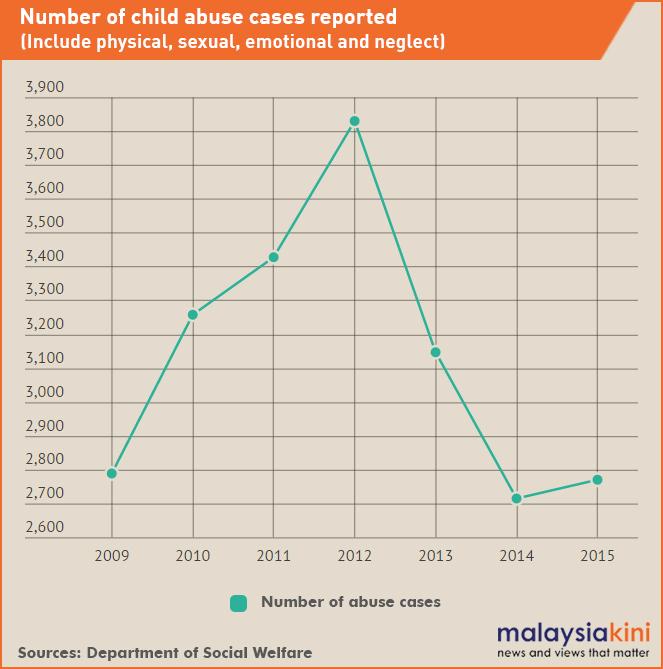
According to the Department of Social Welfare, 2,770 child abuse cases were reported in the year 2015, which is a slight increase from the 2,716 cases in 2014.
No physical signs of abuse
Dr Zahilah Filzah Zulkifli of the Malaysian Advocate of Children’s Health said that in her experience, many of the victims brought to hospital for sex abuse had been victims for years.
 In many cases, Zahilah said, the children showed no physical signs of abuse.
This was because the abuses were not limited to anal or vaginal penetration. These also include oral sex, showing child pornography, molesting and “talking dirty” to the child.
“You have got to remember that in 80 percent of the child sexual abuse cases, the (medical examination) finding is ‘normal’,” she said.
“That is why, in the court of law, what is more important is not that. It is effectiveness and the consistency of the child abuse report.”
Zahilah said the process of obtaining justice for the child is often seen by child advocates as traumatising.
But this was necessary in order to keep perpetrators off the streets and the children safe, she said.
“When abuse happens somewhere else, the police will bring the child to the crime scene. You think she wants to go there again? Won’t she be traumatised? But if you want the child to get justice, this is how to system works,” Zahilah said.
Unwitting victims
Yong said the non-offending parents or guardians are also victims and struggle with their own psychological traumas.
“We do therapy. The children act out or express their emotions through a play. Working with the child is easier than working with the non-offending parent,” she said.
“The (non-offending) parents are really stressed out and we need to work with them so that they can support the child.
“The most difficult ones are when there is sexual abuse and divorce.”
Part 1: For child victims, muddled line between love and sex abuse
Part 2: What happens when the sex offender is a child?
Part 3: Once a sex offender, always a sex offender?


Report this comment
Are you sure you want to delete this comment?
This action cannot be undone.