


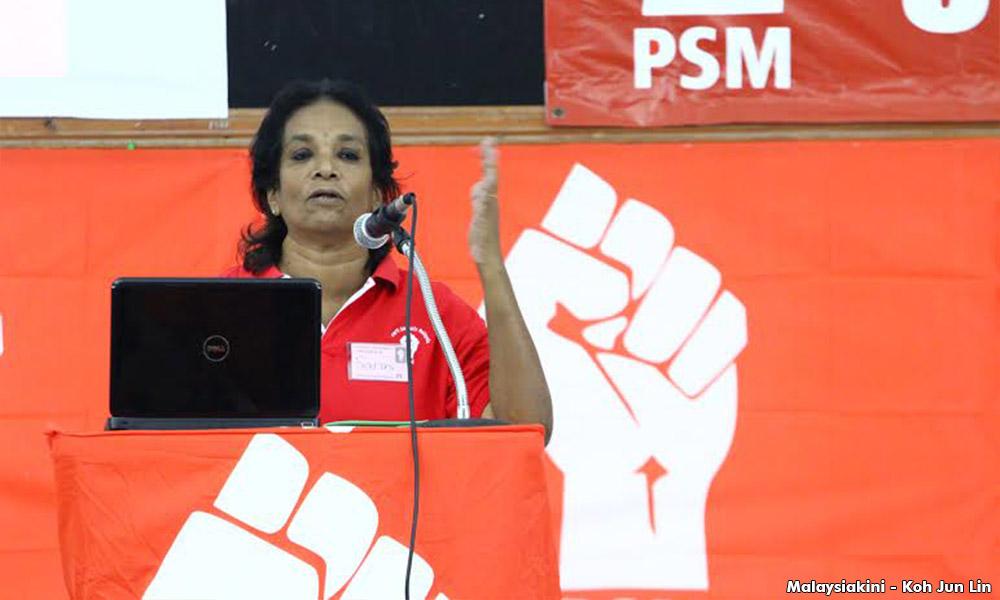

Struck with hot steel, jailed under EO, PSM's Saras defines resilience
MALAYSIANS KINI In a dilapidated office in Jelapang, Ipoh, M Sarasvathy spoke in the dark. The electricity had failed in the midst of a late afternoon thunderstorm; waning sunlight filtered through the windows, barely illuminating the room, which covered wall to wall with campaign posters.
On one wall, Hugo Chavez smiles in a printout of a picture from 2009, when Saraswathy met the socialist giant in Venezuela.
“He was talking about people, people, people,” the PSM vice-chairperson recalled excitedly.
MALAYSIANS KINI In a dilapidated office in Jelapang, Ipoh, M Sarasvathy spoke in the dark. The electricity had failed in the midst of a late afternoon thunderstorm; waning sunlight filtered through the windows, barely illuminating the room, which was covered wall to wall with campaign posters.
On one wall, Hugo Chavez smiles in a printout of a picture from 2009, when Saraswathy met the socialist giant in Venezuela.
“He was talking about people, people, people,” the PSM vice-chairperson recalled excitedly.
On the other side of the room, a blackboard lists the names of volunteers at the service centre. Next to each name is a sum - RM20, RM30 - the amount they contributed to the upkeep of the centre that month.
This centre runs completely on donations, and even the political activist of 31 years survives on the goodwill of her family, after quitting her job as a medical lab technologist in 1985 to dedicate her time to activism.
These days, her family is supportive of her work, but a five centimetre scar on her arm is a reminder of more difficult times.
“My uncle said women should not go out, and just stay at home, and he put a hot iron steel on my hand to stop me. The scar remains till now - I am 62. I was retaliating against the family,” she said.
The Malaysian public got a glimpse of that defiant streak in 2011, when Saraswathy and five others were arrested under the now repealed Emergency Ordinance when PSM was in the midst of a nationwide campaign calling for Umno’s ouster.
Since this campaign coincided with the Bersih 2 rally, Sarasvathy and others were detained under the EO under suspicion that they were the rally's organisers.
Press photographs of her arrest show her surrounded by supporters, raising her handcuffed hands in defiance.
They were arrested for 34 days and were questioned if they were communists.
“This shows how stupid the government is,” said Sarasvathy.
“Their minds are still closed whenever they encounter leftist activists and label them communists, without understanding the difference between the governance of socialism and communism.”
This is her story in her own words:
MY FAMILY IS VERY ORTHODOX. I have eight siblings, only two girls. Father was good, but mother was strict. I read books by many Tamil progressive writers, and that’s how I learned about society, its problems.
That triggered me. It enlightened me and made me realise being rich and poor is not God-given. I did my analysis on why people are suffering and the cruelty by the oppressors.
IF I WENT HOME AT NIGHT AFTER MY MEETINGS, I WOULD BE STRUCK WITH A HOT IRON ROD. There was one day my uncle said women should not go out and just stay at home and he put a hot iron steel on my hand to stop me. The scar remains till now - I am 62. I was retaliating against the family. I was doing my part, I was doing the right thing and that made me stronger.
DURING SCHOOL I was involved in the benevolence society, where we were taught to collect recyclable items to sell and use the income to help the needy students in our school.
Later in my teens I joined the Young Christian Workers Movement (YCW). The YCW was an international movement fighting for workers’ rights. We assisted in forming unions to fight for their rights. We fought against oppressive working conditions and studied in detail the labour value theory to identify why workers’ wages were low.
MY FATHER PLAYED A SUPPORTIVE ROLE. He was a unionist working as a hospital medical assistant. “You must go out and understand the world. You must fight for the people,” he said.
I SPENT TWO YEARS IN A GARMENT FACTORY. There I started to understand exploitation, how capitalists exploit the workers. We formed a union in 1982. It was a multiracial union and within a year we were able to unionise around 3,000 workers.
Following that, we went to many other factories to organise the workers. We successfully held several demonstrations demanding for equal pay rights. It was the high peak of activism.
I MET DR MICHAEL JEYAKUMAR DEVARAJ in 1986 at a childcare education programme. YCW in the 1980s focused on activities for the rural and urban poor. Dr Kumar (now PSM’s Sungai Siput MP) and (his wife) Rani were actively carrying out education classes for five estates in Sungai Siput through their University Tamil Language Society.
THE ESTATES IN PERAK FACED PROBLEMS of electricity and water. They provided basic amenities only for certain hours. The water was so dirty; they got it from rivers and wells and pumped it to the people. The houses were like cowsheds.
In 1990 we started Alaigal, a Perak-based NGO. There was an urgent need to advocate for better amenities for estate workers. At that time we met with other like-minded groups working with estate workers, like the Community Development Centre (CDC) in Kajang.
Both Alaigal and CDC started a rural development program, a national campaign where we demanded that plantations be placed under the rural development ministry, and get proper facilities like other rural areas, such as access roads to the estates, 24 hours a day electricity, proper housing and education.
AS THE CAMPAIGN GAINED STEAM NATIONWIDE, we further collaborated with another grassroots movement called SWP (Suara Warga Pertiwi). SWP was actively fighting urban pioneer issues.
Together we organised a historical demonstration in May, 1994 at Dataran Merdeka. It was after 20 years of no demonstrations in Malaysian history.
THERE WAS MUCH DEBATE BETWEEN ACTIVISTS around 1996 and 1997 on whether a socialist party should be formed. We felt that as long there is exploitation, socialism is relevant and thus we braved ourselves to form the Parti Sosialis Malaysia to safeguard humanity and the environment.
ONE OF THE MOST UNFORGETTABLE EXPERIENCES - I won’t put it as a happy or sad, but it was really ‘brain-storming’, ‘brain-reflecting’. In 2011, six of us were arrested under the Emergency Ordinance.
Under the EO, in 2011, sometime in July, they interrogated us for 34 days. We were placed in separate cells. Every morning they covered our eyes and took us to a room and started asking all sorts of questions for five to six hours.
THEY ACCUSED ME OF BEING A COMMUNIST. I was surprised as we were talking about human rights, sharing the resources of the country. Is it communism? I was laughing, in fact, at how narrow-minded they were.
This showed how stupid the government is. That their minds are still closed whenever they encounter leftist activists and label them communists, without understanding the difference between the governance of socialism and communism.
THEY DON’T READ ANYTHING. This made me realise they want to crack down just for their own interests. They can use any kind of argument to crack down on a movement or a party. It helped me gain a better understanding. Once I was released, I became more active. My energy had gotten a boost – it is all false; nothing was true.
THE POLITICAL SITUATION IN THE COUNTRY is that people see only the main opposition parties. They don’t take us (PSM) as being part of the opposition because we don’t behave like a typical party – trying to do popular things to get votes.
We believe in empowering the people and it takes time for people to understand. Our politics are from the grassroots, from below, and we are teaching a new brand of politics that will make the people participate and not just be an audience.
PEOPLE HAVE TO DEMAND. People have to participate and know what is right and wrong. This is the newer politics that we are teaching. It takes people some time to understand. It is not our failure. It is transparent. We are talking about justice, we are talking about a simple way of life.
WE TALK ABOUT SHARING THE WEALTH IN THE COUNTRY. We can be free, no need to be oppressed by the ruling class. You must serve your constitution. We do talks on the issues of the people. We face problems like no free education, no free healthcare, housing, no more affordable living costs.
PEOPLE HAVE TO EXPERIENCE AND LEARN WHAT IS WRONG AND WHAT IS RIGHT. There is a big iron factory in Lumut. They are cutting down the mangrove trees there. In Pahang, people didn’t question the Lynas issue. On the issue of TPPA, we become another slave to America.
So now we are educating the people. Don’t just trust (the authorities), you have to bring the issues out. You must reach the people. They have to stop GST, but you can’t do anything if you don’t have the people’s power. We are teaching this kind of newer politics.
MALAYSIANS KINI is a series on Malaysians you should know.
Previously featured:
Meet Anis Syafiqah, the ordinary student who wants to catch MO1
How one Malaysian bagged seven journalism awards in the US
Beat me on the track, Supermoto champ Husna tells haters
How arguing on drying laundry led to Science Cafe KL
Bringing student activism to Malaysians abroad
Ramli Ibrahim has a reason to dance for joy
Denounced by relatives, ex-engineer battles for indigenous Sarawakians


Are you sure you want to delete this comment?
This action cannot be undone.