




The lawyer who stands up for Orang Asli
Despite a blockade set up by the Orang Asli to prevent logs from being taken out from their Balah forest reserve in Gua Musang, the Kelantan state government has continued to defend logging in the area.
Kelantan Menteri Besar Ahmad Yakob was reported earlier this month arguing there was no reason for the state government to stop the logging since it was approved by the state.
However, lawyer and activist Siti Kasim told a forum on the predicament of the Orang Asli that there were other more sustainable ways of logging.
And oil palm planting is definitely not one of them as such trees are unable to hold in water, she pointed out.
“That’s why the environment is affected,” said Siti, who was one of the panellists in last night’s forum held at the Kuala Lumpur Selangor Chinese Assembly Hall (KLSCAH).
Commenting on the blockade, Siti said two police reports have since been lodged against her.
“I was surprised why there were police reports lodged against me - they say I’m the one who organised the blockade.”
According to her, there was a need to find a scapegoat in the clash as the Kelantan government was trying to cover up its mistakes.
“The blockade was not my idea. I went in as a lawyer; I have been going into (Orang Asli areas) for a couple of years, explaining (to them) their rights.
“If they call me an instigator because I explain the rights of the Orang Asli, (then) I’m proud of being called an instigator,” she said...
Despite a blockade set up by the Orang Asli to prevent logs from being taken out from their Balah forest reserve in Gua Musang, the Kelantan state government has continued to defend logging in the area.
Kelantan Menteri Besar Ahmad Yakob was reported earlier this month arguing there was no reason for the state government to stop the logging since it was approved by the state.
However, lawyer and activist Siti Kasim told a forum on the predicament of the Orang Asli that there were other more sustainable ways of logging.
And oil palm planting is definitely not one of them as such trees are unable to hold in water, she pointed out.
“That’s why the environment is affected,” said Siti, who was one of the panellists in last night’s forum held at the Kuala Lumpur Selangor Chinese Assembly Hall (KLSCAH).
Commenting on the blockade, Siti said two police reports have since been lodged against her.
“I was surprised why there were police reports lodged against me - they say I’m the one who organised the blockade.”
According to her, there was a need to find a scapegoat in the clash as the Kelantan government was trying to cover up its mistakes.
“The blockade was not my idea. I went in as a lawyer; I have been going into (Orang Asli areas) for a couple of years, explaining (to them) their rights.
“If they call me an instigator because I explain the rights of the Orang Asli, (then) I’m proud of being called an instigator,” she said.
Orang Asli villagers, last month, had erected a blockade to prevent logs from leaving the affected area. However, the blockade was reportedly disrupted by "thugs".
The Orang Asli are seeking to stop logging activities as they claim that deforestation is affecting their water and food sources.
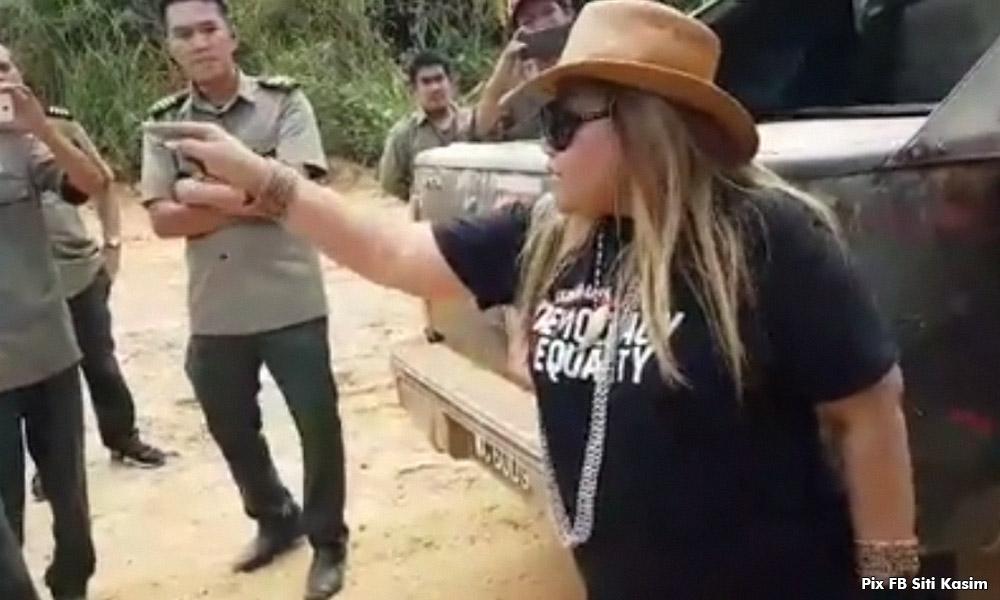 Siti was herself barred by officers of the Forestry Department from sending food and supplies to her clients in the Pos Tohoi Orang Asli settlement two weeks ago.
Commenting further on the blockade, Siti said the Orang Asli did not become “violent” all of a sudden.
“They have been writing to the state government God knows how many letters, had a demonstration in front of the state legislative assembly building.
“(With) logging getting worse and not even one letter of reply, so what do you expect the Orang Asli to do?”
‘We’re losing our natives’
On the state government stating that it would meet with the local Orang Asli community to discuss the stand-off, Siti however claimed that no one from the state government had done so.
“Not one came to meet the Orang Asli. Instead, they had a meeting with the Department of Orang Asli Development (Jakoa).
“Jakoa is not Orang Asli, they are just working for the Orang Asli,” she pointed out.
Meanwhile, Siti also lamented the lack of proper recognition when it comes to the ancestral lands of the Orang Asli in Peninsular Malaysia.
“In the Peninsular, their rights are not really mentioned in terms of ancestral land.
“Act 134 (Aboriginal Peoples Act) says everything about the life of the Orang Asli but nothing about their land rights,” she said.
Siti is of the opinion that there should be clearer laws with regard to the Orang Asli in terms of land rights and called for the overhaul of Act 134.
“Act 134 is useless; it should be abolished. It should be used to protect the Orang Asli but it has instead been used by Jakoa for their own purpose - to control the Orang Asli, to keep them stupid and ignorant,” she said.
Hitting out further at Jakoa, Siti stressed for there to be a proper audit when it comes to money allocated for the development of the Orang Asli.
“I don’t see improvement in the lives of the Orang Asli. RM100 million given to Jakoa to manage, but I don’t see development,” she said.
Siti also warned on the rapid decrease in the population of Orang Asli, stating that there was currently only some 180,000 left in the Peninsular.
“Many tribes are already obsolete […] We are losing our natives, we need to do something to protect their existence,” she stressed.
Meanwhile, fellow panellist social activist Ong Boon Keong believes the best way to know more about the Orang Asli and the Orang Asal was to pay a visit to their community.
“Which is so simple. Malaysians travel a lot, to many countries, but have they been to Sabah and Sarawak?
“I encourage people to make visits to the interiors and see for themselves. You don’t have to wait for blockades.
“When you visit the interior community, you can learn a lot of skills from them, and the not-so-stressful lifestyle that we can aspire towards,” he said.


