


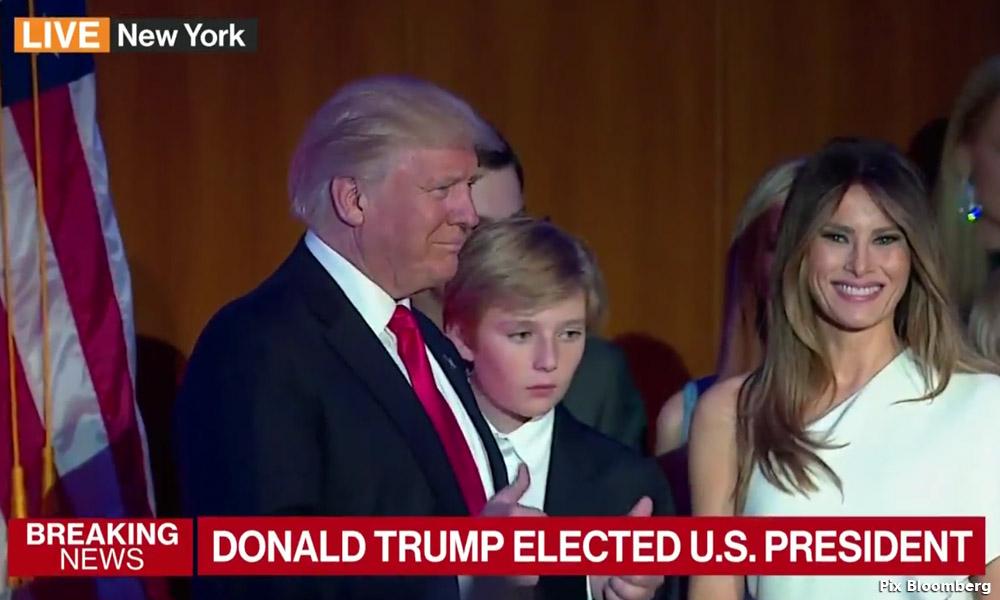

The secrets to Trump’s shock victory
COMMENT Donald Trump wins. My wife puts it best: “We live in the Age of The Kardashians. As long as you can create enough hoopla as a one-man circus, you can make it.”
For some reason, she also always refers to Trump’s "locker room" comments as “catch the kitty”, and seems to think that anything to do with cats always wins.
On more serious notes, let’s speculate and reflect on how Trump won, and what we might learn from this debacle.
Repeating Bush’s victory conditions
My view is that Trump won in circumstances similar to those which propelled George W Bush to victory in 2004.
These men share a number of similarities. They were widely denounced around the world as idiots, they ran a campaign amidst a backdrop of global terrorism, and they faced rather placid, uninspiring Democratic nominees.
Bush’s chief strategist was Karl Rove, and he had a devastatingly simple approach for 2004.
He said: Look, there are millions of right-leaning Americans out there who aren’t voting. Forget compassionate conservatism and centrism, swing hard to the right, inspire right-leaning Americans to come out and vote (when they usually don’t), overwhelm the opposition.
This ended up working beautifully. Rampant fear-mongering, and positioning Bush as a decisive, hawkish leader opposed to John Kerry’s flip-flopping weakness led to a resounding electoral success - while the rest of the world watched on, dumbfounded.
Twelve years later, we appear to be experiencing very similar disbelief and shock - and likely for very similar reasons.
Voter turnout appears to be reaching record highs this year, suggesting that Trump has somehow inspired a lot of people who don’t usually follow politics to come out and vote for him.
Political messaging - the simpler the better
My guess is that inspiration stemmed from simple political messages. I’d bet that for voters the world over, the primary reason for voting for one candidate or another can be summarised in less than three sentences at most.
The results suggest that Trump’s message that foreigners were ruining America for (mostly white) Americans because of weak leadership struck a simple chord, and gave people a convenient outsider to scapegoat - which is always easier than looking inwards.
Combined with rampant fear-mongering and the IS bogeyman, Trump likely succeeded in selling the story that he was the best candidate available to protect America against the many threats it apparently faced. Indeed, terrorism is in some ways the Republican party’s best friend.
Trump’s anti-establishment attacks probably also resonated, especially against Hillary Clinton’s epitomisation of the established, entrenched and privileged political elite. Bernie Sanders would have likely fared better in this regard, but it’s hard to say whether that would have been enough to beat Trump.
Trump’s criticisms of the establishment were not entirely off point either. The old lumbering structures have developed over time (and not just in America either) to favour incumbents, and to encourage keeping power in the hands of an elite club. Sanders’ defeat is a case in point.
We also cannot discount the possibility that many Americans might not have been ready to vote for a woman president.
Twitter no, nuclear weapons, yes
Whatever the reasons, most people with any progressive leanings are reeling from the results.
Nobody seemed to believe Trump could win. Clinton was already shifting her focus from the traditional swing states and targeting traditionally Republican states in anticipation of some sort of landslide victory.
Even Trump seemed to run out of steam the last couple of weeks, making comments that seemed to lay the ground for post-defeat strategies.
With the votes being counted though, it seems that America’s nuclear arsenal is now being put in the control of a man whose own staff couldn’t trust with a Twitter account.
Global fallout
The global implications of this election are scary indeed. It sounds like Vladimir Putin will be delighted to have an American president that admires him, and around whom Putin can probably run circles.
It feels like it’s been a season of swinging to the right. Britain votes out of the European Union, fueled by sentiment similar to those espoused by Trump. Rodrigo Duterte is voted into power in the Philippines; called by some the Trump of Asia, he promptly abandons traditional ally America in favour of authoritarian China (and Najib Abdul Razak soon follows suit).
Trump isn’t likely to be someone who truly respects human rights, and probably has more in common with dictators than American presidents of the last century. What scary things these portend for global geopolitics only time will really tell; so far, crashing global markets have expressed their opinion in no uncertain terms.
Perhaps there are some things we can learn from this locally as well.
Exiting our urban bubbles
The most obvious lesson is not to be overconfident of course.
Another lesson is to never let our urban bubble prevent us from understanding a demographic as a whole.
The media made it look like the entire world (understandably) thought of Trump as a buffoon. This was probably largely true of many urban Americans; but urban Americans and the America the media imagines (or rather sells to) don’t decide elections.
Malaysia has a similar significant urban/rural divide. All major urban areas have solidly voted opposition in recent elections, but Barisan Nasional remains firmly in power off the back of rural support.
It’s an area and a (much less visible) demographic that the opposition truly does not understand well, and surrounding oneself with like minded urbanites is unlikely to change this status quo. As an aside, this is also probably the reason PAS’ relevance will be unlikely to diminish anytime soon.
The third-party effect
Worth noting as well is the effect of third-party candidates. After Trump and Clinton, the two most significant candidates for president were Libertarian Party nominee Gary Johnson and Green Party nominee Jill Stein.
At at least one point in the night, Johnson and Stein were having a visible effect on the elections. Their combined number of votes at that point in Florida and Michigan - key battleground states - were double that of the difference between Trump and Clinton.
This means that if (a very big hypothetical of course) those individuals voted for Clinton instead of Trump, there’s a good chance the election would have gone to Clinton instead.
As our next general election approaches, I think it is safe to say that three-corner fights will almost certainly result in BN victories.
This is not to say that we should blindly support whichever Pakatan we still believe in. I believe that in the long run, our best hope lies in a movement which does not really exist yet.
In the meantime, while it is foolhardy to say that one on one fights will guarantee victory against BN, I think it is equally foolhardy to imagine that three (or more) corner fights will produce anything but a BN victory.
Bridging gaps
It’s easy to rant and rave about how America will truly elect any idiot whatsoever President.
In the end though, if we don’t want to continue living these realities, we really have to move out of our comfort zones, stretch out our imagination and really develop better respect for those who live far away from us, watch different TV shows, and vote differently.
Only then can we start bridging the gaps we need to in order to make our aspirations come true.
NATHANIEL TAN has only ever caught actual kitties; never metaphorical ones.


Report this comment
Are you sure you want to delete this comment?
This action cannot be undone.