



The exploitation of school cleaners and guards
LABOUR DAY | As the ringing bell reverberates across the hall, students begin emptying out from classrooms, boisterously celebrating the end of the school day.
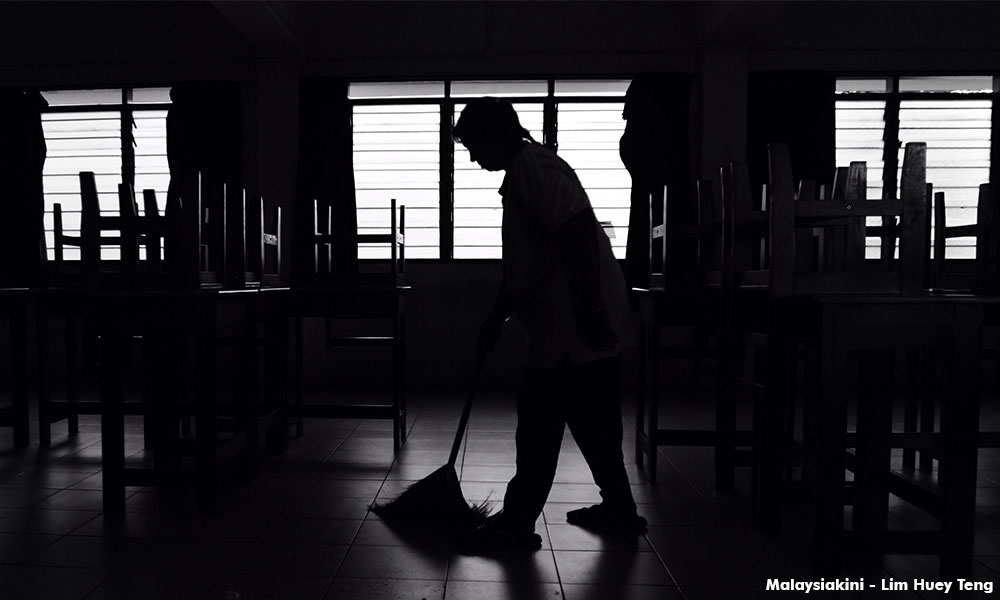
They run past Katie, who is headed in the opposite direction, carrying a bucket, mop, and other cleaning tools. Few acknowledge her on their way out.
Katie starts her routine of cleaning the row of classrooms but is startled by the sudden rumbling of thunder.
She quickly drops her tools and dashes downstairs to the drains, making sure that they are not clogged, to avoid flooding.
 As the sky opens up, rain blankets the school, including its beautiful garden of giant sunflowers and colourful bougainvilleas - courtesy of Katie's tireless gardening efforts every morning before she unlocks the classrooms.
Katie also cleans the school toilets and teachers' office. On some days, if she has enough time, she sees off the students at the gates to ensure they are safe.
For all her efforts to ensure the school is comfortable and safe for the children, she gets a measly RM1,000 as salary, which is the national minimum wage. Her net income is RM900 after deductions.
No safety net
Unlike the past, Katie does not enjoy the welfare benefits of a civil servant as a school cleaner.
This is because the service of cleaners and security guards at schools has been privatised, and people like Katie are now considered as employees of labour companies.
With private contractors acting as middlemen between schools and cleaners, these workers have been made vulnerable to exploitation.
One such example was in 2015, when 24 cleaners at seven government schools in Ipoh were reportedly unpaid between May to December that year after their contractor Time Medi Enterprise filed for bankruptcy.
Katie, who asked not be be identified by her real name, was one of the 24 cleaners who have yet to receive their wages, which are an estimated total of RM150,000.
"If you work for a eight months without getting any salary, what would you do? How can you survive?" she told Malaysiakini outside the school where she works in Ipoh...
LABOUR DAY | As the ringing bell reverberates across the hall, students begin emptying out from classrooms, boisterously celebrating the end of the school day.
They run past Katie, who is headed in the opposite direction, carrying a bucket, mop, and other cleaning tools. Few acknowledge her on their way out.
Katie starts her routine of cleaning the row of classrooms but is startled by the sudden rumbling of thunder.
She quickly drops her tools and dashes downstairs to the drains, making sure that they are not clogged, to avoid flooding.
As the sky opens up, rain blankets the school, including its beautiful garden of giant sunflowers and colourful bougainvilleas - courtesy of Katie's tireless gardening efforts every morning before she unlocks the classrooms.
Katie also cleans the school toilets and teachers' office. On some days, if she has enough time, she sees off the students at the gates to ensure they are safe.
For all her efforts to ensure the school is comfortable and safe for the children, she gets a measly RM1,000 as salary, which is the national minimum wage. Her net income is RM900 after deductions.
No safety net
Unlike the past, Katie does not enjoy the welfare benefits of a civil servant as a school cleaner.
This is because the service of cleaners and security guards at schools has been privatised, and people like Katie are now considered as employees of labour companies.
With private contractors acting as middlemen between schools and cleaners, these workers have been made vulnerable to exploitation.
One such example was in 2015, when 24 cleaners at seven government schools in Ipoh were reportedly unpaid between May to December that year after their contractor Time Medi Enterprise filed for bankruptcy.
Katie, who asked not be be identified by her real name, was one of the 24 cleaners who have yet to receive their wages, which are an estimated total of RM150,000.
"If you work for a eight months without getting any salary, what would you do? How can you survive?" she told Malaysiakini outside the school where she works in Ipoh.
Katie said she had worked at the school for nine years but is now under the employment of a different company after Time Medi Enterprise went under in May 2015.
However, she has yet to receive RM7,200 in wages owed by Time Medi Enterprise.
The long wait
Even though Time Medi Enterprise stopped paying wages in May 2015, the cleaners had continued working until the end of the year as there was no word about their fate from the Education Ministry.
It was only in January 2016 that the Education Ministry announced that Time Medi Enterprise's contract had been terminated.
With the help of Parti Sosialis Malaysia and Jaringan Pekerja Kontrak Kerajaan, the cleaners have made repeated appeals to the Education Ministry and Labour Department in 2015, but to no avail.
Today marks the second Labour Day that has gone by with Katie and 23 other cleaners still pursuing the arrears.
Apart from failing to pay wages, there have also been instances where contractors failed to make Employees Provident Fund (EPF) and Social Security Organisation (Socso) contributions towards their employees.
Loopholes and exploitation
A senior educator familiar with the contract system for cleaners and security guards in schools told Malaysiakini that it was open to abuse, and the exploitation of workers.
"The government will first call for a tender, then many labour contractors will come to the school to conduct a study.
"They will then bid for the contract. Normally, a single contract could cover more than 10 schools.
"But the tender procedure has loopholes... For example, the company may be located in Kuala Lumpur or Johor but still can win a project for schools in northern states," said the senior educator, who asked not to be named as he was not authorised to speak to the media.
He pointed out that some companies which won labour contracts from the government, usually worth a few hundred thousand ringgit, would later sell them to other companies.
Those companies, in turn, would also outsource certain functions to other companies.
"If any of the companies face financial problems or have improper management or file for bankruptcy, the ultimate victims are the cleaners who cannot get their salaries," he said.
Schools: Our hands are tied
A headmaster of a government school told Malaysiakini that there is little that schools can do with regard to the private contractors as they are appointed by the Education Ministry.
According to procedure, the Education Ministry will only disburse a monthly payment to contractors once the school submits a monthly report. The company will then use these funds to pay their workers' salaries.
"The report will cover the performance of the contractor such as whether they pay salaries on time or if there are any arrears salaries.
"The report will also cover the performance of the cleaners and security guards," said the headmaster, who also declined to be named.
Based on his experience, he said, the ministry will usually stop paying the contractors or will appoint a new contractor, upon receiving a report that contractors are not paying wages or if there are performance complaints.
"The ministry can also withhold the contractors' deposit once if there are problems and the deposit can then be used to pay the wages of cleaners and security guards," he said.
No remedy
As such, he questioned why the cleaners from the seven schools in Ipoh could not be paid when Time Medi Enterprise became bankrupt.
The cleaners, including Katie, had complained to the Kinta Utara District Education Department, the Perak State Education Department and the Education Ministry's Procurement and Asset Management Division.
In September last year, they protested at the Education Ministry's headquarters in Putrajaya to appeal for their unpaid salaries.
 Jaringan Pekerja Kontrak Kerajaan founder Rasiah Rani said the contract system meant the formal relationship was between workers and contractor, therefore they couldn't complain directly to the Education Ministry.
Instead, all complaints have to be directed to the Labour Department, which can issue directives, but has no enforcement powers.
"Hence the only way (to solve this issue) is to bring the case to the civil courts, but this takes time and can be a fruitless endeavour," said Rani.
Complicated web
In Time Medi Enterprise's case, Rani said that 15 cleaners had complained to Labour Department which paid them RM1,000 each, but it was not enough to compensate for their unpaid salaries.
She added that the case was further complicated by the fact that it also involved the Insolvency Department due to the company's bankruptcy.
According to a parliamentary written reply, the government stopped paying Time Medi Enterprise after May 2015. The company was declared bankrupt in July 2015 and its contract was terminated in November that year.
Rani said the Education Ministry, instead of disbursing the unpaid salaries from the payment which it had held back between June until December 2015 from Time Medi Enterprise, said it had sent the entire sum to the Insolvency Department.
"When we asked the Insolvency Department, the department told us that they only managed the property or financials of the Time Medi Enterprise before it went bankrupt, that is by the end of July, so where did the rest month's money go?" asked Rani.
The Education Ministry's Procurement and Asset Management Division of Education Ministry has yet to respond to Malaysiakini's request for comment.
'Abolish the contract system'
A resolution is unlikely to happen any time soon and many cleaners involved in the case have had to move on under a new company to make a living.
Among them is Kajah (not her real name), who is still owed seven months of salary.
However, even under a new contractor, things did not get any better.
 Kajah, having become more aware of her rights from the Time Medi Enterprise episode, said she had lodged a complaint when her new contractor was late in paying her EPF.
"I complained and they sacked me," she said.
The story of Katie and Kajah were not isolated incidences.
In June last year, 13 cleaners from three schools staged a protest outside the Education Ministry after they were not paid their wages for two months.
Contract security guards in schools have also faced similar issues, with a group from 10 schools around Hulu Langat complaining that they had yet to be paid their wages.
Rani urged the government to abolish the contract system and allow school cleaners and security guards to be hired as civil servants.
She said the system was exploitative as it lacked job security and welfare benefits with little prospect of salary increase and in some instances, no overtime pay, EPF or Socso.
She added that similar problems are afflicting cleaners and security guards in government hospitals which use a similar contract system.
People such as Katie and Kajah get very little in return for their hard work in ensuring school children get a comfortable learning environment for their future. But who looks out for Katie and Kajah's futures?


Are you sure you want to delete this comment?
This action cannot be undone.