




Why we are paying more for our food?
The cost of daily products, especially food, have indeed increased. And it is not just because of the recent price hike in both fuel and highway tolls.
The cost of daily products, especially food, have indeed increased. And it is not just because of the recent price hike in both fuel and highway tolls.
According to a major consumer organisation, there are other contributing factors in the price hike of consumables.
 The Federation of Malaysian Consumers Associations (Fomca) - which has done extensive price surveillance in towns and cities nationwide - said the reason why we are paying more for almost all goods is partly due to, among others, our reliance of food imports, the availability of easy credit and an inefficient transport system.
"Couple with the recent tariff hikes on various essential public services such as transportation, fuel and toll, our national CPI (consumer price index) has shot to a six-year high of 3.2 percent in June this year," lamented Fomca in a statement released yesterday.
It added that Malaysia is heavily reliant on foreign countries to meet its growing food demand, resulting in a deficit of RM5.04 billion.
"In 2003, our food import bill was recorded at RM12.44 billion while our food export bill only amounted to a mere RM7.4 billion," said Fomca.
The countries which we depend on for food are United States, Australia, New Zealand, China, Thailand and Indonesia.
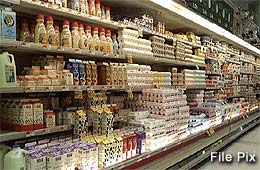 "The increase of our food import bill has inevitably led to the increase in food prices in this country," it said.
In addition, the recent hike in fuel and gas, toll fares and public transportation has significantly contributed to the rise in our cost of living.
Since last year, the price of diesel - the fuel used by most transportation companies - has increased by a whooping 68.3 percent while petrol is up by 20 percent. There was also a 10 percent toll hike by the country's major highway operator Plus.
"The Pan Malaysian Lorry Owners Association has decided to pass the cost of the toll hike to its consumers, as they cannot bear the extra cost. They'll be raising their charges from 18 sen to 25 sen per ton per 1.6 km. Public transportation such as buses and taxis have also raised their charges an average of 30 percent," said Fomca.
Stop fire-fighting
The consumer organisation urged the government to develop a comprehensive and long-term policy to put a lid on prices of good.
"The government should not just deal with prices increase in a fire-fighting manner," said Fomca legal adviser T Indriani.
Indriani, who is also secretary-general of another consumer organisation, the Education and Research Association for Consumers, said prices of food items are especially vulnerable when facing a crisis such as the global hike in oil prices.
"The government should not only look into dealing with (prices of) raw materials, like petrol. The government must come up with a more holistic approach to deal with (prices) of food items," she said.
In contributing to this long-term solution, Fomca plans to produce a published information kit on ways to save cost in our daily activities and how to conserve fuel
It will also contain general information on the price increases of consumer goods and services, and the spending patterns of Malaysians.
The information is currently available in both Bahasa Malaysia and English from Fomca website . The kit, when it is ready, will also be distributed to all government agencies and major retailers.
The purpose of the information kit is to create awareness among consumers. "With the information, the consumers can ask questions because they have the access to information," Indriani explained.
"It is important that ordinary folks know the current situation. Consumers have to play a role in demanding greater transparency. They can do that if they have the information," she said.
Amend OSA
The information kit will contain some recommendations for the government.
It suggested that the authorities source out alternative sustainable, renewable and green technologies. The government should also turn some 800,000 to one million hectarage of idle plots into agricultural land to reduce our food import bill.
It also urged the authorities to step up on the enforcement of laws in rural and urban areas to deter profiteering, and improve the marketing efficiency of food products by reducing the role of middleman in food chains.
"In line with this, the government should review the pasar tani concept as producers should be able to directly market their products to the consumers. By doing so, Fomca trusts that prices of food products will reduce tremendously."
It also suggested that the children and youth be educated on the concept of sustainable consumption and development as part of mandatory subject in the national education system.
"They must place priority on the basic essential items of life such as food, water, shelter and health rather than lavishing their hard-earned money on mobile phones, electronics, entertainment and fashion," it said.
The government must also revise its policy to privatise certain utilities, such as water and healthcare.
"Consumers are burdened with higher and higher expenses due to privatisation and this has turned into a vicious cycle."
Fomca also suggested that the Official Secrets Act be amended to encourage greater transparency.


