




It’s swim or sink for Harapan in Sungai Perak
GE14 | Sungai Perak is Peninsular Malaysia's second-longest river spanning the entire breadth of the state, beginning at the border with Thailand and flowing down to Teluk Intan, where the river ends at the Malacca Straits.
The river is part of Malaysia’s history and since the 18th century, the Perak royalty ruled from the banks of this mighty river in Kuala Kangsar...
GE14 | Sungai Perak is Peninsular Malaysia's second-longest river spanning the entire breadth of the state, beginning at the border with Thailand and flowing down to Teluk Intan, where the river ends at the Malacca Straits.
The river is part of Malaysia’s history and since the 18th century, the Perak royalty ruled from the banks of this mighty river in Kuala Kangsar.
Much further south, near Pasir Salak, was the site of the assassination of British colonial official James WW Birch, a major event in Tanah Melayu’s rebellion against imperialism with the immortalisation of Dato Maharajalela.
Now, as the next general election looms, Perak Pakatan Harapan believes that voters will have a chance to write another chapter of the river’s history.
Since independence, Umno has fortified towns and villages into its strongholds. But for Perak Harapan chief Ahmad Faizal Azumu, these areas are now fertile grounds for change.
“Apart from Telok Intan (a parliamentary seat), the areas along the river have never fallen to the opposition. If we win these seats, Harapan will take Perak and go all the way to Putrajaya,” Faizal, 48 (photo below), said in a recent interview.

Just like the physical terrain at most of Sungai Perak’s undeveloped banks, the political landscape is challenging, said Faizal, because these parliamentary seats also involve Grik, Lenggong, Padang Rengas, Kuala Kangsar, Parit and Pasir Salak - seats that Umno has never lost before, save for once in Parit in 1999.
The Bersatu factor
To win in these seven areas, Harapan would have to tackle the monumental task of triggering a 10 percent Malay vote swing, Faizal said.
But what was different now compared to previous elections, he said, is the Bersatu factor.
He explained that Bersatu, being an Umno-splinter party, can tap the knowledge and skills of local Umno activists which they have now recruited.
"We are working hard towards that (10 percent) target. We engage the voters on a daily basis. We organise “ceramah kelompok” (small gatherings) of about 40 people. We also meet voters, house-to-house," he said.
So far, the response has been encouraging as many Umno members in these areas, he added, have expressed their disenchantment with the ruling party albeit not openly.
"Many have joined Bersatu. Some are government officers or housewives whose husbands work in government agencies or they have contracts with the government. Many of them cannot reveal themselves.
"There are Umno grassroots leaders who want to show their support openly, but can’t. They have promised to vote for the opposition too," said Faizal, a former Umno member himself.
Rural folk do talk about 1MDB
Chief among the complaints of his former Umno colleagues, said Faizal, was their frustration with the lack of channels to voice their grievances against party president and Prime Minister Najib Abdul Razak.
He said questions surrounding the 1MDB affair, which have tainted Najib and Umno’s legitimacy, to which Umno leaders have provided no satisfactory answers, have reached even the far-flung areas around the town of Gerik.
Bersatu was itself born out of unanswered questions surrounding the 1MDB saga. In 2015, several top Umno leaders were either removed by Najib or left on their own when the questions got too hot to handle.

Many of these ex-Umno leaders - most notably Dr Mahathir Mohamad, Muhyiddin Yassin and Mukhriz Mahathir - founded Bersatu shortly after.
Bersatu, which has been given the task of leading Harapan’s charge in Perak, will be taking on mostly Umno strongholds. The chances of winning, however slim, are there, Faizal said.
"We do have our predictions. We stand a good chance. We believe we can cross the magic number of winning 31 out of 59 state seats," he said.
"Umno claims it has 6,000 to 8,000 members in these divisions. We have thousands of members, too.”
Remember Kuala Kangsar
Predictions aside, a cursory look at 2013 results for the seven Sungai Perak parliamentary seats targeted by Harapan show that Umno posted impressive majorities in Grik (23 percent), Pasir Salak (17 percent), Parit (15 percent), Lenggong (14.7 percent) and Padang Rengas (nine percent).

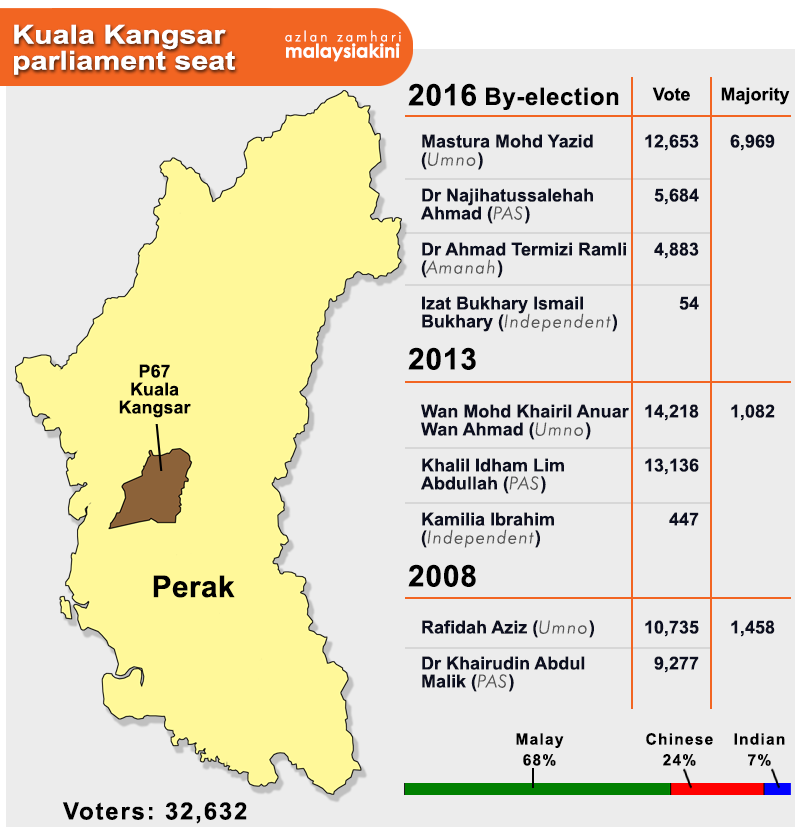
At the time, the opposition only stood a chance in Telok Intan and Kuala Kangsar. BN won both seats when by-elections were called in 2014 and 2016 respectively.
The Kuala Kangsar by-election was particularly noteworthy because it involved a four-way fight among BN, PAS, Amanah (representing Harapan) and an independent.
Although BN’s share of the votes was reduced, PAS garnered nearly a quarter of the votes while Amanah took about a fifth.
PAS’ plans to field candidates throughout Perak this time around has resurrected the spectre of the Kuala Kangsar by-election results but Faizal said much has changed over the past two years.
Many PAS voters now believe that the party is cosying up to arch-rival Umno, said Faizal, leading to many to pin their hopes on Harapan as the legitimate government-in-waiting.
“The (by-election) results show that PAS can’t boast about its Malay support. PAS garnered a good number of votes before because it was part of the main opposition pact.
“Now, PAS stands alone,” he said.
Furthermore, he believes that if Harapan can still come up on top if it manages to cause a 10 percent Malay vote swing.
For now, Faizal remains upbeat over Harapan’s chances in constituencies along the Sungai Perak. Failure will likely condemn Perak Harapan and Bersatu to the sediment heap of the river’s history, observers say.
Tomorrow: Why DAP shouldn't field a Malay candidate in Perak


Report this comment
Are you sure you want to delete this comment?
This action cannot be undone.