


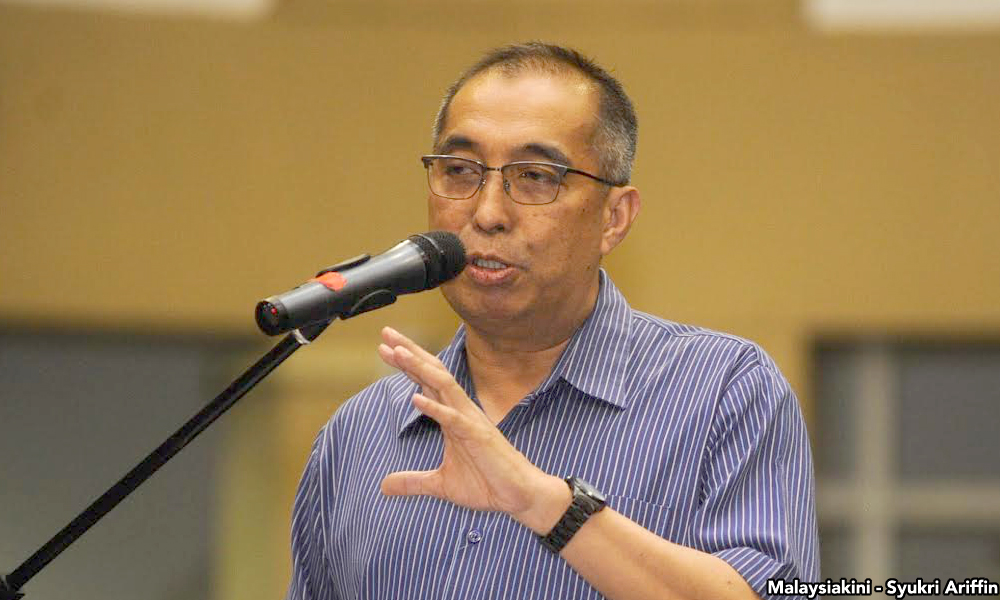

Salleh: Fake news law not to silence 1MDB debate, just false claims
Communications and Multimedia Minister Salleh Said Keruak has denied that the anti-fake news law is aimed at silencing debate on the 1MDB.
“But this is not true. There is nothing to stop anyone from debating or talking about 1MDB,” Salleh said in a blog posting this morning in response to critics...
Communications and Multimedia Minister Salleh Said Keruak has denied that the anti-fake news law is aimed at silencing debate on the 1MDB.
“But this is not true. There is nothing to stop anyone from debating or talking about 1MDB,” Salleh said in a blog posting this morning in response to critics.
However, he said, the issue is when a person spreads false information as “news” and “facts”.
“For example, we keep hearing 'news' that RM42 billion of 1MDB's money has 'disappeared' into thin air when this has been officially explained and proven false.
“The bigger issue here is to deal with the irresponsible spread of such fake 'news' and 'facts', which applies to many other situations in our lives,” he added.
Salleh pointed out that when a lie is repeated many times, the people believe it to be the truth.
“This is the disease of fake news which affects the world globally, not just Malaysia. The truth is not subjective.
“It has to be precise and backed with evidence which is verified to be true. If not, it would be mere claims and allegation, with nothing proven.
“Everyone should understand this concept, so that they would not be easily misled by 'fake news',” he added.
In law, Salleh said, the burden of proof is always on the person who makes the claim or allegation while the defendant is innocent until proven otherwise.
“So it's surprising that some Malaysians appear ignorant of this very basic rule.
“If you claim something, then you have to prove it to be true. You have to show your evidence, which needs to be verified for truth and authenticity,” he added.
On Monday, Putrajaya tabled the Anti-Fake News Bill in Parliament. Critics have accused the government of attempting to further stifle press freedom and freedom of speech.
The opposition, on the other hand, had accused Putrajaya of being the biggest purveyor of fake news, especially with regard to 1MBD.
Previously, Salleh, in a meeting with foreign correspondents, gave his assurance that the US Department of Justice (DOJ) filings on 1MDB would not be considered fake news.
"You can quote them, what did they say, based on the filings. It is not considered fake news. It's their views. Like DOJ, you quote them, what they said," he added.
Pressed for further assurance, Salleh responded: "No, no, no, how can you consider fake news, that one.”


Report this comment
Are you sure you want to delete this comment?
This action cannot be undone.