


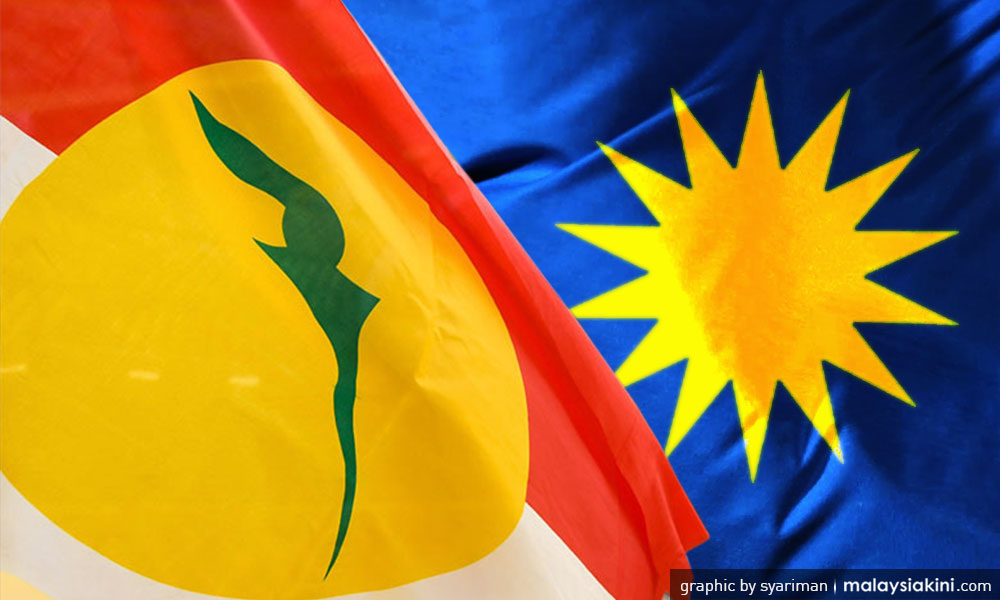

In last-minute ditch, Umno lunges for MCA's Tebrau
GE14 | Despite MCA declaring its vice-president Hou Kok Chong as BN's candidate for the Tebrau parliamentary seat, Umno has not abandoned its quest to contest there.
This comes after Umno requested four MCA parliamentary seats – Kuantan, Wangsa Maju, Lumut and Bandar Tun Razak – for the 14th general election...
GE14 | Despite MCA declaring its vice-president Hou Kok Chong as BN's candidate for the Tebrau parliamentary seat, Umno has not abandoned its quest to contest there.
This comes after Umno requested four MCA parliamentary seats – Kuantan, Wangsa Maju, Lumut and Bandar Tun Razak – for the 14th general election.
A local Umno source said the party stands a chance to win Tebrau, as BN chairperson Najib Abdul Razak has yet to announce the coalition's candidate list.
The source added that the Umno Tebrau division was willing to swap the state seat of Puteri Wangsa for Tebrau. Puteri Wangsa is one of the two state seats under the parliamentary seat of Tebrau.
“Only MCA announced Hou as their Tebrau candidate. But the BN central leadership has not announced any candidate list.
“As Puteri Wangsa is a Chinese-majority area, it is better to give to MCA. And it is better to let Umno fight in the Malay-majority Tebrau seat.
“We have submitted several suggestions. One of the options is to exchange Puteri Wangsa for Tebrau, for which Umno has a name list of potential candidates,” the source told Malaysiakini on the condition of anonymity.
Seat swap
It is understood the so-called 'seat exchange' is for Umno to persuade MIC to give up Puteri Wangsa for MCA, after which MCA will make way for Umno in Tebrau.
The source indicated that even though Hou was not a Tebrau local, Umno grassroots would fully back him should the BN central leadership decided to field him.
“Hou is still Bangsa Johor, while PKR's (potential candidate) Steven Choong was born in Ipoh.”
Hou is a native of Kluang, located some 100km away from Tebrau. When contacted, Tebrau Umno division chief Maulizan Bujang declined to comment.
A typically mixed seat, Tebrau comprises 47 percent Malay, 39 percent Chinese and 11 percent Indian voters as of the fourth quarter of 2017.
The state seat of Puteri Wangsa comprises 50 percent Chinese, 39 percent Malay and 10 percent Indian voters. Apart from Puteri Wangsa, another state seat of Tebrau – Tiram – consists of 56 percent Malay, 28 percent Chinese and 12 percent Indian voters.
In the last polls, BN-MCA won Tebrau by a 1,767 majority vote, contributing a seat to MCA's haul of seven parliamentary seats.
PAS, for the first time, beat BN-MIC by a 3,469 majority vote in Puteriwangsa. Umno defended Tiram by whopping 7,443 majority vote.
According to China Press, Maulizan had suggested to the Umno central leadership for an inter-party swap involving the state seat of Puteri Wangsa and the parliamentary seat of Tebrau.
“The Chinese voters have increased by 50 percent in Puteri Wangsa, while Indian voters decreased from 13 percent to 11 percent. So it is better for an MCA candidate to contest in Puteri Wangsa.
“MIC, who contested Puteri Wangsa in the last polls, needs to find another seat,” Maulizan, the incumbent Tiram assemblyperson, was quoted as saying during an Umno divisional meeting.
Johor MCA chief Wee Ka Siong, however, has insisted Tebrau is the party's traditional seat, and that Maulizan was only giving his personal opinion.
In the last polls, MCA gave up three parliamentary seats – Gelang Patah (now Iskandar Puteri), Wangsa Maju and Kuantan – to Umno.
Previously, Malaysiakini reported that Umno local grassroots had asked to contest in Kuantan, Wangsa Maju, Lumut and Bandar Tun Razak, but MCA had refused to give up these seats.


Are you sure you want to delete this comment?
This action cannot be undone.