



Community empowerment a priority for new housing minister
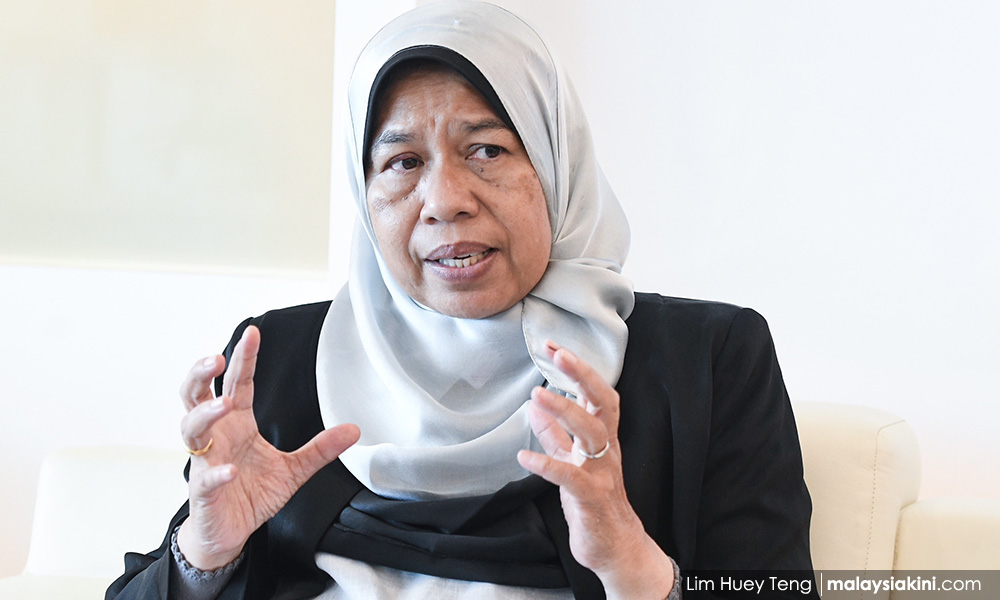
INTERVIEW | Zuraida Kamaruddin was filled with excitement on her first day as the minister of housing and local government.
In an interview with Malaysiakini, she said the sight of the 18-storey ministry building gave her goosebumps, knowing the huge responsibility that lay ahead.
INTERVIEW | Zuraida Kamaruddin was filled with excitement on her first day as the minister of housing and local government.
In an interview with Malaysiakini, she said the sight of the 18-storey ministry building gave her goosebumps, knowing the huge responsibility that lay ahead.
"When I was approaching this building, it gave me some kind of goosebumps. Oh, this is a big responsibility as high as the 18-storey building. Can you imagine, you have to carry yourself as tall as the building. It's scary," she said.
However, she added that the Housing and Local Government Ministry was among the ministries she had been hoping to be selected for if she were to be appointed to the cabinet.
This was partly because she was familiar in dealing with local government issues during her two terms as the MP for Ampang.
As a policymaker now, the 60-year-old said she aimed to push for community empowerment across the country, whereby communities could improve their physical environment and safety of their surroundings.
Such community empowerment can be implemented in a public housing, private housing or even commercial area, she said.
"It is very important that our communities are empowered as it is in line with our nation building. We will encourage residents to form resident associations, and train them in the management of the resident associations," she said.
Pilot project in S'gor
The resident associations will be taught the proper ways to handle various issues and they will be able to decide what type of environment, services, and security they want, she said.
'They will know the importance of taking care of their surroundings in term of cleanliness, environment and security," she said, adding that the ministry would only issue policies and provide a support system.
This would be part of a decentralised process, and federal funding would be channeled directly to these associations, she said.
"I know this could take a long term (to achieve) as it will take a lot of education and awareness programme, (for) the Malaysians to have the capacity to manage their own community," she said.
She noted community empowerment has been a practice in lots of developed countries like Sweden and even neighbouring Singapore.
Zuraida, who is also the Pakatan Harapan Wanita chief, was mulling over the possibility of pushing for a pilot project in community empowerment to be held in Selangor.
In some countries, the government formulated laws that recognise the role of local communities and some were even able to influence the government in its decision-making.
In Singapore, Residents’ Committees (RCs) were introduced in 1978 to promote neighbourliness, racial harmony and community cohesiveness amongst residents. The RCs liaise with and make recommendations to government authorities regarding the needs and aspirations of residents.
PPRs need cleaning-up
Meanwhile, Zuraida also has some ideas for the people's housing projects (PPR), which she hopes to increase as part of a million affordable homes to be delivered in two terms as promised by the Pakatan Harapan in its manifesto.
However, she noted the conditions of some of the PPRs were not conducive and comfortable enough, and had thus become residences for foreigners instead of locals.
"There has to be some cleaning up, so that real Malaysians are staying there," she said, adding by then more Malaysians will be able to live in affordable homes.
PPR was the government's initiative to provide homes for low-income group and to relocate squatters. In 2015, the government announced its plan to build one million homes under the PPR project.
According to the ministry's annual report in 2016, the government proposed to build 169 PPR projects totalling 102,896 units, almost half of which would be located in Kuala Lumpur.
To encourage house ownership, the government introduced rent-to-own PPR units, by allowing the tenants to convert the rental they paid into down payment.
Zuraida, however, said that in future, these PPR owners may need to seek the approval from the local authorities to rent out their units to foreigners.
"The legal foreigners can stay, but we want to see if the owners make enough effort to allow Malaysians to rent the houses," she said.
Only then would the ministry have information on the foreigners who reside in PPRs, Zuraida added.
"We wish the foreigners who stay there to follow our culture and we want to make sure they know how to maintain levels of cleanliness, environment and safety."


Are you sure you want to delete this comment?
This action cannot be undone.