
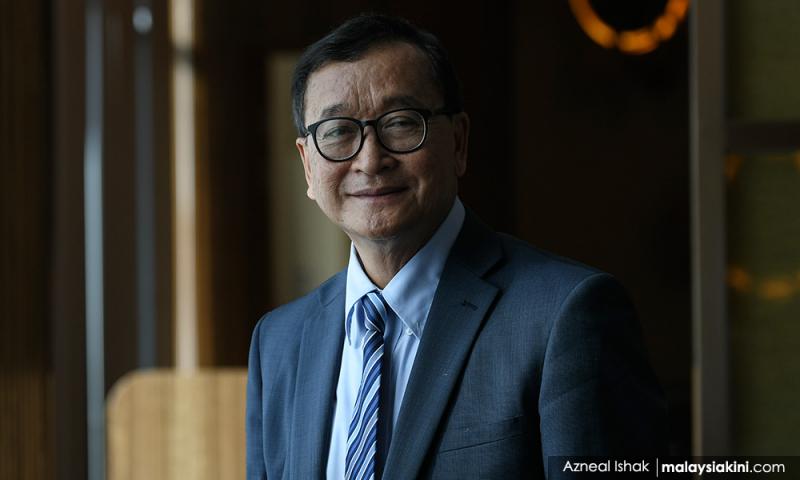
Cambodian opposition leader inspired by M'sia's democratic change
INTERVIEW | After living in exile for four years, Sam Rainsy wants to return to Cambodia to confront Prime Minister Hun Sen, who has been ruling the nation with an iron fist for more than three decades.
The 70-year-old opposition veteran and former cabinet minister, whose party Cambodia National Rescue Party (CNRC) has been outlawed, cited Malaysia as his inspiration.
"We look up to Malaysia as a model. Malaysia has inspired and set an example for us. Malaysia managed to bring about democratic change," he told Malaysiakini in an interview in Kuala Lumpur this afternoon.
INTERVIEW | After living in exile for four years, Sam Rainsy wants to return to Cambodia to confront Prime Minister Hun Sen, who has been ruling the nation with an iron fist for more than three decades.
The 70-year-old opposition veteran and former cabinet minister, whose party Cambodia National Rescue Party (CNRC) has been outlawed, cited Malaysia as his inspiration.
"We look up to Malaysia as a model. Malaysia has inspired and set an example for us. Malaysia managed to bring about democratic change," he told Malaysiakini in an interview in Kuala Lumpur this afternoon.
Referring to the last general election which witnessed the routing of BN after six decades in power, Rainsy said Malaysia set an example for Southeast Asian nations that peaceful change is possible.
"This is the example that we want to follow. We want to bring democratic change like in Malaysia.
"The Malaysian leadership is inspiring. We admire what the Malaysian people have achieved," he added.

According to Rainsy, who arrived in Kuala Lumpur on Saturday afternoon, apart from Malaysia, Indonesia is the only other nation that can be called a democracy in Southeast Asia.
"They are great, their weight and influence will be more important to the democratisation of the rest of Southeast Asia.
"I would like to express my gratitude and admiration to Malaysia for restoring democracy. For making Malaysia a vibrant democracy, to serve as a model for others," he added.
Previously, Rainsy announced that he would cross into Cambodia via the Thai border with other leaders of his party but his plan hit a brick wall when he was refused permission to board a Thai Airways plane from Paris last week.
The opposition leader had fled to Paris in 2015 after a conviction for criminal defamation and faces a five-year sentence in a separate case. He claims the charges were politically motivated.
Two years later, the opposition CNRP was banned with more party leaders going into exile. This resulted in Hun Sen's Cambodian People's Party winning 100% of the National Assembly seats at the 2018 general election.
'Entering Malaysia a moral victory'
Meanwhile, Rainsy, when asked what he hoped for from Malaysia, said: "A shelter to be safe."
He also described Malaysia's decision to allow him to enter the country as a moral victory against Hun Sen's propaganda.

"When we wanted to be near our home country and nobody accepted us, Malaysia accepted us. We are very grateful...
"And this conveys a message to Hun Sen (above) - this is a moral victory for us. Why? Because Hun Sen said that I'm a criminal, a convict, a traitor. This is Hun Sen's propaganda.
"When Malaysia allowed me to come, it means that I am not a criminal. Neither Malaysia nor I have to say anything. Just the gesture implies that Malaysia does not believe in Hun Sen's propaganda.
"It is a moral victory for me that nobody believes Hun Sen," he added.
Previously, it was reported that in the weeks since Rainsy announced his plan to return, some 50 opposition activists were arrested in Cambodia.
Police with assault rifles were stationed at the border crossing with Thailand whereas in the capital Phnom Penh, security forces patrolled in trucks during the nation's independence celebrations.
Last week, it was reported that two CNRP leaders, including vice-president Mu Sochua, were detained by immigration authorities upon their arrival at the Kuala Lumpur International Airport.
Following this, Prime Minister Dr Mahathir Mohamad said Malaysia is attempting to find another country willing to accept the exiled Cambodian opposition leaders.
Foreign Minister Saifuddin Abdullah said Putrajaya has received a list from Phnom Penh on the opposition leaders it wants to be sent back.
However, he pointed out that Malaysia has a good reason not to agree since these individuals did not enter using Cambodia's international passports.
Tomorrow: Sam Rainsy: Thousands of supporters will walk with me into Cambodia


Are you sure you want to delete this comment?
This action cannot be undone.