




Asean fails to find Burma strategy
Asean foreign ministers failed to emerge with a strategy for dealing with recalcitrant member Burma at an annual retreat yesterday on the Indonesian resort island of Bali.
Asean foreign ministers failed to emerge with a strategy for dealing with recalcitrant member Burma at an annual retreat yesterday on the Indonesian resort island of Bali.
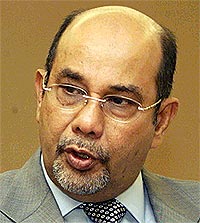
Malaysia's Foreign Minister Syed Hamid Albar, who visited the military-ruled regime in March as Asean's envoy, also said Burma's generals were in no hurry to hold democratic elections, which could still be more than two years away.
 The Association of South East Asian Nations (Asean) has been expressing growing frustration with the regime, which has held democracy leader Aung San Suu Kyi in detention for most of the last 16 years.
But as Asean has traditionally adhered to a policy of non-interference in the affairs of member states, Syed Hamid said the bloc was only able to "express our views in very clear terms" about the country's direction.
"Of course we don't want to interfere in domestic affairs but ... if it impacts on Asean as a whole, we have an interest to express our view and see what types of action Myanmar (Burma) has taken," he said.
"I think when you're dealing with a country you can say so much, but you can't force anything upon a country," he said.
The generals have announced a "road map" to democracy but there has been little progress on beginning steps, such as a national convention to help establish a constitution.
Constitutional talks
The latest rounds have been internationally condemned for failing to include the opposition, which is boycotting the convention to demand the release of Aung San Suu Kyi and other political prisoners.
 The constitutional talks were suspended in January and no date was given for when its 1,000 handpicked delegates would resume their work. The sputtering process began more than a decade ago and has achieved few tangible results.
"I imagine it will take them another two years on the completion as Myanmar's foreign minister informed us it will be when they have a referendum to adopt the constitution," Syed Hamid said.
"After that referendum, they will be having an election."
The minister said that nine chapters of the constitution had been completed with six more left.
Burma agreed at last year's Asean summit to invite Syed Hamid in the face of growing international pressure for evidence of democratic progress, as well as embarrassment among some members over its 1997 inclusion in the bloc.
"They don't want interference in their domestic process. We'll leave it at that and see how we can assist them in whatever way we can," Syed Hamid said.
"They don't like pressure but they like suggestions from us, so we give suggestions to them. We hope they can convey our suggestions to their own government."
Continue with engagement
Indonesia's Foreign Minister Hassan Wirayuda told the press briefing that the bloc had only "agreed to continue to engage Myanmar".
 Ministers as well as Asean's chief had earlier expressed frustration with the slow pace of Rangoon's reform efforts.
"There is a certain impatience because the people around the region as well as around the world say, 'You keep talking, you keep going there - and then what happened?'" secretary-general Ong Keng Yong said Wednesday.
"People want to see some concrete steps forward."
Ong and several ministers have also said that regional powerhouses China and India should use their economic clout - considerably mightier than Asean's - to nudge Burma towards reform.
Asean groups Brunei, Cambodia, Indonesia, Laos, Malaysia, Burma, the Philippines, Singapore, Thailand and Vietnam.


Are you sure you want to delete this comment?
This action cannot be undone.