




Get your facts right, Pak Lah told
It is misuse of power and mismanagement of economic resources that threaten development, not peaceful protests against such abuses, said several human rights activists.
It is misuse of power and mismanagement of economic resources that threaten development, not peaceful protests against such abuses, said several human rights activists.
Human Rights Society of Malaysia secretary-general Elizabeth Wong said premier Abdullah Ahmad Badawi's statement on Saturday - that demonstrations would adversely affect the economy - showed his ignorance of the basic principles of democracy.
About 500 people had participated in a demonstration against the fuel and electricity tariff hikes on May 28, but were brutally suppressed by riot police in the course of dispersing the gathering.
 "Mismanagement of national resources will ruin the economy and deter investments, and people should be allowed to highlight this," said Wong.
Pointing out that the Federal Constitution provides for the freedom to expression and to assemble peacefully, she said all developed nations allow for demonstrations as part of a healthy democracy.
"There is no proof that peaceful demonstrations have led to an economic downturn in any particular democracy," she said.
"Demonstrations do not arise out of nothing. They occur because people want to express their grievances."
'Tell the truth'
Information Minister Zainuddin Maidin's instructions to the media last Saturday not to report expressions of discontent also came in for criticism.
Human rights group Suaram secretariat member S Arutchelvan pointed out that Zainuddin's concern was that the media only reported such incidents to raise their ratings or sell more copies.
 "Ministers like Zainuddin would want the press to report only what the government wants to hear. But the only way for the media to survive is to tell the truth," said Arutchelvan.
"People will not read the newspapers if they feel they cannot get the truth, because they can get it through the Internet. The press might as well close down."
 Human Rights Commission of Malaysia chairperson Abu Talib Othman also supported the obligations of the press and urged them to continue to report on matters involving human rights.
"We hope that the press will continue to highlight issues so that we can continue to promote and protect human rights," said Abu Talib during a meeting with the groups on the Bloody Sunday incident.
He added that groups have a right to express themselves and to assemble as long as the gatherings were peaceful and the organisers have obtained police permits.
Context of statement
On a related matter, PAS women's leader Aiman Athirah al-Jundi pointed out that party president Abdul Hadi Awang's call for demonstrators to throw stones at police was made in the context of redressing the unfair balance of power between armed policemen and unarmed civilians.
"They hit us a lot, we hurt them back, but just a little," Abdul Hadi had said at a press conference after closing the party's annual muktamar (general convention) last Friday.
On Bloody Sunday, peaceful demonstrators had faced squads of helmeted riot policemen armed with batons - some brandishing M-16s - while wearing full body-armour and shields.
Aiman compared this to a scenario of Palestinian children throwing stones at Israeli soldiers and tanks.
"The president (made his call) just after the conclusion of the muktamar where leaders spoke at length on the Palestinian situation and the need to help Palestinians who are struggling against the might of the Israeli military," she said.
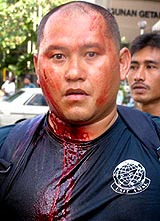 Pointing to the images of PAS member Amran Zulkifli, whose bloodied figure after being beaten by policemen cracking down on the demonstration had shocked many, Aiman said people had been outraged.
"If the police can claim self-defence, then we can claim self-defence as well," said Aiman, who had been at the forefront of the demonstrations.
She also pointed out the contradiction between constitutional provisions to freedom of expression and peaceful assembly and the Police Act 1967, which require a police permit for any gathering of five people or more.
"When you have an Act that says one thing and the Federal Constitution which says another, which one is higher and actually supreme? This contradiction has to be corrected," she added.
Making it clear that they do not advocate violence, Wong and Arutchelvan also said the right to self-defence in the face of police brutality is recognised by the law.
Echoing them, PAS youth chief Salahuddin Ayub said the party would never issue a directive to commit violence in any form.
"If an act of self-defence is committed spontaneously by the citizens themselves, then we cannot be blamed for it. Everyone has the right to defend themselves, even if it is the police who are involved," he said.


