


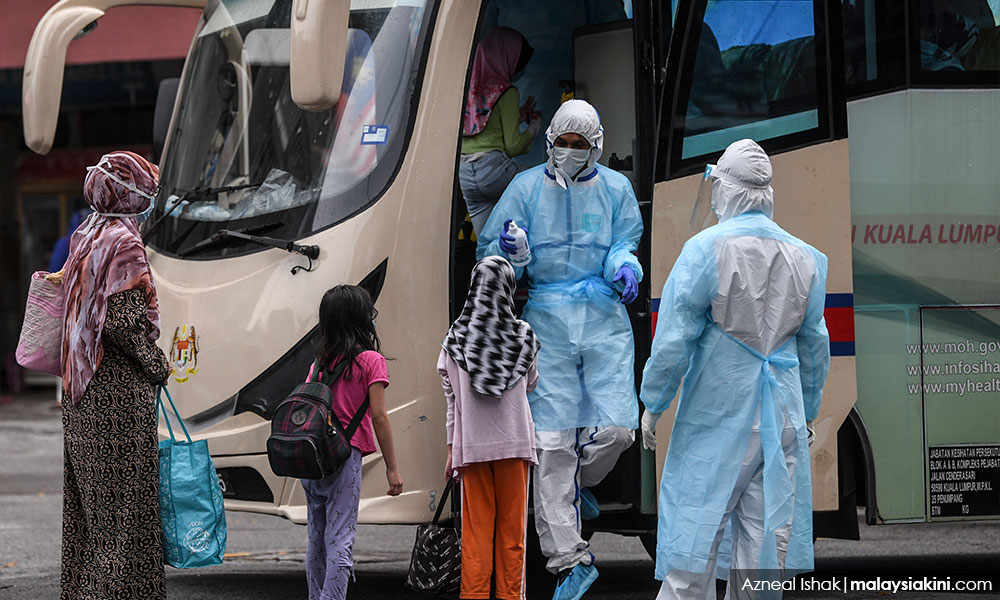

DG: Ministry mulls placing returnees from high-risk countries at quarantine centres, hotels
CORONAVIRUS | The Health Ministry (MOH) is considering placing those returning from high-risk Covid-19 countries under quarantine at designated centres for two weeks before allowing them to go home.
It is also studying whether to allow returnees without conducive quarantine conditions at home to be quarantined away from home.
CORONAVIRUS | The Health Ministry (MOH) is considering placing those returning from high-risk Covid-19 countries under quarantine at designated centres for two weeks before allowing them to go home.
It is also studying whether to allow returnees without conducive quarantine conditions at home to be quarantined away from home.
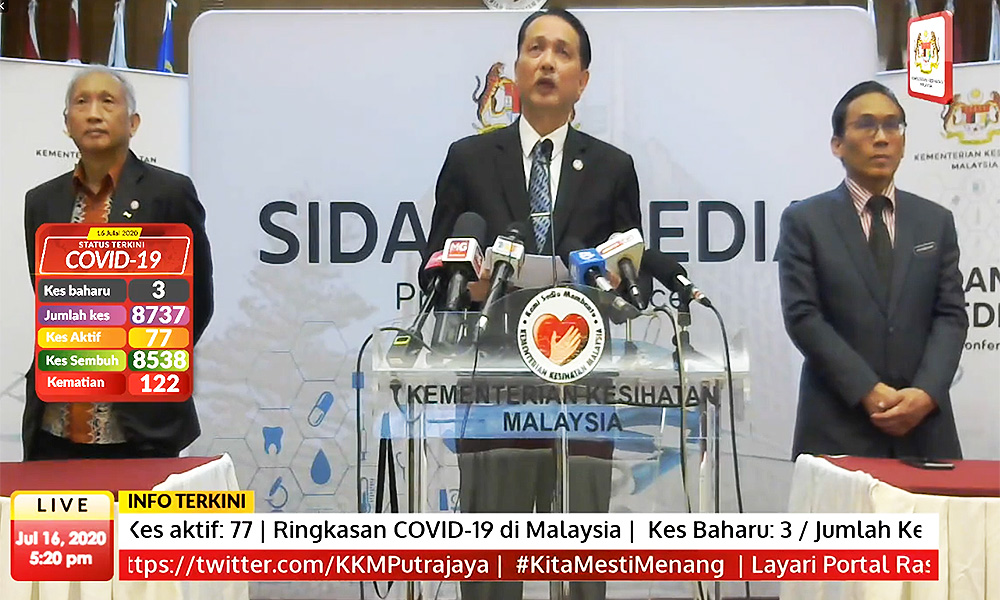
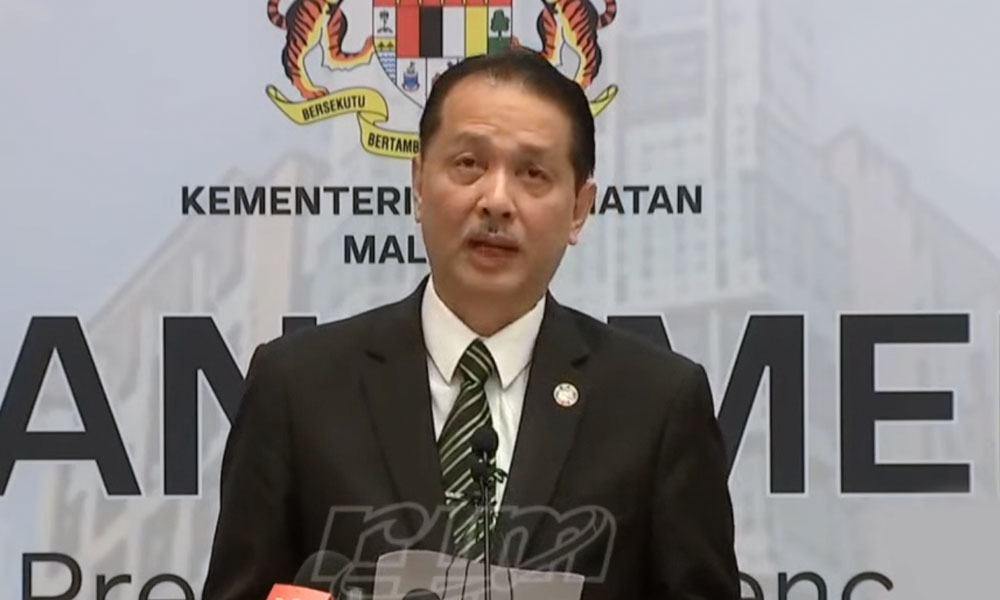
Speaking at his twice-a-week Covid-19 briefing today, director-general Dr Noor Hisham Abdullah did not disclose which high-risk countries the ministry was looking at.
“Now we are relooking into the possibility of quarantine in a quarantine centre or even at a hotel for those who do not have a proper, conducive environment at home to quarantine [...]
“And for those coming back from high-risk areas, can we consider (placing) them in quarantine centres or even hotels? We are looking into that,” he said.
Malaysia previously placed all returnees under a 14-day quarantine order at designated centres before allowing them to go home.
Starting June 10, returnees were allowed to carry out their quarantine order at home if they exhibited no symptoms and tested negative for Covid-19 upon arrival.
No false negatives using RTK
Meanwhile, Noor Hisham said he was satisfied with the use of antigen-based rapid test kits (RTK) on returnees upon arrival.
He also refuted concerns that such test kits produced “false negative” results, meaning they gave a negative result when a patient had Covid-19.
The Sarawak Disaster Management Committee previously reported that five travellers had tested negative on antigen-based RTKs at KLIA before testing positive on an RT-PCR test in Sarawak.
https://codeblue.galencentre.org/2020/07/08/five-sarawak-covid-19-cases-cleared-klia-antigen-rapid-tests-sdmc/ TESTING POSITIVE
Today, Noor Hisham stated that antigen-based RTK used by the ministry had a 90 percent sensitivity and 100 percent specificity.
Furthermore, the RTK was cheaper and produced results faster than the RT-PCR test.
“To conclude that this is a false negative, (you) have no proof to say it is a false negative.
“At that point of time, the patient (could be) asymptomatic, it might have been in the incubation period and the virus load is not high, so the RTK could not detect it.
“It is possible (that even) if we were to do an RT-PCR test, maybe the results will also be negative,” he said about the Sarawak cases.
Asked about the Malaysian Medical Association’s (MMA) request for the ministry to publish a list of approved RTK, the top official said they did not want to inadvertently “promote” the companies manufacturing the kits.
“We will engage with MMA and inform the list of companies,” he added.


Report this comment
Are you sure you want to delete this comment?
This action cannot be undone.