




No accolades for proposed UUCA changes
Parti Keadilan Rakyat (PKR) has reiterated its support for the Universities and University Colleges Act (UUCA) to be abolished.
Parti Keadilan Rakyat (PKR) has reiterated its support for the Universities and University Colleges Act (UUCA) to be abolished.
Its president, Dr Wan Azizah Wan Ismail said PKR would back any effort to amend the UUCA for the benefit of Malaysian students and the creation of a more vibrant higher education system in the country.
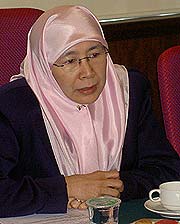 Noting that the UUCA has been utilised to clamp down on legitimate student activities in public universities, she pledged the party's support to any effort made to either amend or abolish UUCA.
"We will have a working group to synthesise all views expressed by student representatives and victims of UUCA in regards to the abolishment of UUCA," she said at a dialogue session on UUCA organised by the party at Parliament House this morning.
The views would then be presented to the minister for higher education, Azizah said.
The PKR chief added that her party would continue to hold discussions with other bodies such as the Bar Council and the academic staff union from University Malaya to get their support to abolish the UUCA.
At the session, PKR deputy president Dr Syed Husin Ali highlighted that the power of chancellor and vice chancellor of public universities have been absolute where all decisions including student affairs are decided by them without consulting student representatives.
"Clearly, there is a pressing need to amend certain sections of the act," he stressed.
Yesterday, the Higher Education Ministry held a review session for MPs on the proposed amendments to the UUCA but the effort did not win any praise from the group attending PKR's session today.
Stricter, not freer
Hishamuddin Rais, ex-student leader of University Malaya, commented that it was impossible for Barisan Nasional (BN) components to make UUCA less restricted because UUCA was enacted due to the 'excessive powers' that the students had in the 1970s.
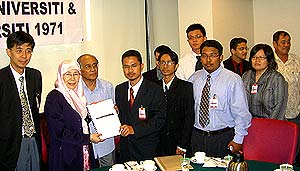 "They (government) don't want the students to become critical towards them because they want to absorb young students into their ranks," Hishamuddin explained.
Therefore, any amendment to the UUCA will only become stricter and not freer, he added.
The Kuala Lumpur and Selangor Chinese Assembly Hall Youth Chief, Tan Soon Lim noted that every time UUCA was amended, the amendments were getting from bad to worse.
"The act has not only suppressed the freedom of expression but also imposed a 'culture of fear' among students and employees of public universities although they are not aware of the exact content in the UUCA.
"Let the pilot fly the plane, the students should have the power to manage the affairs involved in universities and not the chancellor or vice-chancellor (to make the decision for them)," Tan said.
He also stressed the importance of returning power to the students and be an independent campus because only by doing so could democracy and academic freedom be revitalised.
Yesterday, Deputy Higher Education Minister Ong Tee Keat and the ministry's management department director-general Prof Dr Hassan Said - both of whom were present at the function - were tightlipped on the details of the proposed UUCA amendments and its on-going consultation.
Despite being pressed by reporters, Hassan refused to divulge more information apart from saying that the review would be "holistic", which include the governance of universities, students' freedom and the powers of vice-chancellors.
Although the meeting was attended by only a handful of MPs, Hassan said the feedback was "positive". The ministry aimed to table the amendment bill of the UUCA in the next session of parliamentary sitting in September.
All-powerful VC
As if not wanting to miss the bandwagon, two DAP MPs called a press conference at Parliament lobby today to echo anti-UUCA sentiments.
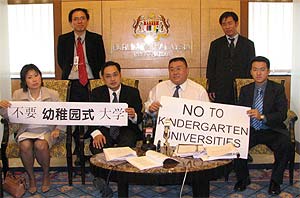 Fong Po Kuan (DAP-Batu Gajah) and Chong Chieng Jen (DAP- Bandar Kuching) highlighted the fact that "the absolute power of the vice-chancellor as he plays all three roles of legislator, enforcer and judge".
"There is too much politics involved in the appointment of the VC and the board of directors in universities. In our constitution, it is stated that politics should be separate from the judiciary, yet how come this fails to apply for universities?" the DAP leaders argued.
Section 16C of the UUCA empowers the board to make rules regarding the conduct of students and etiquette while in university.
The disciplinary board is headed by the VC who has the exclusive authority to set the guidelines of student activities. On top of that, the board has the power to both charge and hear students, with the VC determining the witnesses in proceedings.
They called on the ministry to set up a select committee which will comprise both members of the government, and the opposition as well as academics from universities to not only review article 15 and 16 of the UUCA, but the entire act altogether.
The opposition parties will be briefed on the proposed review of the UUCA on Thursday morning.


