




Probe Dr Ms Ops Lalang, set-up truth commission
A truth commission must be set up to unravel the 'real story' behind the 1987 Internal Security Act crackdown.
A truth commission must be set up to unravel the 'real story' behind the 1987 Internal Security Act crackdown.
 Making this call at a public forum in Kuala Lumpur last night, ex-detainees and concerned individuals said former premier Dr Mahathir Mohamad had wanted to create an atmosphere of fear.
The crackdown, codenamed Ops Lalang, saw the detention of 106 individuals and the suspension of three dailies, Sin Chew Jit Poh (now known as Sin Chew Daily ), Watan and the Star .
Former detainees Lim Guan Eng, who is the current DAP secretary-general and academic Dr Kua Kia Soong, felt the government resorted to such measures whenever Umno faced a crisis.
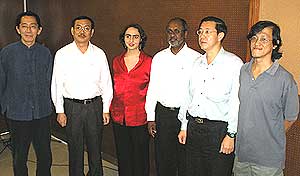 Parti Keadilan Rakyat (PKR) vice-president R Sivarasa, who was one of the speakers, also agreed with this.
They said the first mass arrests followed the May 13, 1969 racial riots, and five years later, another dragnet was mounted in the wake of demonstrations against the government's rural and agricultural policies.
Regaining control
Sivarasa claimed that Ops Lalang was launched to create the perception that Mahathir was regaining control after a challenge was mounted against his leadership.
In April that year, ex-finance minister Tengku Razaleigh Hamzah challenged Mahathir for the Umno presidency and lost by a mere 41 votes. After accusations of vote-rigging surfaced, the High Court declared Umno illegal, which led Mahathir to set up Umno Baru.
Ops Lalang took place on Oct 27 while an appeal was ending against the Umno ruling.
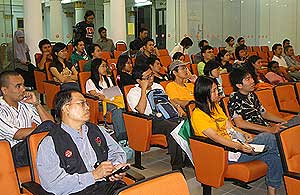
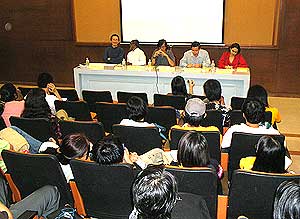
"Mahathir needed to assert control over the situation. Another pressure on him was the litigation of UEM (United Engineers Malaysia)," Sivarasa told the 60-strong audience who packed the Selangor Chinese Assembly Hall.
(DAP filed a civil suit to prevent the government from privatising the North-South highway to the Umno-linked UEM. The suit was rejected in January 1988 by the Supreme Court).
 "We need a real telling of the truth. We call for some sort of truth commission like (the one in) South Africa. I don't see a commission being set up under this government, though," he said.
"This country needs some commission to be set up. We must know the real story...," he added.
Newfound solidarity
Meanwhile, Kua said the 1987 mass arrests gave birth to a newfound solidarity among NGOs, opposition parties and support groups.
"It was the undoing of the government to arrest people from such vast and diverse backgrounds. For the first time, leaders of PAS were thrown in with leaders of DAP. There were the Chinese educationists, the Christians and social activists.
"While we were in there (Kamunting Detention Centre), there was the common perception that we were all victims of this big state strategy," he said.
Kua, the director of New Era College, also pointed out that no detainee has yet to be tried in court, or was found to have committed any crime after being released.
Linking Ops Lalang to the tussle in Umno at that time, he said Mahathir needed to create an imaginary nemesis.
"If the (court) judgment went against him, he (Mahathir) would have to step down. The imaginary enemy was the Chinese," he added.
Teenage detainee
Lim, who spent 18 months in Kamunting, said the youngest ISA detainee at that time was a 14-year-old boy from Kampung Memali.
In 1985, 18 people, including four policemen, were killed in a clash between villagers in Memali and the police. Forty-nine people were detained.
 "It was wholesale detention, no questions asked. You detain a 14-year-old boy who knows nothing. You detain people on false allegations. At least five allegations were levelled against me. They say we were threatening national security.
"I was detained only after a year I was elected as a member of parliament. I'd like to think that I'm a bigger threat now than 20 years ago, but yet I'm not detained now. I still repeat the same things now as I did 20 years ago.
"Where is the basis of the accusation that we threatened national security then?" asked Lim, who was detained together with his father and current Parliamentary Opposition Leader Lim Kit Siang.
Lim said the ISA should instead be used to detain those who question the Bangsa Malaysia concept.
This was in reference to Umno Johor chief Abdul Ghani Othman's recent remark that the multi-racial concept threatens Malay identity.
Will Pak Lah do it?
"Ops Lalang was an epochal event ... after 106 people were detained, Malaysians started realising how oppressed Malaysians actually were.
"Mahathir likes to talk about climate of fear. But there was a genuine climate of fear then during those dark days. After the arrests, Mahathir appeared stronger.
"Now when Mahathir attacks (Prime Minister) Abdullah (Ahmad Badawi), I was asked wether the ISA would be used again. I said I do not think so because the climate now is a little bit different.
"But if things get worse for Abdullah, things might be different, who knows? I hope I'm wrong," he said.
Another speaker Centre for Independent Journalism (CIJ) executive director Sonia Randhawa said the younger generation appears to be in the dark about Ops Lalang and its impact.

12-minute video clip


