


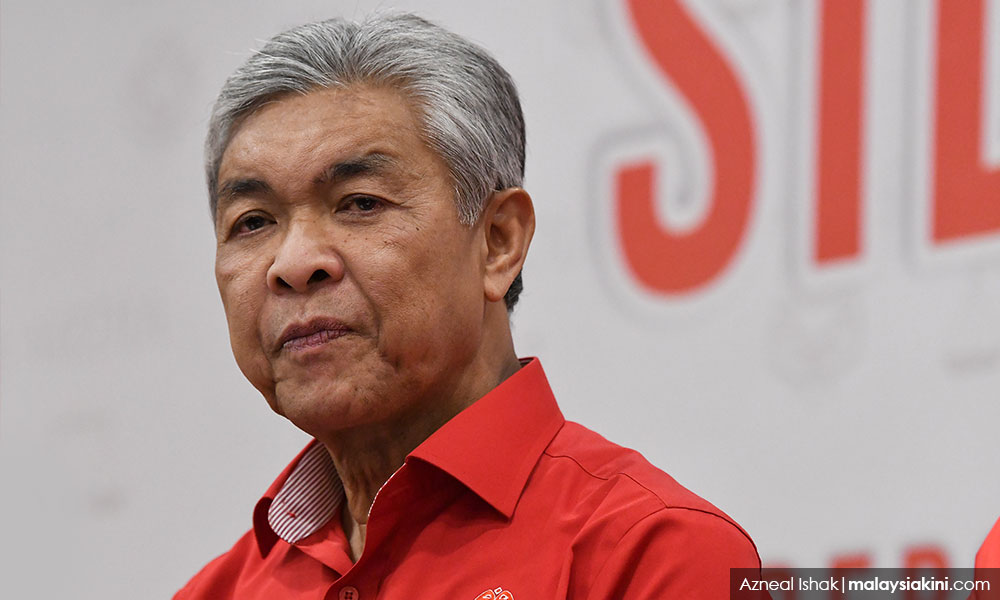

Umno factional fight: How Zahid uses state polls to besiege the centre
Speculation has been rife that Johor may be the next state to hold an election following Malacca and Sarawak.
Political analysts opined it is possible and also welcomed the trend of having national and state elections separately.
The internal struggle within Umno may trigger the...
Speculation has been rife that Johor may be the next state to hold an election following Malacca and Sarawak.
Political analysts opined it is possible and also welcomed the trend of having national and state elections separately.
The internal struggle within Umno may trigger Johor polls, said political scientist Wong Chin Huat.
"Umno is not targeting PKR, but Bersatu. It wants to wipe out Bersatu via state elections," he told a virtual forum dubbed "Malacca and Sarawak State Poll: Benchmark for Next General Election?" held on Wednesday.
"In addition, they (Umno president Ahmad Zahid Hamidi's faction) may not fall out with Ismail Sabri Yaakob if the latter insist to stay on (as prime minister) until next year. But they (Zahid's faction) can still besiege the federal by calling for elections in these states.
"With two or three states dissolving their state legislative assemblies and holding elections, the federal may have to follow suit," he said.
Wong said the Covid-19 pandemic is the most significant reason behind the postponement of an election.
"But when everyone is used to it (state polls during a pandemic), Parliament has to be dissolved too," he added.

Wong said it is beneficial for the voters when the national and state elections are held separately as it would be tougher for political parties, which need to seek a mandate from the voters, to do something bad.
He added that it is "abnormal" for Malaysia to conduct the national and state polls simultaneously.
"Australia even stipulates that federal and state elections cannot be held on the same day. So, this is an opportunity for us to return to normal. It may sound like we want (the country) to be in chaos, but a power struggle comes when there is democracy.
"When federal and states hold elections simultaneously, the voters are likely to be influenced by major issues across the nation, resulting in the same type of political parties coming into power. It is tough to have check and balance in place," he said.
The virtual forum was jointly held by Kuala Lumpur and Selangor Chinese Assembly Hall (KLSCAH) and Pocket Times New, a video portal linked to Sin Chew Daily.
Open competition is good
Besides Wong, Merdeka Center research manager Tan Seng Keat and Universiti Malaya senior lecturer Ngu Ik Tien also agreed on holding the national and state elections separately.
Tan said an election in Johor is possible, particularly following the death of Bersatu's Kempas assemblyperson Osman Sapian. The number of state seats controlled by the government and the opposition becomes closer.
Following the former menteri besar's death, the 56-seat Johor assembly now has 14 representatives from Umno, Bersatu (11), MIC (two) and PAS (one), totalling 28 for the government, while Pakatan Harapan has 27 seats.
Tan said open competition is good as he noted that Malay politics is no longer an internal fight within Umno but now has become a contest between parties for talents, resources, and ideas.
"Open competition in politics allows us to examine the process of competition, and the inferior stuff will be eliminated," he added.

Ngu however felt it is unlikely that separate elections for federal and state seats would become a trend in the peninsula.
"In Sarawak, the federal and state elections are held separately. The Sarawak government felt it will run out of luck by staying with the federal government as people will vent their frustration towards the federal government on the state government.
"But I don’t think there is such a sentiment in the peninsula. There are no identity issues here. For instance, Selangor will be opposing the federal government just because of being Selangor.
"As such, the federal government will pick the best time to hold elections in order to win the federal and state polls," she said.
"But as an ordinary citizen...if the elections are held separately, then the state government will answer to us one more time and allocate another round of allocation to us, which is more beneficial to the people," she added.
So far, there have been three state elections - Sabah, Malacca and Sarawak - after the 2018 general election.
The Sarawak election was called after the term of the state legislative expired in June, while Sabah and Malacca were forced to hold fresh polls in September 2020 and November respectively following political coups.
READ MORE
Harapan loses shine after state polls, risks becoming 'third force'






Report this comment
Are you sure you want to delete this comment?
This action cannot be undone.