




MCA Youth backs press freedom committee
MCA Youth has pledged support for a parliamentary select committee on press freedom, following controversy generated by the sale of the Barisan Nasional component party's stake in Nanyang Press Holdings to Chinese print media mogul Tiong Hiew King.
MCA Youth has pledged support for a parliamentary select committee on press freedom, following controversy generated by the sale of the Barisan Nasional component party's stake in Nanyang Press Holdings to Chinese print media mogul Tiong Hiew King.
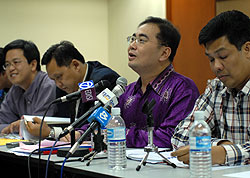 The wing - represented by secretary-general Wee Ka Siong, vice-chief Boey Chin Gan, Loh Seng Kok, Gan Ping Shou, Hang Chin Pheng and Wong Nai Chee - held a rare dialogue with student leaders held at MCA headquarters in Kuala Lumpur last Friday.
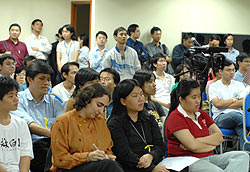
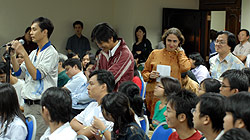
About 100 students and representatives of non-governmental organisations attended the session.
The students had organised protests nationwide outside the offices of Sin Chew Daily , which is part of Tiong's media stable.
Wee, Wong and Loh said they would support a parliamentary select committee on media freedom. Wong also said he would moot the creation of a select committee when the next session of Parliament begins in March.
 Loh, the Kelana Jaya MP, said there is a sub-committee that discusses media freedom within the select committee on National Integration and Unity, in which he sits. However, he did not elaborate.
"We can't just rely on solely on MCA to pursue media freedom. Public support is vital as well," said Wee.
He reiterated the party's stand that the disposal of shares was a purely commercial decision as Chinese daily Nanyang Siang Pau was haemorrhaging financially.
When questioned, Boey conceded that the Nanyang purchase had been a political decision, but did not elaborate. The party took over the company in May 2001 in a unpopular decision that split the party into two factions.
 Tiong gradually acquired shares from MCA and became the largest shareholder on Oct 18. On Nov 27, tycoon Lau Swee Nguong - who owns rival media company KTS -
offered
to buy Tiong's stake in a bid to return ownership of
Nanyang
to the Chinese community.
Tiong gradually acquired shares from MCA and became the largest shareholder on Oct 18. On Nov 27, tycoon Lau Swee Nguong - who owns rival media company KTS -
offered
to buy Tiong's stake in a bid to return ownership of
Nanyang
to the Chinese community.
Gan said no offers have been received from any party to acquire MCA's remaining stake in Nanyang.
'No straight answers'
Students interviewed considered the dialogue a disaster, saying the Youth leaders had not given "straight answers".
"Everyone knows that MCA's acquisition and disposal of Nanyang Press shares cannot purely be just a commercial decision. There must be the political factors as well," said a student.
Said another: "We are disappointed that they did not reveal the hard facts."
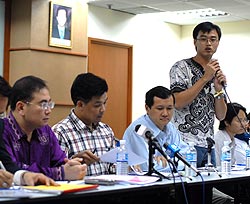 Student leader Lee Khai Loon (
standing
) said the answers "did not indicate clearly what remedial steps would be taken", but that the dialogue was a good start in opening up a channel of discussion.
Student leader Lee Khai Loon (
standing
) said the answers "did not indicate clearly what remedial steps would be taken", but that the dialogue was a good start in opening up a channel of discussion.
The students' group, Concerned Young Citizens, handed over a two-page memorandum after the dialogue.
In it, they demanded that the MCA relinquishes its remaining stake to a non-dominant player and that these shares must not be sold to Umno-linked Media Prima or Tiong.
They also called on MCA parliamentarians to support a select committee or parliamentarian caucus on media reform.
"Readers, advertisers, journalists and the whole nation all stand to lose, while Tiong wins. MCA's irresponsible decision to divest its stakes to Tiong is adding insult to injury," said the memorandum .
Students have argued that concentration of ownership allows Tiong to control circulation and advertisement pricing in the Chinese media, check journalists' bargaining power and determine agenda-setting and gatekeeping in newsrooms.
They said the monopoly facilitates news censorship as the government "can easily now hold Tiong to ransom".
However, Youth leaders insisted that MCA has never interfered with Nanyang Siang Pau's editorial policy.
Boey cited the example of extensive coverage of the controversial purchase of luxury cars through the Customs Department by MCA leader and Deputy Finance Minister Dr Ng Yen Yen.
"After we took over, many party leaders and grassroots members were not happy because the newspaper did not give us coverage. We never told Nanyang what to publish," he claimed.


