




Glaring digital divide in M'sia
With 14 years left for Malaysia to achieve its target of being a fully industrialised nation, the digital divide here remains highly pronounced with large segments of society having little or no access to Information and Communication Technologies (ICTs).
With 14 years left for Malaysia to achieve its target of being a fully industrialised nation, the digital divide here remains highly pronounced with large segments of society having little or no access to Information and Communication Technologies (ICTs).
The government's efforts to narrow the divide so far has been described as largely unco-ordinated with uneven reach of programmes to under-served sections of society.
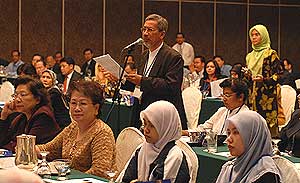 "Earlier lessons are not being adequately applied to current initiatives," said business consultant Dr Roger Harris at a forum organised by the Economic Planning Unit (EPU) and United Nations Development Programme (UNDP) in Kuala Lumpur today.
Harris said many development programmes are not making use of ubiquitous ICTs, which are mobile phones, television and radio.
The government has also failed to make use of existing ICT infrastructure, he noted.
"Malaysia's digital divide remains highly pronounced. Mobile phones have overtaken fixed lines. Radio and TV are at saturation. However, Internet has hardly begun. Computers are off the bottom rung," he said.
Target date
Harris said government policies regarding ICTs have not been blended "into policies for socioeconomic development for under-served groups."
He said there is overemphasis in providing coverage to urban dwellers. "We are providing broadband to people who already have access. There need's to be balance where resources are diverted," he added.
Asked during the question and answer session whether Malaysia should set a target date for it to close the digital divide, Harris said he is confident the divide would be closed "inline with the country's aspirations to be fully developed by the year 2020."
However, he did not indicate the time frame when this would be achieved.
"I rather not raise expectations," he said, adding that he had held a private discussion with government officials recently on the matter.
A member of the audience, National Union of Teaching Profession (NUTP) secretary-general Lok Yim Pheng felt that the Economic Planning Unit (EPU) had problems co-ordinating government programmes.
"A lot of money and time is wasted because each unit is busy with its own projects. There's no communication," she said.
She said the EPU provided low quality equipment and the unit overlooked families who cannot afford computers. Lok also suggested that a non-government body heads any impact assessment teams whenever a new programme is implemented.
"We need a neutral body to get feedback. This should apply to whatever projects introduced," she said.
EPU deputy director-general Noriyah Ahmad, who was also present, said she would look into the matter.
Penetration rates
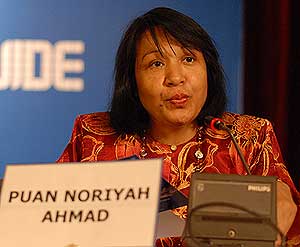 When Noriyah was directed a question on whether Malaysia would emulate Singapore, where three wireless operators will provide free wi-fi coverage in 5,000 locations islandwide by Sept next year, she deferred the query to Ministry of Science and Technology Institute representative Megat Sharifuddin Megat.
"Malaysia is expected to adopt the WiMAX (Worldwide Interoperability for Microwave Access) technology. That would help us with the penetration rates," said Megat, adding that the matter fell under the Energy, Water and Communications Ministry.
It's Minister Dr Lim Keng Yaik announced last month that the government would assign WiMAX 'spectrum' to three companies by the end of this year. He said the country will see at least two WiMAX operators by the end of the year.
WiFi coverage is limited to "hotspot" areas of around 100m, a WiMAX tower can provide broadband wireless access within a 50km radius.
The Malaysian Communications and Multimedia Commission (MCMC) had said it received a total of 17 submissions in the tender for 2.3GHz spectrum.
Among the bidders are DiGi.Com Bhd, Maxis Communications Bhd, Telekom Malaysia Bhd, REDtone International Bhd and NasionCom Holdings Bhd.
Perak offers wireless connection
Meanwhile Bernama reported that Perak is set to be the leader in providing free wireless broadband internet service all major towns in the state by April next year.
Menteri Besar Tajol Rosli Ghazali said the service would be available at all 15 district council areas in Perak.
At present Ipoh offers such a facility, which is available at the three rest and recreation areas along the North-South Highway in Perak since last March.
Tajol said that the state government allocated RM20 million annually for development of information and communication technology (ICT) of which RM19 million was for infrastructure cost and the remaining for training.


Are you sure you want to delete this comment?
This action cannot be undone.