


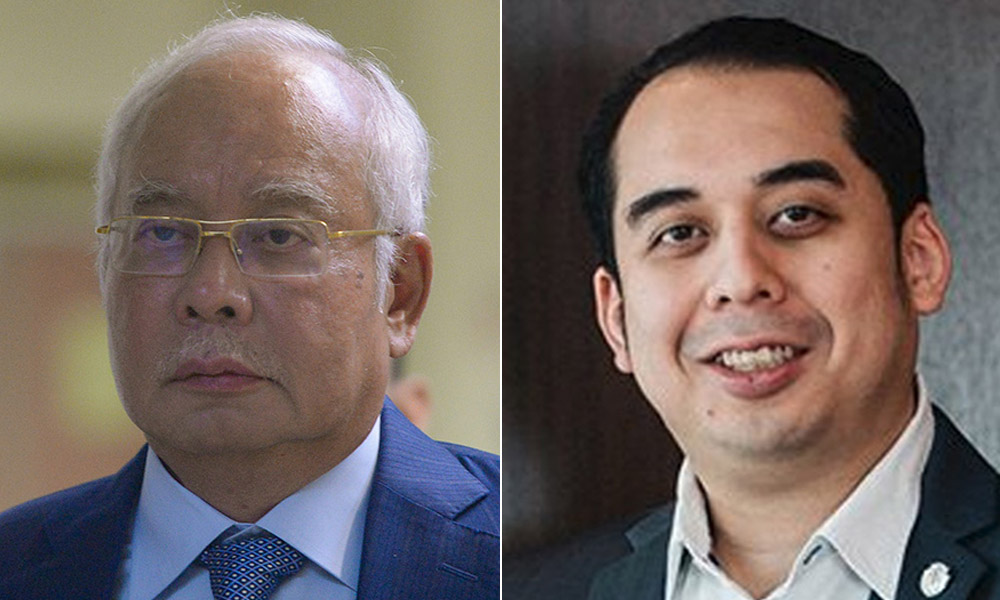

Court postpones Najib, son's hearing as IRB rep gets Covid
As a result, the Federal Court has vacated the Feb 16 hearing date for appeal leave applications by Najib Abdul Razak and his son Mohd Nazifuddin over tax-related summary judgement against the duo.
The father and son’s counsel Wee Yeong Kang today confirmed that...
A revenue counsel for the Inland Revenue Board (IRB) came down with Covid-19.
As a result, the Federal Court vacated the Feb 16 hearing date for appeal leave applications by Najib Abdul Razak and his son Mohd Nazifuddin over tax-related summary judgement against the duo.
The father and son’s counsel Wee Yeong Kang today confirmed the apex court set a new hearing date on May 10.
The lawyer explained that on Feb 8, the tax authority sought the postponement as one of their officers, tasked to represent them in the appeals, tested positive for Covid-19.
“IRB applied for the adjournment on Feb 8, 2022, as one of their revenue counsel tested positive for Covid-19.
“The (Federal) Court allowed their adjournment application,” Wee said when contacted this afternoon.
The lawyer added that following today’s case management, the Federal Court fixed May 10 as the new hearing date of the appeals by Najib and Nazifuddin.
Revenue counsel Sakinah Najwa Hussin appeared for the IRB in today’s case management.
Najib and Nazifuddin are appealing against a Court of Appeal dismissal of their appeal to quash High Court summary judgement rulings in the RM1.69 billion and RM37.6 million tax suits against them, respectively.
Two years ago, two separate benches of the High Court in Kuala Lumpur allowed the IRB’s application for summary judgement in the tax suits.
In effect, this allowed the lower courts to rule in favour of the IRB in the tax suits against Najib and Nazifuddin, without needing full trial, which could have considered the duo’s possible defence.
Relying on the summary judgement rulings, the IRB has since commenced bankruptcy proceedings against Najib and Nazifuddin to recover the tax arrears.
However, on Oct 21 last year, the Court of Appeal allowed an application by Najib and Nazifuddin to stay the tax-related summary judgments against the duo, pending their appeal to the Federal Court.
Under Malaysian law in regard to civil action matters such as the tax-related ones by Najib and Nazifuddin, any such appeal to the Federal Court would require the apex court’s leave beforehand.
If leave is granted, the apex court would set a date to hear the merits of the appeal.
One central issue in the appeals is whether Section 106(3) of the Income Tax Act 1967 (ITA) is invalid for contravening Article 121 of the Federal Constitution.
Section 106, in general, empowers the IRB to institute a civil action in court to recover tax arrears and penalties from taxpayers.
Section 106(3) specifically states when in relation to IRB’s civil action to recover taxes, the court “shall not entertain any plea that the amount of tax sought to be recovered is excessive, incorrectly assessed, under appeal or incorrectly increased”.
Article 121 is in relation to the powers of the judiciary in Malaysia.
In their appeals, Najib and Nazifuddin’s legal team contended that Section 106(3) is unconstitutional as it takes away the court’s power (as per Article 121) to consider the defence of a taxpayer against the IRB’s civil actions to recover the tax.

/file/publisher-c1a3f893382d2b2f8a9aa22a654d9c97/2020/07/2f971a43582e59027d90e227e88fac9a.jpg)


Are you sure you want to delete this comment?
This action cannot be undone.