
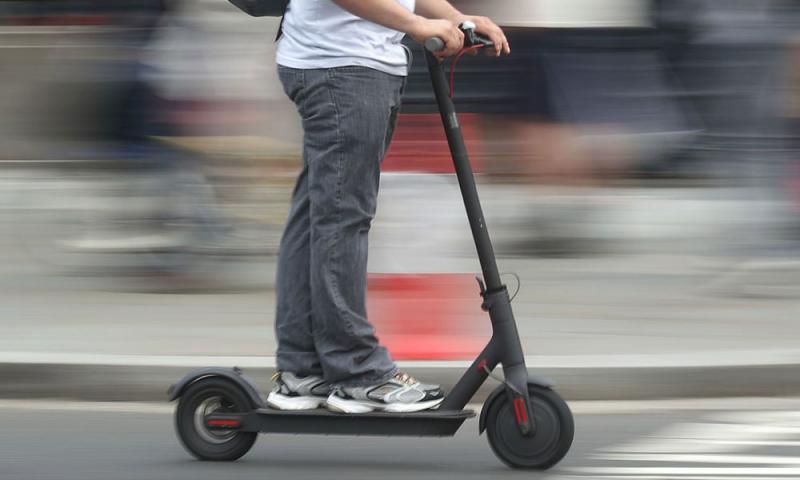
Micromobility vehicle ban: Confusion reigns despite clarification
There is still much confusion regarding the Transport Ministry's newly announced ban on micromobility vehicles despite Minister Wee Ka Siong's clarification on Wednesday.
For instance, while the minister has specifically addressed the issue of personal mobility aids (PMAs) by saying that people with disability can still use such vehicles to cross roads, questions remain for other types of micromobility vehicles.
There is still much confusion regarding the Transport Ministry's newly announced ban on micromobility vehicles despite Minister Wee Ka Siong's clarification on Wednesday.
For instance, while the minister has specifically addressed the issue of personal mobility aids (PMAs) by saying that people with disability can still use such vehicles to cross roads, questions remain for other types of micromobility vehicles.
Apart from PMAs, mopeds and personal mobility devices - whether powered by a human, an engine, or batteries - are also affected by the ban.
Can people on mopeds and electric scooters cross walkways?
According to the Road Traffic (Prohibition of Use of Certain Micromobility Vehicles) Rules 2021, people are banned from using any of the micromobility vehicles listed in the rules "on any part of any road".
The term "any part of any road" also raises questions about whether it also applies to footpaths in public areas, as well as those on public premises such as condominium complexes.
According to an infographic released by the ministry, the ban is applicable to pedestrian crossings too.

The rules came into force on Dec 17 last year after it was gazetted a day earlier but were only made known when Wee announced it on April 26 this year.
At a press conference on Thursday, however, Wee said the ban is only applicable to public roads.
For example, people can still use mopeds or electric bicycles on walkways, in shopping malls, or even inside buildings like the Kuala Lumpur International Airport (KLIA).
"They can use (micromobility vehicles in) shopping (malls) or walkways. No issue. No one will stop them.
"For instance, at KLIA, they can use mopeds or e-scooters. We allow that, no issue (to use) inside a building because the distance is two, three kilometres.
"We know there are security guards using micromobility vehicles. That is not an issue, as long as they don't use it on the public roads."
When asked, Wee's special function officer, Mike Chong Yew Chuan, clarified that the ban is targeted at public road users only.
According to Chong, other surfaces such as shopping mall areas, sidewalks, five-foot ways, and park areas are not under the Transport Ministry's jurisdiction.
Nevertheless, local governments and owners of parks and shopping malls would have to decide whether to allow the use of micromobility vehicles in their areas.
"Sidewalks are not under the Transport Ministry's jurisdiction, so it's up to local governments to decide (whether to allow micromobility vehicles)".

Even if micromobility vehicles are allowed on footpaths, however, another question arises – how to ensure the safety of pedestrians?
Chung Yi Fan, who was Anthony Loke's special functions officer when the latter was transport minister, told Malaysiakini that the ban would drive micromobility vehicle users onto the sidewalks.
This could lead to more accidents involving pedestrians.
If the government's policy is unclear, he said both pedestrians and riders could face problems making insurance claims in the event of such an accident.
He conceded that micromobility vehicles need to be regulated, but he disagreed with the government's "one size fits all" approach.
Instead, he urged the ministry to use Singapore's approach to micromobility vehicles as a model for formulating a more comprehensive policy.

He pointed out the Singapore authorities have specified different types of roads and paths, the types of micromobility vehicles that are allowed on each type of surface, and the conditions of their use.
"For instance, devices powered by electricity cannot be used on footpaths. They can ride on public roads but need to wear helmets, and users are required to pass a test.
"The key is to protect (micromobility vehicle) users and other road users through regulation, instead of banning them entirely," he said.
According to the Singapore Land Transport Authority's website, the riders' types of micromobility vehicles will determine where they can ride. If they ride on the wrong path, they will be penalised.
Limits on speed, weight, width, the user's age, and the number of passengers are also imposed, depending on the type of device involved.
A copy of the Road Traffic (Prohibition of Use of Certain Micromobility Vehicles) Rules can be found below. The English version is in the second half of the document.


Are you sure you want to delete this comment?
This action cannot be undone.