


Filmmakers attempt to piece together fragments of Hang Tuah
Most Malaysians would be familiar with the legend of Malay warrior Hang Tuah through pop culture, the education system, and folklore.
Despite this, there is much dispute about the specifics of his story - his appearance, his origin, and where his remains now lay in the region, among other things.
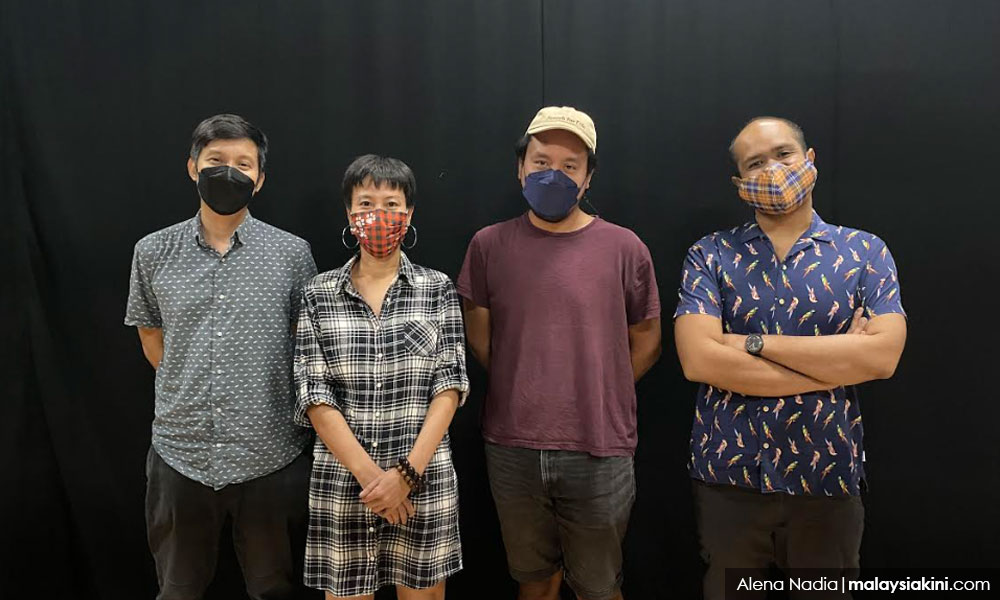
Although initially hesitant to approach the material, theatre practitioners - Faiq Syazwan Kuhiri, Mark Teh, Wong Tay Sy and Syamsul Azhar - set out to assemble the jigsaw puzzle that Hang Tuah had evolved into over the years through their video essay ‘Fragments of Tuah’.
The four are also members of the Five Arts Centre.
Speaking to Malaysiakini, Teh explained that they first explored it as a potential performance piece before it unfolded into a short film during the Covid-19 pandemic.
The idea to explore the amorphous Hang Tuah came after Teh’s discovery of a book written by Universiti Putra Malaysia academic Hashim Musa called ‘Hang Tuah Catatan Okinawa’ (Okinawa notes on Hang Tuah) while conducting a research project on the Okinawa prefecture in Japan.
“It seemed like a conspiracy theory. The book argues that Hang Tuah existed because a keris was found in Okinawa and he also existed because, in the Okinawan courts, they have letters from a laksamana (army general) from Malacca - it may not have been Hang Tuah necessarily but it was signed as ‘Laksamana Melaka’,” said Teh.
“So, I spoke to Faiq, Wong, and Sam (referring to Syamsul). Of course, none of us was interested in Hang Tuah, for obvious reasons like (Hang Tuah is seen as a) patriarchal, nationalistic ‘Umno’ kind of figure.
“From this discomfort of looking at Hang Tuah, we wanted to lean into it, precisely because we didn’t have any affinity with the character.
“Let’s investigate that, why are we uncomfortable with it? That's where some of the more personal things come out,” Teh added.
He referred to collaborators Faiq and Wong’s closer connections to the mythic laksamana due to the former’s ethnic identity and the latter originating from Malacca.
Influences
The 47-minute long video essay unravels seven sets of ideas dealing with different aspects of what Hang Tuah means in several contexts.
Influenced by the likes of Farish Noor, Kassim Ahmad and Ishak Haji Muhammad (Pak Sako), the group undertook reading sessions together to tease the tale of the warrior out of the ‘Hikayat Hang Tuah’ chronicles.
It had also helped to contextualise the hero with the stories of his then-global contemporaries such as Christopher Columbus and Ferdinand Magellan.
Teh noted that the epic consists of approximately 500 pages and that the climax of the Hang Tuah-Hang Jebat struggle covers “only 60 percent of the story”.

According to the chronicles of Hang Tuah, Malacca ruler Sultan Mansur Shah sentenced him to death for treason, but a Malacca bendahara (chief minister) rescued and hid him in a remote region of Malacca.
Upon the discovery that Hang Tuah was still alive, the sultan called the warrior back, providing him full amnesty before commanding Hang Tuah to kill Hang Jebat.
Hang Tuah’s loyalty to the sultan led him to oppose Hang Jebat - who was eventually stabbed by Hang Tuah.
The remaining half of the chronicles is described by the filmmakers to be written like a travelogue of a wandering Hang Tuah.
Faiq, who narrates the majority of the video essay from the perspective of a Malay male musician living in Kuala Lumpur, pointed to a particular essay by Farish on the Hang Tuah-Hang Jebat debate as being helpful in the making of the film.
“This story is unknown to me - and I think, to a lot of people. It opened up the ‘hard’ symbol of Hang Tuah and brought forth possibilities of the reimagined Hang Tuah, according to how we saw it.
“I think that’s where the personal point of view sits to reassess this character from a poetic perspective,” he said.
Faiq also drew more obvious comparisons between the video essay and the song ‘Hang Loklaq’ by Terrer, a rock outfit he fronts, which was also pointed out in ‘Fragments of Tuah’.
Past and present
Wong coincidentally grew up a stone’s throw away from the Hang Tuah mausoleum in Kampung Kling, Malacca and described her fascination with the locations mentioned in ‘Hikayat Hang Tuah’.
“If you read the ‘Hikayat Hang Tuah’, it mentions these names. These are all names familiar to me - Kampung Kling, Kampung Jawa. Of course, the image (of the area) is now different.
“That means (back in the day), these areas in Malacca were already there. Of course, there is Bukit Cina. These names suddenly went beyond (being) just names to me,” she said.
“What I’m trying to say is, I’m reluctant to associate with Hang Tuah. We would all say we are more of a Hang Jebat person, because what Hang Tuah did not make sense,” added Wong.
In the video, viewers are shown various locations associated with the hero by name via Google Maps - such as Jalan Hang Tuah in Kuala Lumpur, Universitas Hang Tuah in Surabaya and Perigi Hang Tuah in the Pattani region of Thailand.
Keris found in Okinawa
There is a saying that a keris without its handle is said to have lost its soul.

This was the state of a keris found in Okinawa two decades ago. Without its curved pistol-grip hilt, it is nothing but a mere double-edged wavy blade.
Yet, it is the premise on which Hang Tuah’s existence rests on in ‘Hang Tuah Catatan Okinawa’.
Based on court reports from Okinawa which detailed correspondence between the Malacca sultanate and the Okinawan government, it is said that a laksamana from Malacca had travelled to the Japanese prefecture.
The examined letters were alleged to have been written and signed by Hang Tuah.
Contemplating this discovery of the keris, Wong felt that the keris, being one of Hang Tuah’s most symbolic items, was another interesting aspect central to his identity as a Malay man.
“What else symbolises a Malay man? It’s actually the tanjak (a traditional Malay headgear made from long songket cloth folded and tied in a particular style).
“For a Chinese man, headgear coming in different shapes and lengths symbolises your ranking,” she said.
In the course of making the film, Wong explained she came across a documentary on traditional Okinawan textiles which was similar to Malaysian batik.
“They had this cloth that they would dye in seawater. This scene was so beautiful. I told them about it.
“How do we show Hang Tuah liberated in a sense - like he disappeared in the sea? How can that scene be achieved?
"What if we had a tanjak? A tanjak looks like a boat. That’s why that last scene is very subtle,” she said.
Wong added that the final scene in the film was symbolic of how the filmmakers attempted to soften the hardened image of Hang Tuah as a Malay warrior.
It shows the tanjak losing its form as it drifts along Malaccan waters to the melancholic singing of the narrator.
"I will disappear into the world," were the final words sung by Faiq.
When asked if they might explore Hang Tuah further in future projects, the group admitted that they were open to the possibility of interpreting other parts of the ‘Hikayat Hang Tuah’ as much remains unexplored.
‘It would be nice to see the women’s side of Hang Tuah,” said Wong, who added that female characters were mostly accessory characters, and were not focused on in the ‘Hikayat Hang Tuah’.
The video essay is supported by the Japan Arts Fund and Saison Foundation.
The film is presented in English with the option of subtitles in Japanese and Malay. Ticketed viewing of ‘Fragments of Tuah’ is available to watch on Vimeo.




Report this comment
Are you sure you want to delete this comment?
This action cannot be undone.