
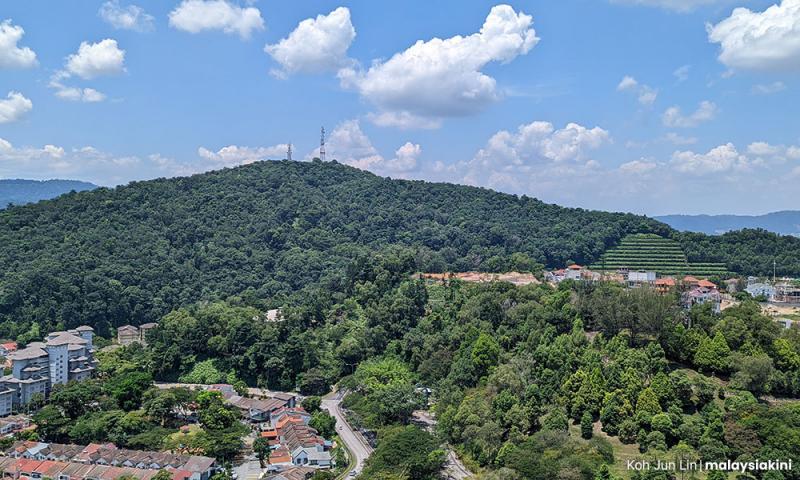
Bukit Dinding project's 2017 EIA report still valid, says developer
In an email response to Malaysiakini, the developer said: “The approved EIA report in 2017 remains a valid document to date.”
This clarification comes in response to claims by resident associations around Bukit Dinding in Northeast Kuala Lumpur that the EIA report was alarmingly outdated.
According to the report, it was completed eight years ago in 2014 with geotechnical...
A developer planning to build 300 condominium units at the foot of Bukit Dinding in the capital said that its 2017 Environmental Impact Assessment (EIA) report is still valid.
Nova Pesona Sdn Bhd which received Kuala Lumpur City Hall’s (DBKL) approval for the project, told Malaysiakini in an email response: “The approved EIA report in 2017 remains a valid document to date.”
This clarification comes in response to claims by resident associations around Bukit Dinding in Northeast Kuala Lumpur that the EIA report was alarmingly outdated.
According to the report, it was completed eight years ago in 2014 with geotechnical elements checked by Ikram Premier Consulting and received conditional approval in 2015.
However, a resident of nearby Bukit Setiawangsa since 1995, Mustafa Kamal Abdul Aziz, contends that after two years, EIA reports are invalid.
“They stopped taking data in 2014 so it was outdated in 2017.
“They got an extension in 2019 but whether they updated their data is a question to us because they did not share any reports with residents’ associations here,” said Mustafa, who is an honorary professor with the University of Nottingham in the study of chemical engineering.
Nova Pesona plans to commence construction in the second half of next year.
“We take weather conditions into consideration in our planning and will only start preliminary work in the next few months.
“This will include erecting the hoarding and temporary drains,” the developer revealed.
Keeping the report alive
Nova Pesona said, moving forward, the post-EIA process involved the submission of an Environmental Management Plan (EMP).
“This involves periodic monitoring, reporting, and auditing of environmental compliance for the site.
“The EMP is considered a living document and will be updated with changes happening at the site, during development,” read the email.
The developer explained that the geotechnical element of the project was properly checked by Ikram.
“Ikram’s independent report and our appointed geotechnical consultant’s design report have all been submitted to DBKL,” it added.
The existing Bukit Dinding green lung stretching across a 121ha area is private property belonging to multiple owners.
The latest development approval for the condominium units was on a 2.4ha area which was part of a 52ha parcel owned by Nova Pesona.
DBKL’s Town Planning Department director Zulkarnain Hassan approved the development plan on March 28 this year but 6,000 residents living around Bukit Dinding claim to have been left in the dark of this approval.

Shocked that the development of two high-rise blocks was approved, residents who are still haunted by the memory of a catastrophic landslide incident in Puncak Setiawangsa in 2011, have objected vehemently to the approval.
Zulkarnain’s approval comes mere months after five slope failures occurred on Dec 19, 2021, shining the spotlight on hazards that await residents should the hillslope come thundering down.
However, following objections, Zulkarnain declared on Monday (Sept 26) that no construction could take place until retaining walls, berms, and drainage were constructed.
Last week, DBKL also announced that development could not commence until the developer held communication sessions with residents, the first of which was on Sept 15.

Room for misinterpretation
DBKL’s approval was also viewed as a contradiction to its declaration in 2014 of Bukit Dinding being at “high risk” of landslides.
This was announced at DBKL’s launch of the Kuala Lumpur Slope Information System (Kulsis) where the then mayor Ahmad Phesal Talib pointed out Bukit Dinding as one of 1,740 slopes at “high risk” of landslides.
At the 2014 launch, it was also announced that Kulsis would be used in every development proposal and that the city was determining charges to developers for using the system.
The 2014 media reports also revealed Kulsis was created to integrate all relevant information on hill slopes including rivers, roads, geology, and rain distribution.
Phesal explained that the data would be recorded with the Kuala Lumpur Hazard and Risk Map in partnership with Ikram.
However, when asked, Nova Pesona said Kulsis was an online system accessible to DBKL officers only and not to the public.
“It is a slope classification map based on slope gradient and is not meant to classify for development restriction.
“The planning of the development shall be referred to Guidelines for Hillside and Slope Areas Development Planning for Federal Territory of Kuala Lumpur, 2010, (WPKL) in which development Class III can be considered subject to Development Plan.
“Meanwhile, for Class IV, the development can be considered with engineering solutions,” Nova Pesona said.

However, the Guidelines WPKL 2010 was also cited in the Department of Environment (DOE)’s Technical Guidance on Scoping in Preparation of EIA Report for Development on Hill and Slope Area, and revealed another contradiction.
It identified Bukit Arang, Bukit Gasing, and Bukit Dinding as sensitive areas, “only limited to development such as infrastructure, utility, recreation, and maintenance of hilly areas.”
Meanwhile, the Draft Kuala Lumpur City Plan 2020 classifies Bukit Dinding as an Environmentally Sensitive Area (ESA) that is highly sensitive to development or changes in land use.
The city plan lists Bukit Dinding under ESA Rank Two as a hill land and under Rank Three as a hillside.
ESA Rank Two allows no development except for low-impact recreational activities.
ESA Rank Three allows controlled development subject to compliance with requirements specified by the Kuala Lumpur Development Control Plan 2008.

Residents fear for their lives
Mustafa said there were two contradicting hill slope development guidelines issued by the DOE which left loopholes for developers.
“In the 2010 guidelines, Bukit Dinding is identified as an ESA but in their 2017 guidelines, Bukit Dinding was omitted,” he said.
He explained that the omission was not mentioned or justified so it cannot be assumed that the hill was now safe for development.
Mustafa said Nova Pesona’s 2017 EIA report implied that the hill will be safe after the project was completed.
“But that is a wrong assumption.
“In 2021, when climate change brought higher rainfall, the groundwater in the hill shifted and found another outlet.
“It didn’t crash in the areas that were fixed, it crashed around those (other) areas,” he pointed out.

Setiawangsa MP Nik Nazmi Nik Ahmad said weather patterns were changing dramatically and slope stability was a valid concern.
“Residents in Setiawangsa, neighbouring Bukit Antarabangsa and Highland Towers have valid concerns and just complying with the letter of the law was not enough for their safety.
“They deserve transparency because they fear for their lives and property.
“Residents want to see DBKL as a real authority that acts on behalf of the community without biases against residents,” said Nik Nazmi, who explained that his campaign promise in the 2018 general election was to reform DBKL.
Nik Nazmi, whose MP office is about 5km from Bukit Dinding in Sri Rampai, stressed that slope stability is important.
He said that even if the developer built a park that was handed over to DBKL for maintenance, it would mean nothing if residents’ houses got buried in a mishap.
A Housing and Local Government Ministry circular issued in August 2021 sighted by Malaysiakini yesterday, revealed that 81 percent of local authorities do not implement hill slope maintenance.
/file/publisher-c1a3f893382d2b2f8a9aa22a654d9c97/2022/09/a0018ae375ef4e28128635fb32f6cc31.jpg)

/file/publisher-c1a3f893382d2b2f8a9aa22a654d9c97/2022/09/db3f7b0fc6a18ed1081b6e14cc577398.jpg)
/file/publisher-c1a3f893382d2b2f8a9aa22a654d9c97/2022/07/31a0effc0e5c3be35d26c110d64c26da.jpg)
/file/publisher-c1a3f893382d2b2f8a9aa22a654d9c97/2020/09/a2d1cf7fadb3f8b7f7d134f9bc9f485e.jpg)
Are you sure you want to delete this comment?
This action cannot be undone.