


/file/publisher-c1a3f893382d2b2f8a9aa22a654d9c97/2019/09/606f69c5d0952805ea19970d35d58e21.jpg)

'Parliament dissolved, why Najib still pursuing legal challenge?'
A government legal representative questioned why incumbent MP Najib Abdul Razak is still pursuing a legal challenge to attend Parliament when the august house was already dissolved last week.
Senior federal counsel Shamsul Bolhassan said this in raising his objection against the Kuala Lumpur High Court giving leave to the former premier to proceed with the judicial review.
During proceedings before judge...
A government legal representative questioned why incumbent MP Najib Abdul Razak is still pursuing a legal challenge to attend Parliament when the august house was already dissolved last week.
Senior federal counsel Shamsul Bolhassan said this in raising his objection against the Kuala Lumpur High Court giving leave to the former premier to proceed with the judicial review.
During proceedings before judge Ahmad Kamal Md Shahid this afternoon, Shamsul, who represents the government, the home minister, and the prisons commissioner-general, pointed out that the whole legal action has become academic.
The counsel said the reliefs sought in the judicial review were for situations that no longer existed, namely for Najib to attend previously-scheduled Dewan Rakyat sittings until Nov 29, and for him to have access to aides to facilitate constituency work in Pekan.
“It is not disputed and the court can take judicial notice that it is known throughout the world that the Malaysian Parliament has been dissolved.
“We see that the declaration sought (in the judicial review) is academic,” Shamsul said.
“Here, we say there is no controversy as his application for his officers to visit him for parliamentary constituency work is no longer there when Parliament was dissolved.
“We say the circumstances have changed (since the judicial review was filed on Oct 5) when Parliament was dissolved.
“So the practical question is why do you need to attend Parliament and why do you need access for legislative and parliamentary and constituent work,” Shamsul argued in his oral submission.
However, Najib’s counsel Muhammad Shafee Abdullah countered the matter is not academic as there is still an arguable case that needs leave to be granted so that a full hearing of the merits of the judicial review can be conducted by the court.
The lawyer contended that among these triable issues is whether Section 31 of the Prisons Act 1995 grants the prison commissioner general the power to order a convict to be produced at certain places in Malaysia.
Section 31 deals with the power of the prison commissioner-general to order the production of a prisoner in some instances.
The provision states that the prison commissioner-general “may, being satisfied that there are reasonable grounds requiring the presence of a prisoner at any place in Malaysia, or shall, where the presence of a prisoner is required for the purpose of any public inquiry, by order in writing, direct that the prisoner be taken to that place”.
Subsection 2 of the provision states that such prisoner “shall, whilst outside that prison, be kept in such custody as the commissioner-general may, by order in writing, direct, and whilst in that custody shall be deemed to be in lawful custody”.
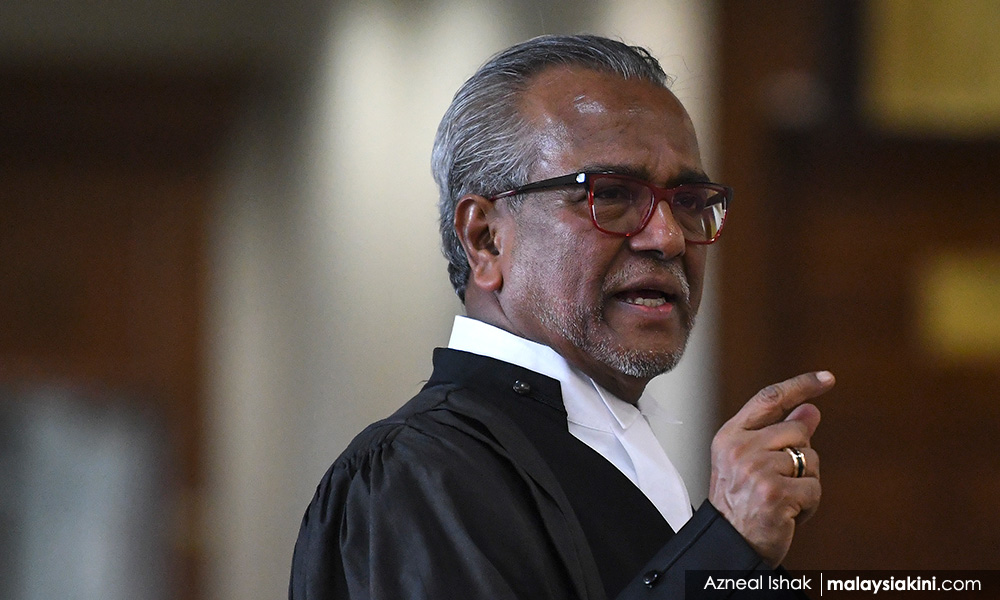
At the end of proceedings today, Kamal set Oct 27 for a decision on whether to grant leave to Najib to commence with the judicial review.
Only if the court grants leave, then it would set another date to hear the parties’ oral submissions on the merits of the legal action.
Mandamus order
On Oct 5, incarcerated Najib filed the judicial review leave application to be allowed to participate in Dewan Rakyat proceedings.
The BN lawmaker is seeking a court order to have access to his parliamentary officers in order for him to do his work as an MP, and secondly, for him to attend Parliament.
Via an affidavit in support of the legal action, Najib claimed that from Sept 19 onwards, he had been “adversely affected” by the respondents’ refusal to allow him access to his officers/aides for the purposes of parliamentary, legislative and constituent work.
Najib also alleged that he was adversely affected by the respondents who declined him to have “access and attendance in Parliament on the scheduled dates of session/sitting”.
Among the reliefs sought are declarations that he is entitled to attend Parliament on the scheduled session dates and to have reasonable access to his officers/aides for parliamentary, legislative and constituent work.
Najib also seeks a mandamus order to compel the respondents to take necessary steps to allow him to partake in the Dewan Rakyat sessions and have reasonable access to his said officers/aides.
He is serving a 12-year jail term in relation to the RM42 million SRC International corruption case.
Initially a subsidiary of sovereign wealth fund 1MDB, SRC became wholly owned by the Minister of Finance Incorporated (MOF Inc).
Najib also used to be chairperson of 1MDB’s board of advisers as well as adviser emeritus of SRC.
/file/publisher-c1a3f893382d2b2f8a9aa22a654d9c97/2022/09/4c1aa018deffb89e0c9dee6736eaa6f8.jpg)
/file/publisher-c1a3f893382d2b2f8a9aa22a654d9c97/2022/08/e231eda5bc3a749f8097d5563e252898.jpg)
/file/publisher-c1a3f893382d2b2f8a9aa22a654d9c97/2022/08/a1b63c9c9bc269fd7f5e8cc4a25d7d3e.jpg)
/file/publisher-c1a3f893382d2b2f8a9aa22a654d9c97/2020/08/549bbd5428a5adfd22fbd568dfd73e88.jpg)
/file/publisher-c1a3f893382d2b2f8a9aa22a654d9c97/2019/03/1fa389274d5d989423ad06a699c3a18d.jpg)
/file/publisher-c1a3f893382d2b2f8a9aa22a654d9c97/2019/03/bd796a0bd1544370e3b019c598dd0357.jpg)
/file/publisher-c1a3f893382d2b2f8a9aa22a654d9c97/2022/08/173fd70d2f0262d2990ee252da5d9a2b.jpg)
/file/publisher-c1a3f893382d2b2f8a9aa22a654d9c97/2020/12/d749c6d0c2437d389ec4ca7ec7025cc5.jpg)


Report this comment
Are you sure you want to delete this comment?
This action cannot be undone.