




DJZ to give feedback on new education policy
The country's Chinese schools tutelary association, Dong Jiao Zong (DJZ), wants to have a say in the National Education Blueprint, which it describes as unfavourable for Mandarin-speaking communities.
The country's Chinese schools tutelary association, Dong Jiao Zong (DJZ), wants to have a say in the National Education Blueprint, which it describes as unfavourable for Mandarin-speaking communities.
 DJZ, or the United Chinese School Committees Association, expects to complete its education development programme by early next month.
At least 20 teachers and academicians are involved in the drafting of the proposals, said DJZ president Yap Sin Tian when contacted today.
The ad hoc committee will also obtain feedback from education guilds and associations before presenting it to the ministry.
"We will make an overall view of the proposal with special emphasis on government policy impact of Chinese education," said Yap. He did not elaborate on the specifics of the proposal.
The education ministry's blueprint, which will set the direction on education policy in the Ninth Malaysia Plan (2006 - 2010), came under attack late last year after the government announced that will be no new Chinese schools.
Yap today said that DJZ was taking advantage of the feedback invite the ministry offered. Since last month, the public can post their feedback on the Education Ministry's website.
Education Minister Hishammuddin Hussein said yesterday that the ministry also welcomed feedback from the National Union of the Teaching Profession (NUTP) and the DJZ.
Alarming figures
 Goh Kean Seng, chairperson of the proposal committee, said that DJZ welcomed Hishammuddin's comments, but with some reservations.
"The minister said that the policy was not geared towards removing vernacular schools, but time and again, the black and white has contradicted this. We want more concrete effort," said Goh.
From 1970 to 2006, DJZ estimated that the country saw an increase of 2,900 national schools. During the same period, a total of 193 vernacular schools - 58 Chinese schools and 134 Tamil schools - were closed down for various reasons.
DJZ insists that there is a demand for 134 Chinese schools nationwide at present.
Currently, there are 1,810 vernacular schools, 205 of which are run entirely without government aid.
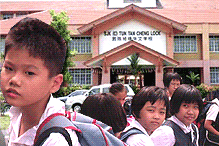 DJZ has long since lamented that the government has spent more money on SK (
sekolah kebangsaan
or national schools) and have marginalised SJK (
sekolah jenis kebangsaan
or vernacular schools).
DJZ has long since lamented that the government has spent more money on SK (
sekolah kebangsaan
or national schools) and have marginalised SJK (
sekolah jenis kebangsaan
or vernacular schools).
"This government has been adopting an open and close policy, vacillating back and forth. But it seems the main trend now is towards openness and multiculturalism. Before they can do that they must overcome chauvinistic forces," added Goh.
In his visit last month, United Nations special rapporteur on education Vernor Munoz Villalobos noted the low numbers of vernacular schools in comparison with the population.
"Communities have to decide what forms of education best suits their needs," he had said.


Are you sure you want to delete this comment?
This action cannot be undone.