




Subashini wins hearing in case against husband
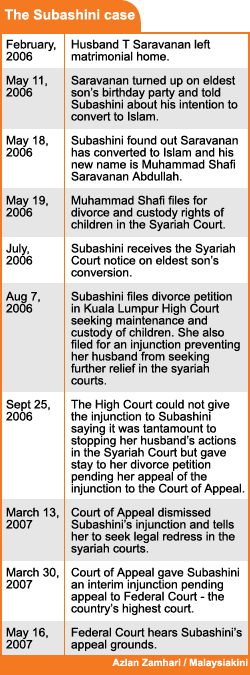
The Federal Court has granted secretary R Subashini leave pending the disposal of her appeal but directed both parties to answer a paramount question concerning jurisdiction before arguing the case further.
The Federal Court has granted secretary R Subashini leave pending the disposal of her appeal but directed both parties to answer a paramount question concerning jurisdiction before arguing the case further.
The issue of jurisdiction - whether civil or syariah courts is more authoritative on the issue of divorce when one spouse converts to Islam - has been a long-standing moot point in Subashini's trial.
The overriding question decided by the three-member panel was whether a court can make a conclusive decision on the issue of jurisdiction or to limit their considerations only to a serious issue of law during an interim injunction application.
Chair judge Abdul Hamid Mohamad said if the answer is in the affirmative, then the nine questions pertaining to issues of jurisdiction and the abuse of process in the conversion of a child that were agreed by both parties will be dealt with.
If it's in the negative, the issue of jurisdiction will not be addressed.
The decision was reached by Abdul Hamid after a 30-minute discussion in chambers with S Augustine Paul and Abdul Aziz Mohamad hearing Subashini's counsel [Malik Imtiaz Sarwar] arguments on the issue of jurisdiction.
Prior to this, Paul appeared unconvinced with Malik's argument that the issue of jurisdiction must be urgently settled by the apex court.
Malik had explained that jurisdiction was decided prematurely in the Court of Appeal that used constitutional reasons to decide in favour of T Saravanan during the interim injunction stage.
Commit same mistake
 "The issue of jurisdiction should have been fully addressed in the High Court when Subashini's divorce petition against her husband was heard," he argued.
"Even so, when the issue of jurisdiction is invoked, it is logically the first thing to deal with by the courts before the injunction is heard," Malik said.
Paul then said the Federal Court would commit the same mistake as the Court of Appeal if it allowed the issue of jurisdiction to be raised in the highest court of the land.
"The question of law is whether this court has to address the issue of jurisdiction. If we attempt to answer this question we would be adding a mistake on top of another.
"Your job at the injunction stage is only to highlight that there's a serious question to be tried, not jurisdiction," he said.
Malik then stressed the repercussions of the majority decision in the appellate court where Subashini was told by Justices Suriyadi Halim Omar and Hassan Lah to take her case before the Syariah Court instead.
It was also held in the landmark ruling that a Muslim could apply to the Islamic court to convert his or her underaged children without permission from the non-Muslim spouse.
"I felt their decision was conclusive and it binds the Court of Appeal and the High Court. This could severely affect other cases coming up," he said.
Subashini's injunction restraining her husband from converting their second child and from pursuing divorce and custodial claims in the Syariah Court remain until the appeal is over.
She was also represented by K Shanmuga and Haris Ibrahim while Zainul Rijal Abu Bakar and Mohamed Haniff Khatri Abdullah appeared for Saravanan.


Are you sure you want to delete this comment?
This action cannot be undone.