




Booming stock market not economic barometer
Stop obsessing with the stock market as if it and other financial indicators are in themselves the real economy.
Stop obsessing with the stock market as if it and other financial indicators are in themselves the real economy.
Instead, we should start looking at how a combination of incentives and disciplining can spur entrepreneurial activity, productivity, growth and jobs.
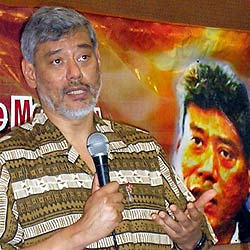 In saying this, economist KS Jomo pointed out that investments into the real economy produce real wealth, whereas the preoccupation with the stock market and 'hot money' have only led to the asset price bubbles that in turn have led to such financial crises as the region experienced in 1997.
"We have to pay far less attention to financial indicators and stop associating financial indicators with the real economy," said Jomo, currently assistant secretary-general for economic development in the United Nation's Department of Economic and Social Affairs.
"The indicators of the real economy are quite different from the financial indicators, and there's a tendency in this country to pay too much attention to financial indicators and not enough attention to the real economy," he added.
The Malaysian stock market has been on a bull run over the past year, reaching 1,373.71 today, a 13-year high.
In his lecture - organised in Kuala Lumpur last night by Strategic Information Research Development (SIRD) - Jomo summarised 50 years of Malaysia's economic development before concluding with "lessons for the present and future."
Among them, he said, is for the government and the middle-class of the population to recognise the fact that economic fundamentals are not solidly related to the erratic changes in stock market indices.
This has not stopped either of them, however, from favouring - and calling for - the unimpeded flow of capital controls and stock market speculations.
Do the correct thing
"I hope that the Malaysian authorities will do the correct thing when they face (the stock market bubble)," said Jomo, a former economic professor at Universiti Malaya who has authored dozens of books on the Malaysian economy.
"Knowing the influence of the elite and the middle-class, it will be quite formidable, it would be very difficult for the government to resist that kind of pressure from the middle-class," said Jomo during the question-and-answer session.
He added that to create real wealth, the private sector should play its role by seeking to develop "new capacities and new capabilities" and "greenfields" rather than treading in the steps of most foreign direct investors by channeling their money into acquisitions and mergers.
"In other words, (they invest in) what is called brownfield investment. You're taking over existing capacity, existing plant, you're not augmenting it in any significant way. Those types of investments do not really help the economy," said Jomo.
The government, on the other hand, can complement the private sector effort not only by protecting its industries but also by structuring incentives in such a way as to promote those Malaysian companies and corporations seeking to make inroads into international markets.
"That kind of ability of the government to exercise a disciplining effect on the private sector is a crucial part of trying to create the industrial community which will invest in the real economy, which will ensure progress in the real economy," he said.
Institutionalise mechanisms
Jomo also highlighted the need to institutionalise mechanisms by which consultation and participative democracy can take the place of crisis-driven policy changes.
Whether it was the socio-economic changes that took place in reaction to the communist insurgency in the 1950s, the reform following the riots of May 1969, or the economic downturn of the mid-1980s, Malaysia had always reacted on impulse.
"In Malaysian society, it is additionally high cost because everything is cast in an ethnic mould, in a cultural mould, and sometimes in a religious mould.
"We must have a less socially costly way of bringing about policy reform or policy improvement or policy changes. The crucial way of doing so is having a much more consultative society, more consultative forums, for doing so," he said.
Jomo also called for a 'true nationalism' inspired by universal values as opposed to the "ethno-populism" where the communities are currently mobilised only by their respective ethnic identifications.


