


/file/publisher-c1a3f893382d2b2f8a9aa22a654d9c97/2023/10/a7231a93b8518d3e231ac9b5ce97b9c6.jpg)

KINIGUIDE | Police's long-awaited body cams
KINIGUIDE | The proposal to equip the police with body-worn cameras (BWCs), or body cams, has been mooted for many years.
That long wait may finally be over after Home Minister Saifuddin Nasution Ismail announced in May that the first batch of the device will arrive as early as this month.
For this instalment of KiniGuide, Malaysiakini spoke to the Bukit Aman Crime Prevention And Community Safety Department director Wan Hassan Wan Ahmad and BWC supplier Mindwave Consultancy director Fakhrun Nizam Tajudin on what to expect in the roll-out.
KINIGUIDE | The proposal to equip the police with body-worn cameras (BWCs), or body cams, has been mooted for many years.
That long wait may finally be over after Home Minister Saifuddin Nasution Ismail announced in May that the first batch of the device will arrive as early as this month.
For this instalment of KiniGuide, Malaysiakini spoke to Bukit Aman Crime Prevention And Community Safety Department director Wan Hassan Wan Ahmad and BWC supplier Mindwave Consultancy director Fakhrun Nizam Tajudin on what to expect in the roll-out.
What is a BWC and why is it important?
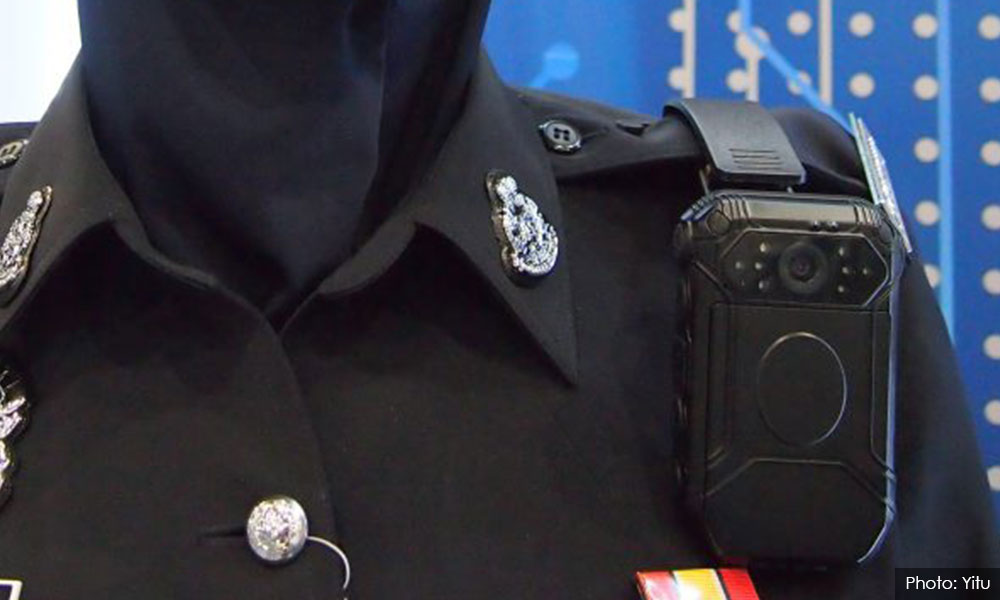
As the name suggests, a BWC is a video camera intended to be worn on a law enforcement officer’s person, typically placed over the chest facing forward.
Compared to consumer action cameras, they are typically designed to be tamper resistant, can be used in rugged environments, can survive rough handling, and have sufficient battery life and storage to record an officer’s entire shift.
Depending on the model, it may record additional information that may be helpful in an investigation, such as the date, time, and GPS coordinates.
It will also require infrastructure to handle charging and maintaining a large number of devices, as well as downloading, managing, and archiving vast amounts of data.
It acts as a silent witness to police interactions with the public they have sworn to protect.
Civil society groups see BWCs as a way to hold the police accountable and prevent abuses of power. Police also see it as a way to maintain their integrity and prevent any unwarranted accusations against its personnel.
This is especially when the police and the public offer conflicting accounts of what transpired in a high-profile case.
When are the police getting the cameras?
Wan Hassan said the installation of the supporting software and servers at federal police headquarters in Bukit Aman is already complete, and pilot projects to field the camera in the Klang Valley will begin this month.
The initial phase involved wiring works for docking stations at selected police stations and district police headquarters in Selangor and Kuala Lumpur.
“From June 10 onwards, the wiring and installation of docking stations will commence at selected pilot locations in Kuala Lumpur and Selangor contingents,” he told Malaysiakini earlier this week.
The pilot sites in Kuala Lumpur are the Dang Wangi police district headquarters, Tun SH Lee police station, and Jalan Bandar traffic police station. In Selangor, they are the Klang Utara police district headquarters and the Bandar Bharu Klang police station.
Wan Hassan revealed that the Dang Wangi and Klang Utara district police headquarters will receive 136 units on June 19. Police in these two districts will evaluate the cameras until July 24 and continue using them daily after the pilot period.
Once the pilot test is completed, the full roll-out ensues:
Central Zone (Bukit Aman, Kuala Lumpur, Selangor contingents): 1,744 units to be received by the last week of August 2024 including those received earlier in the pilot phase.
Southern Zone (Negeri Sembilan, Malacca, Johor): 1,472 in early October 2024.
Northern Zone (Perak, Kedah, Penang, Perlis): 1,952 in mid-November 2024.
Eastern Zone (Pahang, Terengganu, Kelantan): 1,048 in early December 2024.
Sabah: 704 units in the fourth week of December 2024.
Sarawak: 728 units in the third week of January 2025.
“Full adoption in the police force will be in March 2025,” Wan Hassan said.
Who will be wearing them?
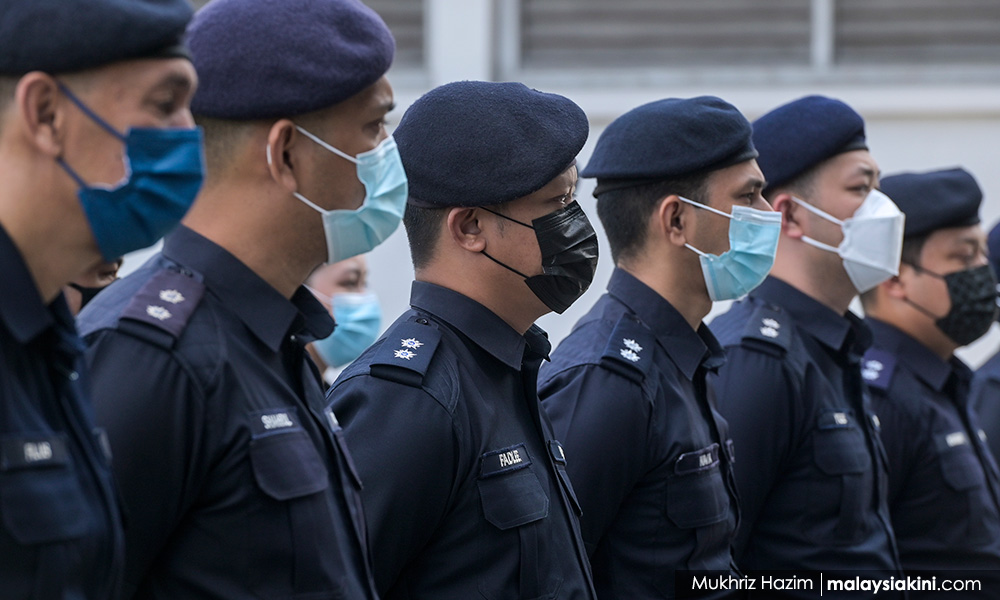
Wan Hassan said the BWCs will be used by his department's mobile patrol vehicle and motorcycle patrol units.
It will also be issued to police station personnel assigned to carry out crime prevention patrols, as well as the Traffic Enforcement and Investigation Department.
To get the force ready for BWC adoption, Wan Hassan said the procurement contract for the devices includes 17 “training of trainers” sessions each involving 20 people. The first session starts next month while the last one will be in late January next year.
Meanwhile, the standard operating procedures for the devices will be finalised during a workshop in the final week of August this year.
Can the devices be tampered with?
No. Fakhrun said the cameras cannot be tampered with by deleting the footage or altering the recorded time and date.
“As long as the video is kept inside the system, the video will be watermarked with location, time and (the officer’s personal) information,” he added.
Fakhrun told Malaysiakini that the cameras are the MPT221 from China’s Dahua Technology, which is already being used by other law enforcement agencies at home and abroad.
It can be used for at least eight hours at a time and can survive being submerged in water up to 1.5m deep for at least 30 minutes.
“It's the current model and the system supports the latest technology and security in the market,” he said.
The manufacturer’s website states that the camera also features infrared lights that can be turned on automatically or manually to enable it to “see” in the dark, and electronic image stabilisation to improve image quality.
Fakhrun said the procurement contract also includes a backend system to help monitor and control the usage of the BWCs.
However, Wan Hassan said this does not mean Bukit Aman can access the devices remotely as the procurement contract does not include SIM cards.
According to Wan Hassan, the devices cost RM1,650 each, meaning the total cost for the 7,648 BWCs alone is over RM12.6 million.
He added that the government’s contract with Mindwave Consultancy is for two years from Feb 15, 2024, until Feb 14, 2026, for a total contract value of RM28,396,340.
/file/publisher-c1a3f893382d2b2f8a9aa22a654d9c97/2019/09/c916a373cc5b5fbdab26287af65cc802.jpg)
/file/1080/cfa74acc068d9c3b79382c158b9310f2.jpg)
/file/publisher-c1a3f893382d2b2f8a9aa22a654d9c97/2023/07/49bb3af3efc23ac8d84455977cb4601d.jpg)
/file/publisher-c1a3f893382d2b2f8a9aa22a654d9c97/2023/02/50202a57dfdac55ee2e838ca434116c4.jpg)


Are you sure you want to delete this comment?
This action cannot be undone.