
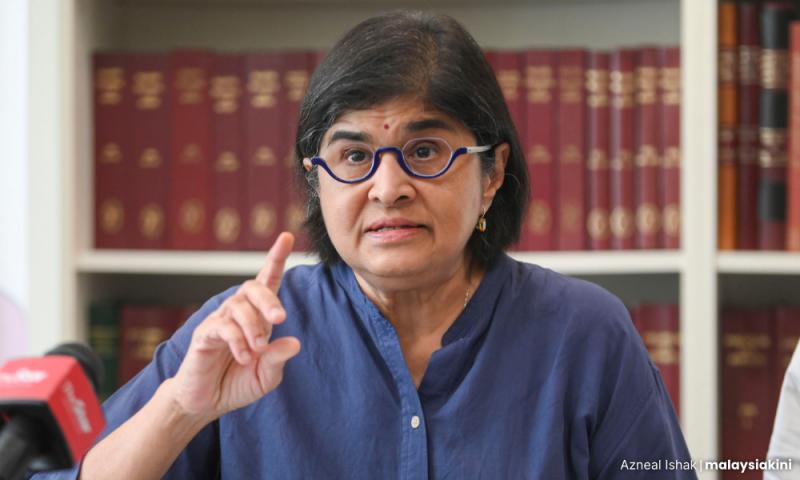
Awarding MPs lifelong pensions is a “disgrace”, especially considering the level of output and service they deliver to the people, said former Bersih chairperson Ambiga Sreenevasan.

The lawyer said this is especially when considering that MPs can receive a lifelong pension after just serving one term, and how this differs greatly when compared to the civil service.

“I am completely against giving MPs pensions on top of all that they are getting as they are not deserving of it at all.

“It is a disgrace in my view how many allowances they get considering their output and service to the people.

“It’s a disservice to loyal government servants who have to serve much longer before they are entitled to a pension,” she (above) said when contacted.

Savings of RM2.4 million per MP

Ambiga was responding to an interactive article by Kini News Lab which looked into the various types of pensions awaiting MPs who were elected in the two last general elections when they turn 50 and are no longer in office.

Taking into consideration the different positions held by MPs throughout their career, including at the state level, Kini News Lab found that some MPs could get more than RM30,000 in monthly pensions once they retire.

They could receive multiple pensions if they held positions at the state level as assemblypersons or state executive councillors, and at the federal level as MPs, ministers or deputy ministers, speakers or deputy speakers.


READ MORE: How much pensions can MPs receive?


This comes as Prime Minister Anwar Ibrahim said MPs should do what is “morally” right by accepting only one of the various pensions they are entitled to, but the decision is up to them.

The debate erupted when the government said it is mulling amending the civil service pension scheme, possibly changing it to Employees Provident Fund (EPF) contributions, in a bid to reduce sizeable pension costs.

Economist Muhammed Abdul Khalid

While the impact of MP pensions on the government’s bottom line is not huge, said economist Muhammed Abdul Khalid, it is a significant amount in ringgit terms.

He estimates the government can save RM2.4 million per MP if the pension scheme is changed to EPF contributions. This works out to over half a billion ringgit for a single cohort of 222 Dewan Rakyat members.


READ MORE: Allowances and perks: How much do MPs, speakers and deputy speakers get?


Lawmakers decide their salaries, pensions

Engage chairperson Thomas Fann said Malaysia is among the few countries in the world where elected representatives can draw multiple pensions.

“Most countries have a single pension scheme for MPs, where the pension amount is calculated based on their overall years of service and their salary during the highest-earning years or last few years in office.

“Malaysia must be one of the very few exceptions where a politician could earn multiple pensions across federal and state legislatures,” he said.

However, he said making changes to the law to reform MP pension schemes is challenging because lawmakers are the ones who decide on their own salaries and pension packages.

Engage chairperson Thomas Fann

“There is a clear conflict of interest… As such, it is unsurprising that reforming the MP pension scheme would be one of the rare instances of bipartisanship among our politicians,” he said.

Even so, abolishing MP pensions or reforming them to adopt different types of schemes like EPF contributions is not impossible.

In 2012, Singapore abolished MP pensions while those who were elected after 1995 and who were eligible for pensions had theirs frozen until May 20, 2011.

“The removal of pensions will further strengthen the principle of clean wages and align the retirement scheme of office holders and MPs to the Central Provident Fund system,” then-deputy prime minister Teo Chee Hean said when tabling the abolition bill for second reading.

Link between remuneration and corruption

Fann said turning all the different types of pension schemes enjoyed by elected representatives into EPF contributions would signal that they “do not have a different stature from the rest of us”.

It also has a bonus effect of disincentivising those who enter politics as a “shortcut to living comfortably after serving a few years in politics”, he said.

However, before the pension scheme is changed to EPF contributions, Fann said there is an urgent need to first revise the salaries of lawmakers and those serving in cabinet positions to better reflect their position.

“For example, the PM’s salary is only RM22,826 while the salary of a CEO of a multinational firm in Malaysia would be over RM100,000. Surely, the responsibility of a PM far exceeds that of any CEO of a company,” he said.

Although reducing pensions has its benefits, others fear it could have unintended consequences like encouraging corruption.

Lau Chak Onn (right)

“On paper… they should feel the pinch that everyone else is feeling. However, off the books, would a lower payout result in a higher risk of corruption, especially if an MP is nearing the end of their term?” asked Lau Chak Onn of MyMP, an initiative to encourage Malaysians to evaluate their MPs’ performance.

“Looking at Singapore’s most well-paid lawmakers against their fifth-lowest corruption in the world ranking (sic), it’s definitely something to be considered,” he said, referring to the Transparency International Corruption Perception Index.

He said more research should be done on how the perks enjoyed by elected representatives might affect their tendency for corruption before any changes are made.

“We need to look into potential corruption leakages and how to stem those. If we pay MPs RM10 million more a year, but it stops RM1 billion in corruption leakages, I think everyone will agree that’s a good return on investment,” he said.


Read more: How much pension can MPs receive?