
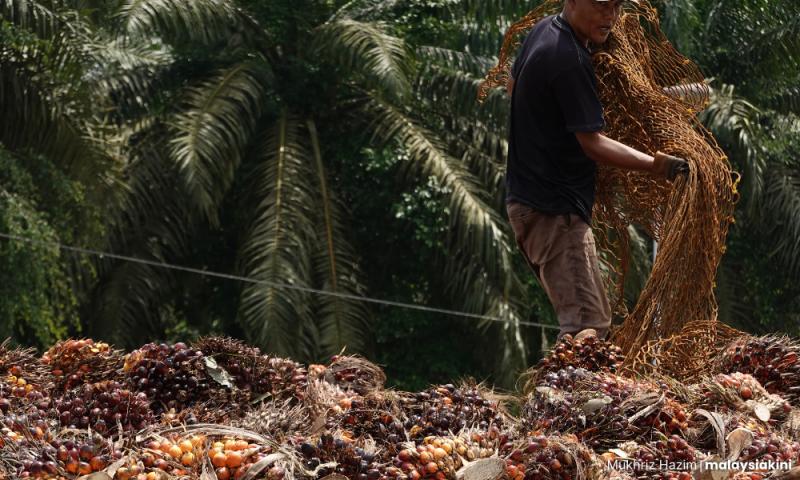
Kuala Nerus oil palm project will destroy unique ecosystem: Green groups
An environmentalist group has objected to Pure Green Development Sdn Bhd’s plan to develop a new oil palm plantation in a forest area in the Kuala Nerus district in Terengganu.
Sahabat Alam Activists Association (Kuasa) chairperson Hafizudin Nasarudin said the project was clearly not sustainable for the environment.
An environmentalist group has objected to Pure Green Development Sdn Bhd’s plan to develop a new oil palm plantation in a forest area in the Kuala Nerus district in Terengganu.
Sahabat Alam Activists Association (Kuasa) chairperson Hafizudin Nasarudin said the project was clearly not sustainable for the environment.
“We strongly object to the project and if possible, don’t do it because the area to be developed is unsuitable.
“One, it is a natural forest area, and secondly, it is a peat swamp forest, which is the most sensitive forest in our country.
“We are in Malaysia and there are not many peat swamp forests, so we need to save these peat swamp forests,” he told Malaysiakini.
According to Hafizudin, peat swamp forests are critical to the environment because they act as a carbon dioxide “sponge” in addition to preventing floods.

“It is a habitat for wildlife and supports an important ecosystem. So, when it is replaced with oil palm, the processes cannot happen,” he stressed.
Hafizudin also said the country will also face big problems if the implementation of oil palm plantations in peat swamp forests is not properly managed.
“We know that in Indonesia the biggest problem of the oil palm industry is when they do it in the peat swamp forest.
“When the forests are cleared and planted with oil palm, at one point the oil palm will reach maturity.
“We are worried that they will burn the palm trees involved (for replantation),” he said, adding that open burning on peatland could result in severe fires and haze.
‘Not economically sustainable’
Hafizuddin said if the project should continue, its crops may not be able to be exported abroad due to sustainability violations.

“Because there is an SPO (sustainable palm oil programme) with Malaysian Sustainable Palm Oil (MSPO) and it will not certify this palm oil for export.
“So, this oil palm project is very unsustainable for the environment and from an economic point of view,” he said.
Hafizuddin reiterated Kuasa’s objection to the development and urged the Terengganu state government and developer to use land outside the forest reserve, such as abandoned and swamp peatlands, instead.
He also noted the Plantation and Commodities Ministry’s promise to stop opening new oil palm plantations in forest reserves and natural forest areas, including peat swamp forests.
‘Do not abuse royal power’
Hafizuddin also said the Environment Department should not approve the project’s environmental impact assessment (EIA) report.
“This EIA cannot be approved and I urge the relatives of the Terengganu sultan not to misuse his power and position to legitimise this project.
“This project is indeed unsustainable for the environment and very inappropriate and we strongly object to the project,” he emphasised.
He also questioned the need to exploit forested areas for economic reasons when, unlike Kelantan, the state has income from petroleum royalties.

Malaysiakini previously reported that Pure Green Development Sdn Bhd submitted an EIA two months ago to develop an oil palm plantation in a forest area in the Kuala Nerus district.
The project caused controversy because, in addition to the expected impact on the forest, concerns also arose about the risk of flooding, and disruption of water supply during the dry season.
Pure Green Development is owned by the younger brother of Terengganu ruler Sultan Mizan Zainal Abidin.
The EIA also revealed that different companies owned by the sultan were clearing forests in adjacent areas.
Harmful to the country
Commenting further, environmental activist and EcoKnights vice-president Amlir Ayat said the project’s implementation will only result in a negative impact due to the loss of 2,229ha of virgin peat swamp forest.
“The absence of this ecosystem will definitely increase the risk of overflowing water that will flood the surrounding area, which will make life difficult for the locals for a long time.
“Its groundwater recharge function will also be affected and threaten the stability of the hydrological cycle in the area,” he explained.
According to Amlir, peat swamps burn easily and for a long time when exposed to hot weather as it consist of organic matter that has been decaying for thousands of years.

Additionally, he said, the peat swamp forest also acts as a carbon sink of about 2,000 metric tonnes per hectare, equivalent to the carbon emitted by about 1,600 vehicles per year.
Amlir said this also makes it difficult for the country to achieve its international commitment to maintaining half of Malaysia’s land surface as forest areas. It is understood that forests currently cover 54.58 percent of Malaysia’s land mass.
He added that the project will threaten the peat swamp’s unique ecosystem, which will then cause Europe to reject Malaysian palm oil due to sustainability concerns.
Federal govt’s decision
Sahabat Alam Malaysia (SAM) field officer Meor Razak Meor Abdul Rahman said the group disagrees with any degazettement of Permanent Forest Reserve areas or other protected areas for the purpose of oil palm cultivation.
“This decision has clearly been stated by the Plantation and Commodities Ministry since 2008 in line with one of the MPSO certification conditions.
“From time to time, Malaysia still maintains the decision, and even recently, Plantation and Commodities Minister Johari Abdul Ghani firmly reiterated the ruling which does not allow the opening and planting of oil in palm forest areas,” he said.

Meor said SAM is also saddened by several states, including Terengganu, that do not want to adopt the rulings decided at the federal level.
He also concurred that the oil palm project would destroy an ecosystem rich in unique biological diversity and stressed that the state government should not be exploiting a permanent forest reserve for economic gains.
Walk your talk, Putrajaya
On that note, forestry expert Lim Teck Wyn urged Putrajaya to put its money where its mouth is and stop deforestation.
“The plantations minister made the promise (to stop deforestation for oil palm projects) and also the deputy prime minister.
“In fact, the prime minister and environment minister promised to keep 50 percent of our forests intact,” he told Malaysiakini.
Lim then called on Putrajaya to come up with a comprehensive economic formula to guarantee the 50 percent forest pledge.
So far, he added, there is only the Ecological Fiscal Transfer scheme, which is not enough.
“It is presently at RM200 million but it needs to be much more. The National Land Council needs to start negotiations on this.
“Otherwise, there will be no change on the ground. The forests will still be cleared.
“If they can’t plant oil palm, then they will plant something else such as rubber, durian or just leave it wild.”
/file/publisher-c1a3f893382d2b2f8a9aa22a654d9c97/2024/03/83dae433a050661c413e4fe42167b6ed.jpg)

/file/publisher-c1a3f893382d2b2f8a9aa22a654d9c97/2024/09/a830372cd36892bfc0f1cb70be931999.jpg)
/file/publisher-c1a3f893382d2b2f8a9aa22a654d9c97/2024/09/b6810948c9646d1d1e0fe45e19fc1700.jpg)
/file/publisher-c1a3f893382d2b2f8a9aa22a654d9c97/2024/09/97bc24a31074110e2d74a370ca3ffbde.jpg)
/file/publisher-c1a3f893382d2b2f8a9aa22a654d9c97/2024/08/3908994bb8c9d6a897bd1e96445e13dd.jpg)
/file/publisher-c1a3f893382d2b2f8a9aa22a654d9c97/2024/08/a01e178ed796dee18c863403dc5de1f4.jpg)
/file/publisher-c1a3f893382d2b2f8a9aa22a654d9c97/2024/08/c63955b205dfec6f770aec8f0aaaaaf0.jpg)
Are you sure you want to delete this comment?
This action cannot be undone.