
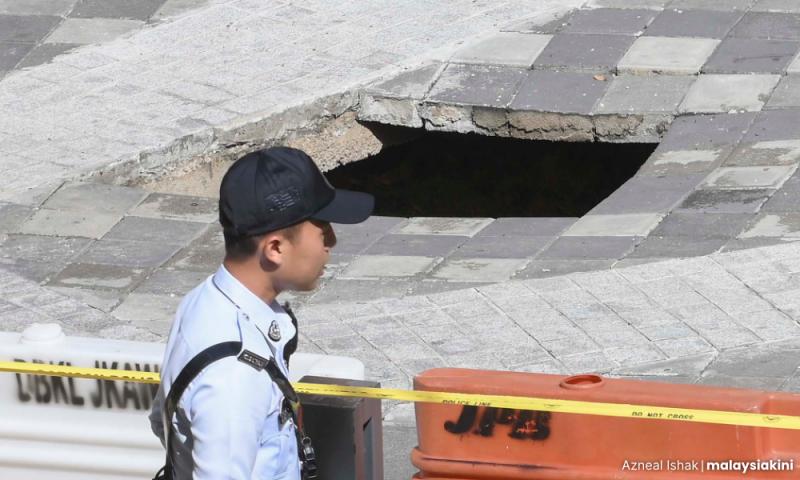
The second sinkhole that has appeared on Jalan Masjid India was caused by search and rescue operations for an Indian tourist who fell into an 8m-deep hole due to a sudden ground collapse last week.

Universiti Kebangsaan Malaysia geologist and geohazard expert Goh Thian Lai told Malaysiakini that it was likely a human-induced sinkhole, one that is caused by human activities.

“Human-induced sinkholes existing 50m from the scene of the incident are likely due to the existence of holes dug for rescue works.

“It may also be due to another broken pipe,” he said.

Such sinkholes can also be caused by tunnel activities, he added.

Last Friday, a female tourist, Vijayaletchumy, 48, from Kuppam, Andhra Pradesh, India, fell into the sinkhole and disappeared.

Search and rescue efforts are still ongoing.

On Wednesday, another sinkhole appeared 50m away from the first one and it was then cordoned off to prevent untoward incidents.

Broken sewer pipe

Commenting further, Goh, who is also the Society for Engineering Geology and Rock Mechanics Malaysia (SEGRM) president, said the incident is known as an anthropogenic sinkhole.

“Anthropogenic” refers to acts of pollution or environmental change caused by human activities.

“The main cause of this anthropogenic sinkhole is because the 1.5m sewer pipe broke. I’m not sure what caused it to break.

“Backfill material under the footpath is gradually carried away and washed away by the water flowing in the sewer pipes. This phenomenon creates a hollow space under the footpath - an anthropogenic sinkhole,” he explained.

Geologist and geohazard expert Goh Thian Lai

On the other hand, he said, natural sinkholes are caused by natural processes.

“It is common to experience drought when there is a drop in the underground water level.

“Other factors are earthquake tremors, quarry pilling works and major construction works,” he added.

Steps to be taken

To combat the issue of sinkholes, he said authorities must focus on the technical and social aspects of the problem.

To tackle the technical aspect, he advised the authorities to rope in certified geologists and engineers to carry out field identification and subsurface mapping using geophysical methods.

Then, remedial measures such as pumping epoxy or grouting into the identified cavities should be taken, he said.

As for the social aspect, the authorities ought to carry out an awareness campaign to inform the public on what sinkholes are, how to identify them and how to avoid causing them, he added.

Goh also advised the public to stay away from the affected area for the time being.

“This is because the cavity or anthropogenic potential has not been identified.

“The authorities need to ensure or make a safety assessment of this area, which is to identify the existence of non-human induced sinkholes,” he said.